

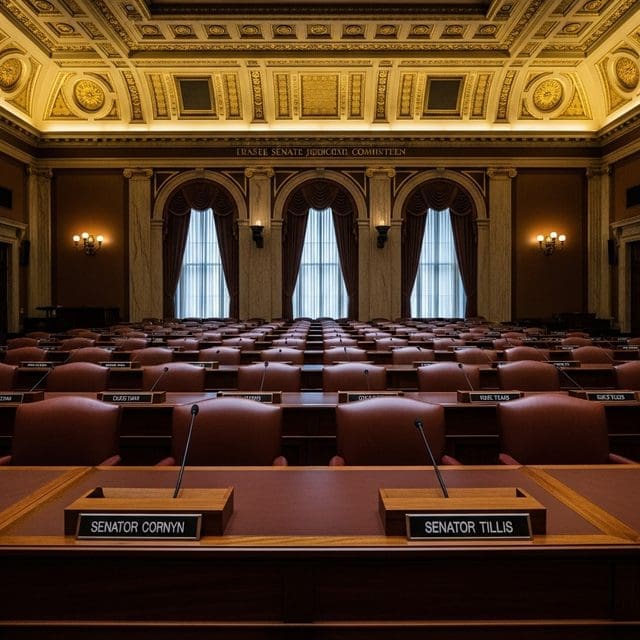
Senator John Cornyn and other Republicans are blocking the confirmation of Attorney General nominee Todd Blanche over a controversial $1.8 billion fund and related IRS immunity provisions.
The constitutional tension between executive prerogative and legislative oversight has reached a fever pitch this week as the Senate Judiciary Committee indefinitely postponed a vote on Todd Blanche’s nomination for Attorney General. At the heart of the dispute is a $1.8 billion ‘anti-weaponization’ fund, established via a now-nullified IRS settlement, which critics argue lacks the transparency and fiscal guardrails required for federal expenditures. This administrative deadlock reflects a broader struggle over the independence of the Department of Justice and the limits of executive discretion in managing taxpayer-funded settlements.
Senator John Cornyn (R-TX) and Senator Thom Tillis (R-NC) have remained steadfast in their opposition, demanding more than verbal assurances from the administration. While Blanche, currently serving as acting attorney general, has testified that the fund is defunct and offered to help draft legislation to prevent its revival, the senators are insisting on a formal paper trail. This includes a signed Attorney General order rescinding the fund and narrowed language regarding IRS audit immunity for the President and his family. The demand for written documentation is not merely procedural; it is a safeguard against the potential for future executive overreach that could bypass congressional appropriation powers.
President Trump escalated the conflict on July 31, using social media to demand Blanche’s immediate approval while simultaneously defending the $1.8 billion pot of money. The President characterized the fund as a necessary mechanism to compensate individuals whose lives were allegedly destroyed by the previous administration, though a federal judge in Miami recently nullified the settlement that created it. This dual messaging—claiming the fund is ‘dead’ while publicly justifying its existence and blaming Senator Cornyn for the delay—has significantly complicated negotiations with Senate leadership. The President has even signaled he has no objection to temporarily withdrawing the nomination, a move that would prolong the leadership vacuum at the Justice Department.
The friction extends beyond mere personality clashes, touching on the fundamental power of the purse. Senators are wary that without a formal rescission order and legislative guardrails, the Department of Justice could potentially route similar payouts through existing, less visible administrative mechanisms. Under questioning, Blanche conceded that a future executive could attempt to revive the fund by claiming a breach of the original settlement, a loophole that constitutionalists in the Senate appear determined to close. The impasse is further exacerbated by the administration’s insistence on the SAVE America Act and other legislative priorities that are now being weighed against the confirmation fight.
This dispute occurs against a backdrop of other significant oversight battles on Capitol Hill. On July 29, Dr. Anthony Fauci invoked his Fifth Amendment right more than 100 times during a Senate hearing chaired by Senator Rand Paul (R-KY), leading to calls for a contempt of Congress citation. Meanwhile, the influence of outside capital in the upcoming midterms has intensified, with Elon Musk authorizing over $100 million for field programs to assist Republican candidates. These developments underscore a political environment where institutional trust is low and the demand for executive accountability is at an all-time high.
As the 2026 midterm elections approach, the stalemate highlights a growing divide within the Republican party regarding the limits of executive authority over the Department of Justice. With the President signaling a willingness to escalate the clash rather than compromise on the settlement terms, the path to a confirmed Attorney General remains obscured by a cloud of procedural and fiscal distrust. For the Senate, the priority remains ensuring that the Justice Department operates within the bounds of traditional statutory authority, free from the influence of unappropriated, discretionary funds.

Miles Harrington serves as the Senior Correspondent for Federal Systems & Executive Power at Just Right News, where he brings a disciplined, constitutionalist lens to the inner workings of the American government. With a focus on the mechanics of the federal bureaucracy and the limits of executive authority, Harrington has established himself as a vital voice for readers who value transparency, accountability, and the preservation of the separation of powers.
A native of Richmond, Virginia, Harrington’s perspective is deeply rooted in the traditions of the Old Dominion. Growing up in a city defined by its historical significance and its role as a center of American jurisprudence, he developed an early appreciation for the foundational principles of the Republic. His upbringing in Richmond—a place where the legacy of the Founding Fathers is woven into the landscape—instilled in him a belief that the federal government should remain within its constitutional bounds. This background informs his skepticism of centralized overreach and his commitment to reporting on the ways in which the administrative state impacts the lives of everyday citizens.
In his current role, Harrington specializes in the complexities of federal systems. He doesn’t just report on the headlines of the day; he digs into the structural shifts within the executive branch that often go unnoticed by the mainstream press. Whether he is analyzing the implications of a new federal regulation or investigating the expansion of agency jurisdiction, his work is characterized by a rigorous adherence to the facts and a dedication to the rule of law.
Harrington is perhaps best known for his signature feature series, “How Washington Works.” Through this ongoing project, he demystifies the often-opaque processes of the nation’s capital, pulling back the curtain on the “Deep State” and the unelected officials who wield significant influence over national policy. By breaking down complex legislative maneuvers and executive orders, he empowers Just Right News readers to understand the true levers of power in Washington. His reporting serves as a necessary check on the federal government, ensuring that the actions of those in power are held up to the light of public scrutiny.
Now based in Washington, D.C., Harrington operates at the epicenter of the political world, yet he remains intentionally distanced from the “Beltway bubble.” His proximity to the halls of power allows him to maintain a robust network of sources across the federal landscape, but his heart remains in the principled conservatism of his Virginia roots. He views his role not merely as a reporter, but as a steward of the public trust, dedicated to providing the clarity and context that conservative voters need to navigate an increasingly complex political environment.
Through his sharp analysis and unwavering commitment to the truth, Miles Harrington continues to be a cornerstone of the Just Right News team. His work ensures that the principles of limited government and executive restraint remain at the forefront of the national conversation, providing a crucial service to those who believe in a government that is truly of, by, and for the people.