

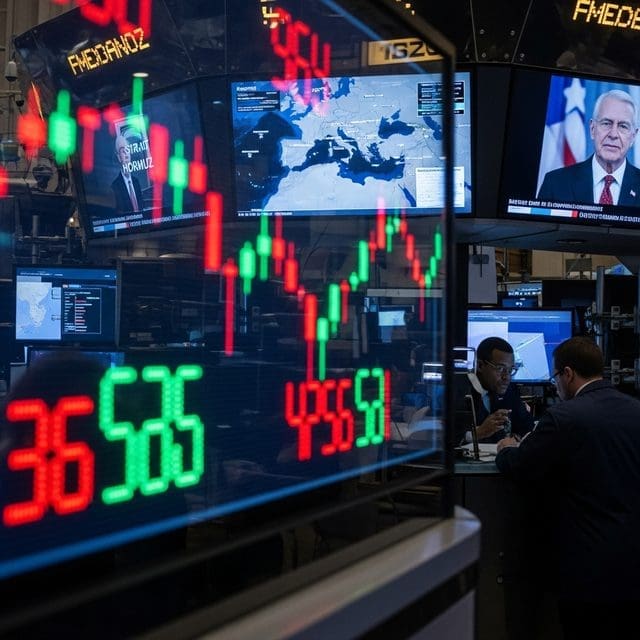
Markets remain volatile as semiconductor stocks slide on Chinese competition reports, while energy prices retreat following President Trump’s diplomatic overtures to Iran ahead of a critical Federal Reserve interest rate decision.
Global financial markets are navigating a period of friction as the tech-led rally meets the reality of geopolitical competition and a hawkish Federal Reserve. On July 28, 2026, the S&P 500 managed a marginal 0.51% intraday gain, yet the internal mechanics of the market revealed a stark divide. While the Dow Jones Industrial Average rose 0.5% to 52,210.08, the tech-heavy Nasdaq struggled, reflecting concentrated anxiety within the Information Technology sector which saw the XLK ETF decline nearly a full percentage point.
Technology and semiconductor stocks faced renewed pressure following reports that China has developed its own deep ultraviolet (DUV) lithography tools. This development directly challenges the market dominance of ASML Holding N.V., whose shares fell 5.8% as investors weighed the long-term impact on Western export sovereignty. The chip-led risk-off move has left the Nasdaq volatility index (VXN) elevated at 1.5 times the VIX, signaling that jitters are specifically targeted at the tech sector rather than representing a broad-based panic. Investors now look toward guidance from Microsoft, Amazon, and Apple to see if massive AI spending can translate into sustainable growth.
For the American household, immediate relief came from the energy sector. Crude oil prices continued a three-session decline, with West Texas Intermediate falling toward $81.35 per barrel and Brent futures settling near $88.36. This retreat follows President Trump’s announcement of “good talks” with Tehran, suggesting a potential 10-day ceasefire to reopen the Strait of Hormuz. While the naval blockade remains in effect, the prospect of a diplomatic breakthrough cooled the risk premium that recently pushed oil above $95. This decline in energy costs provided a necessary tailwind for the Dow, even as the Energy Select Sector SPDR fell 2.1% on the session.
Monetary policy remains the primary shadow over Main Street. The Federal Open Market Committee (FOMC) begins its meeting with the CBOE Volatility Index (VIX) edging up to 18.67. While many analysts expect Chair Warsh to maintain current rates, futures markets now price in a greater than one-in-three probability of a rate hike this week. This hawkish shift responds to durable goods orders rising 0.3% to $334.77 billion. While this figure was lower than the 1.6% consensus estimate, it suggests an economy that is not cooling fast enough for a central bank wary of persistent inflationary pressures.
In the broader economy, industrial and real estate sectors showed signs of consolidation. MAG Capital Partners completed the sale of a 1.37 million square foot Midwest industrial portfolio for $89 million, and Livmark Communities broke ground on the 457-unit Collins Apartments. These moves, alongside Merritt Properties doubling its Jacksonville portfolio, indicate that while high finance is fixated on chip wars, physical infrastructure continues to seek equilibrium. However, the legal landscape remains fraught, with Genius Group Limited and Peabody Energy Corporation both facing securities class action lawsuits.
Ultimately, the current market posture is defensive. The rotation into consumer staples, which gained 1.5%, suggests institutional investors are bracing for lower growth and higher volatility. With the Nasdaq underperforming and the administration balancing a naval blockade against potential peace deals, the message to the American taxpayer is clear: the era of easy tech gains faces structural challenges from both foreign competition and a Federal Reserve that refuses to blink.

Jordan Lee serves as the Senior Correspondent for Wall Street, Finance, and Monetary Systems at Just Right News. Based in the heart of the world’s financial capital, New York City, Lee brings a sharp, principled eye to the complex mechanisms that drive the global economy. His reporting is defined by a commitment to fiscal responsibility, the defense of the free market, and a deep-seated belief that a transparent monetary system is the bedrock of a free society.
Raised in Portland, Oregon, Lee’s perspective was forged in a city that has undergone significant cultural and economic shifts. His upbringing in the Pacific Northwest instilled in him a profound appreciation for the industriousness of small business owners and the importance of local economic stability. Watching the evolution of his hometown’s landscape sparked an early interest in how federal fiscal policy and large-scale financial trends eventually trickle down to the average citizen. This background provides him with a unique vantage point; he understands the growing disconnect between the policy-making elite and the reality of Main Street, a theme that frequently resonates throughout his work.
Now operating from his base in New York City, Lee bridges the gap between the high-stakes trading floors of Manhattan and the households of everyday Americans. He views the financial sector not merely as a collection of numbers and tickers, but as a vital engine of American prosperity that requires constant vigilance and accountability. His reporting often highlights the dangers of centralized financial control and the necessity of maintaining a system that rewards merit, risk-taking, and innovation.
As the creator and lead of the featured series, “The Invisible Economy,” Lee pulls back the curtain on the often-opaque world of monetary systems. He specializes in translating the dense jargon of central banking and international finance into actionable insights for the Just Right News audience. His work explores the “invisible” forces—such as inflationary pressures, regulatory creep, and the expansion of the administrative state—that erode the purchasing power of American families. By focusing on these systemic issues, Lee empowers readers to understand the hidden forces shaping their financial independence.
Lee’s journalistic philosophy is rooted in a steadfast commitment to traditional American values. As an Asian American professional who has navigated the competitive corridors of the financial world, he is a vocal advocate for meritocracy and the preservation of the American Dream. He believes that a stable currency and a predictable regulatory environment are essential for national sovereignty and individual liberty. His reporting frequently warns against the risks of government overreach in the private sector, arguing that the most effective solutions to economic challenges arise from competition and individual enterprise rather than bureaucratic mandates.
At Just Right News, Jordan Lee remains dedicated to providing a clear-eyed defense of the taxpayer. Whether he is analyzing market volatility or investigating the long-term implications of national debt, his mission is to provide the truth about where the money is going and what it means for the future of the country. Through his rigorous analysis and principled stance, Lee has become a trusted voice for those who value a strong, sovereign, and fiscally sound America.