

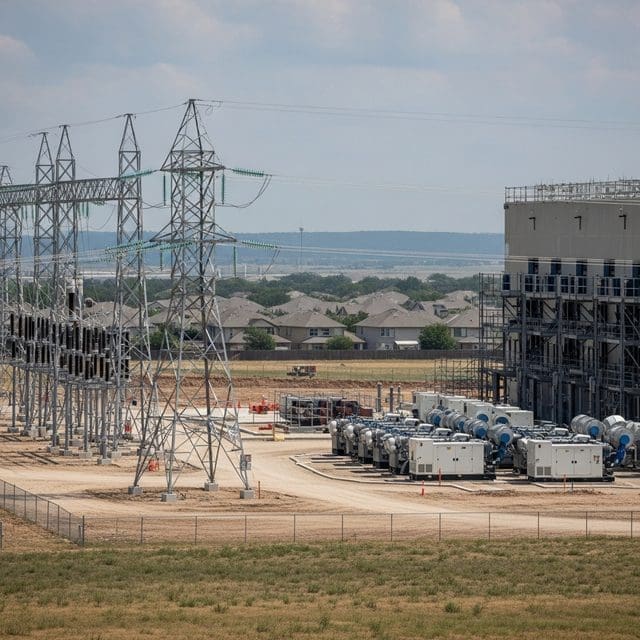
Governor Greg Abbott and Texas regulators are implementing new rules to ensure massive data center energy demands do not drive up housing costs through inflated utility bills.
The intersection of infrastructure expansion and housing affordability has reached a critical flashpoint in Texas. On July 24, 2026, Governor Greg Abbott announced that state regulators are adopting new rules to limit the strain large-scale data centers place on the ERCOT grid. Crucially for the American taxpayer, these measures are designed to prevent the massive costs of new generation and transmission from being passed on to residential ratepayers, ensuring that the digital gold rush does not manifest as a hidden tax on the kitchen table.
This regulatory shift arrives as grid operators project that Texas electricity demand could double by the end of the decade, fueled by artificial intelligence, cryptocurrency mining, and oilfield activity. For residents in the growth corridors between Austin and San Antonio, this surge creates a dual threat: skyrocketing monthly utility bills and degraded local air quality. Without state intervention on cost allocation, the capital expenditures required to upgrade the grid would likely be socialized across the ratepayer base, further squeezing households already struggling with elevated mortgage rates and high rent.
A legal battle in San Antonio illustrates the friction between industrial development and local property rights. On July 22, 2026, environmental groups issued a notice of intent to sue Vantage Data Centers and VoltaGrid regarding two campuses on the city’s west side. The groups allege the projects utilized “minor source” permits to bypass public hearings and stricter federal Clean Air Act reviews. These campuses, with 423 MW capacity and 151 diesel generators, are located in Bexar County—an area already failing to meet federal ozone standards.
The San Antonio projects utilize “behind-the-meter” gas plants, which serve data centers exclusively rather than contributing to the regional grid. This arrangement forces local residents to absorb concentrated pollutants—including an estimated 5,600 tons of nitrogen oxides annually—without receiving the benefit of increased grid reliability. Regulatory gaps have exacerbated these concerns; the Texas Commission on Environmental Quality previously approved permits using reduced assumptions for generator operating hours to keep expected emissions just under the 100-ton threshold that triggers rigorous oversight.
The challenge is national. At least 74 new gas plants are planned to power data centers across the U.S., with 32 in Texas alone. Furthermore, federal grid emergencies have recently authorized large users to disconnect from the grid and run on diesel backup, waiving environmental limits to prevent blackouts. This trend intensifies pollution in communities near data centers during extreme heat, exactly when housing-energy stress is at its peak.
As Texas begins its regulatory response, the focus remains on who pays for the infrastructure of the future. By signaling policy changes on interconnection and cost allocation, state leaders are attempting to decouple industrial growth from residential cost-of-living increases. For families living in the shadow of these plants, the coming months will determine if Texas can balance its role as a tech hub with its commitment to protecting the financial and physical well-being of its citizens.

Deborah Cole serves as a Senior Correspondent for Just Right News, where she spearheads the network’s coverage of Housing, Infrastructure, and Mobility. With a career defined by a commitment to rigorous reporting and a focus on the fundamental pillars of American community life, Deborah brings a principled perspective to the complex issues that dictate how and where we live. Her work is grounded in the belief that sound policy, fiscal responsibility, and respect for private property are the essential foundations of a prosperous society.
Originally from Boston, Massachusetts, Deborah’s upbringing in one of the nation’s oldest and most historically significant cities deeply influenced her professional trajectory. Growing up amidst the architectural legacy and dense urban planning of New England, she developed an early appreciation for the importance of durable infrastructure and the role of local tradition in shaping neighborhoods. Her perspective is informed by the classic American values of her hometown—hard work, community cohesion, and a healthy skepticism of top-down bureaucratic mandates that often overlook the unique needs of individual citizens.
Today, Deborah operates from her base in Austin, Texas, a city that serves as a primary laboratory for her reporting. Austin’s rapid expansion and its status as a hub for innovation and migration provide her with a front-row seat to the most pressing challenges in modern infrastructure and housing. From the Lone Star State, she chronicles the tensions between rapid growth and the preservation of the American Dream, often highlighting how market-driven solutions and deregulation can address the housing shortages that plague many of the country’s metropolitan areas.
At Just Right News, Deborah is perhaps best known for her signature feature series, “Where We Live.” Through this platform, she explores the intersection of public policy and private life, moving beyond mere statistics to tell the stories of families, small business owners, and local developers. Her reporting frequently highlights the importance of mobility—not just in terms of transportation and transit, but as a vehicle for economic opportunity and social stability. She remains a staunch advocate for the taxpayer, consistently scrutinizing government spending on large-scale projects and advocating for transparency in how infrastructure dollars are allocated.
Deborah’s beat is more than just a collection of policy topics; it is an investigation into the physical and legal structures that allow families to flourish. Whether she is reporting on the impact of zoning laws on suburban development or the necessity of maintaining the nation’s highway systems, her work is characterized by a dedication to the facts and a respect for the constitutional principles that protect the rights of homeowners.
As a Senior Correspondent, Deborah Cole continues to be a vital voice for Just Right News, providing the audience with the clarity and context needed to navigate an ever-changing landscape. Her reporting ensures that the values of individual liberty and local sovereignty remain at the forefront of the national conversation regarding the future of our cities and towns. Through her tireless efforts, she remains committed to informing the public on the issues that hit closest to home.