

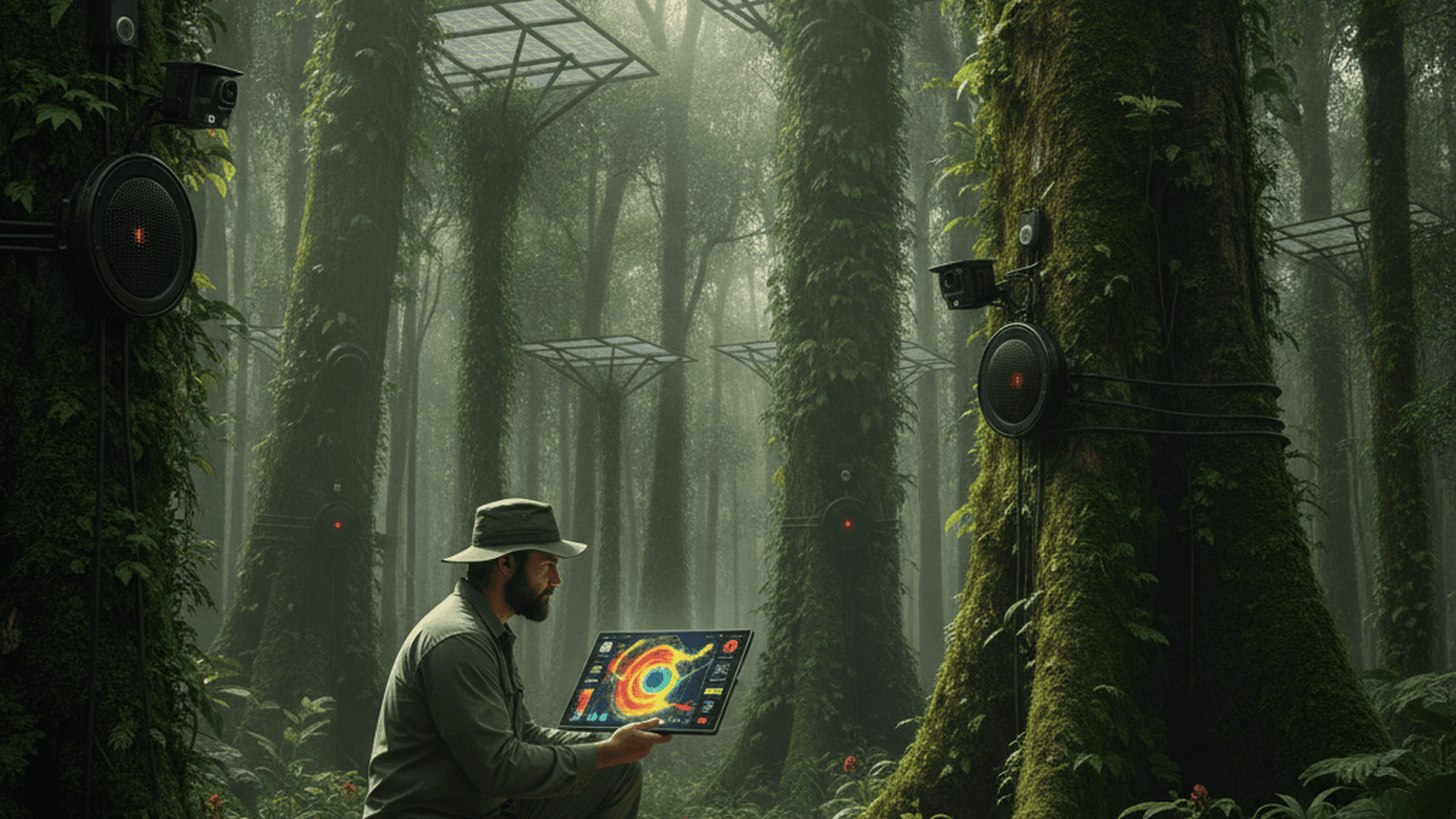
Researchers in the Colombian Amazon have deployed an advanced AI system known as Project Guacamaya to monitor biodiversity in real-time. By integrating acoustic sensors and satellite data, the platform identifies species and tracks environmental changes with unprecedented speed.
TLDR: A collaborative initiative in Colombia is using artificial intelligence to revolutionize rainforest conservation. Project Guacamaya processes vast amounts of acoustic and visual data from the Amazon, allowing scientists to identify endangered species and detect illegal deforestation instantly, providing a critical tool for protecting one of Earth’s most vital ecosystems.
Deep within the Caquetá region of the Colombian Amazon, a technological shift is redefining how scientists understand one of the most complex ecosystems on Earth. A collaborative initiative known as Project Guacamaya has deployed a sophisticated artificial intelligence platform designed to monitor biodiversity with a level of precision and speed previously thought impossible. This field expedition marks a departure from traditional ecological surveys, which often relied on manual data collection and months of retrospective analysis. By bringing high-performance computing to the edge of the jungle, researchers are now able to listen to the heartbeat of the forest in real-time.
The project integrates three primary data streams: high-resolution satellite imagery, motion-activated camera traps, and specialized acoustic sensors. While these tools have been used individually for years, the Guacamaya system utilizes advanced machine learning models to synthesize the information into a coherent ecological narrative. Developed through a partnership between Microsoft, the Alexander von Humboldt Institute, the Sinchi Institute, and several Colombian universities, the AI can process over 20 million acoustic records in a fraction of the time required by human researchers. This massive throughput is essential for a region where a single week of recording can generate terabytes of data.
During recent deployments, the AI demonstrated its ability to distinguish between the calls of various macaw species and other tropical birds amidst the dense noise of the rainforest. The acoustic models are trained to filter out environmental sounds such as heavy rainfall, thunder, and wind, focusing on the specific frequencies of animal vocalizations. This allows researchers to confirm the presence of elusive species, such as the jaguar or the pink river dolphin, without the need for direct human observation. The system’s ability to identify species by sound alone is particularly valuable in the Amazon, where the thick canopy often renders visual sightings impossible.
Beyond species identification, the AI provides a critical eye on the landscape itself. By analyzing satellite data from Planet Labs and the European Space Agency, the system identifies hotspots of environmental change. It can detect the early stages of illegal road construction or small-scale clearing for agriculture, often before the damage becomes irreversible. This real-time monitoring capability allows local conservation authorities to deploy resources more effectively to combat deforestation. The integration of ground-level sensors with orbital data creates a multi-layered defense against habitat destruction.
The technical architecture of Project Guacamaya relies on deep learning algorithms that have been fine-tuned using local biological data. This localization is essential, as global models often struggle with the specific acoustic profiles of Amazonian wildlife. By training the AI on datasets curated by Colombian biologists, the system achieves an accuracy rate that rivals expert human identification. The data is then hosted on cloud platforms, making it accessible to a global network of scientists and policymakers. This open-access approach ensures that the insights gained in Colombia can inform conservation strategies worldwide.
The implications of this technology extend far beyond the borders of Colombia. As the world faces a dual crisis of climate change and biodiversity loss, the ability to monitor ecosystems in real-time is becoming a necessity. Project Guacamaya serves as a blueprint for how artificial intelligence can be harnessed to protect the planet’s remaining wilderness areas. Future phases of the research will focus on expanding the AI’s repertoire to include insect populations and soil health indicators, providing an even more comprehensive view of the rainforest’s vital signs. Scientists hope that by quantifying the value of standing forests through data, they can create stronger economic and political incentives for their preservation.

Mason Reed serves as a Staff Writer for Just Right News, where he spearheads the Future Frontiers & Special Projects desk. In an era defined by rapid technological shifts and evolving social landscapes, Mason provides a steady, principled voice, examining the innovations of tomorrow through the lens of traditional American values. His work is most prominently featured in his signature series, “The Next Horizon,” where he explores the intersection of emerging technology, national sovereignty, and the preservation of individual liberty.
A native of San Diego, California, Mason’s worldview was shaped by the unique culture of his hometown. Growing up in a region defined by its strong military presence and its history of maritime industry, he developed a deep-seated respect for the institutions that provide national stability and the entrepreneurial spirit that drives the American economy. This upbringing instilled in him a belief that true progress is not found in discarding the past, but in building upon a foundation of proven principles. His reporting often reflects this San Diego influence, emphasizing the importance of a robust national defense and the necessity of maintaining a competitive edge in the global marketplace.
Now based in San Francisco, Mason operates from the heart of the world’s technological engine. Living and working in the Bay Area provides him with a front-row seat to the advancements—and the ideological challenges—emanating from Silicon Valley. While many in the region embrace a “move fast and break things” mentality, Mason’s reporting serves as a vital counterweight. He offers Just Right News readers a “boots on the ground” perspective, documenting how radical local policies and the concentration of tech power impact the everyday lives of citizens. His proximity to the industry allows him to cut through the marketing jargon of big tech to uncover the real-world implications for privacy, free speech, and the nuclear family.
In his “Future Frontiers” beat, Mason tackles complex subjects ranging from the ethics of artificial intelligence to the burgeoning private space race. He approaches these topics with a healthy skepticism toward centralized bureaucracy, championing instead the decentralized innovations that empower individuals. Through “The Next Horizon,” he highlights the pioneers and thinkers who are working to ensure that the future remains a place where human dignity and constitutional rights are protected. He believes that the rapid pace of change requires more than just technical expertise; it requires a moral compass rooted in the Western tradition.
Throughout his tenure at Just Right News, Mason has remained committed to the idea that the future is something to be shaped, not merely accepted. His writing is characterized by a rigorous defense of American exceptionalism and a belief that the country’s best days lie ahead, provided it remains true to its founding ideals. Whether he is investigating the impact of automation on the American workforce or profiling the next generation of aerospace engineers, Mason Reed ensures that his readers are equipped with the insights they need to navigate a changing world with confidence and clarity.