

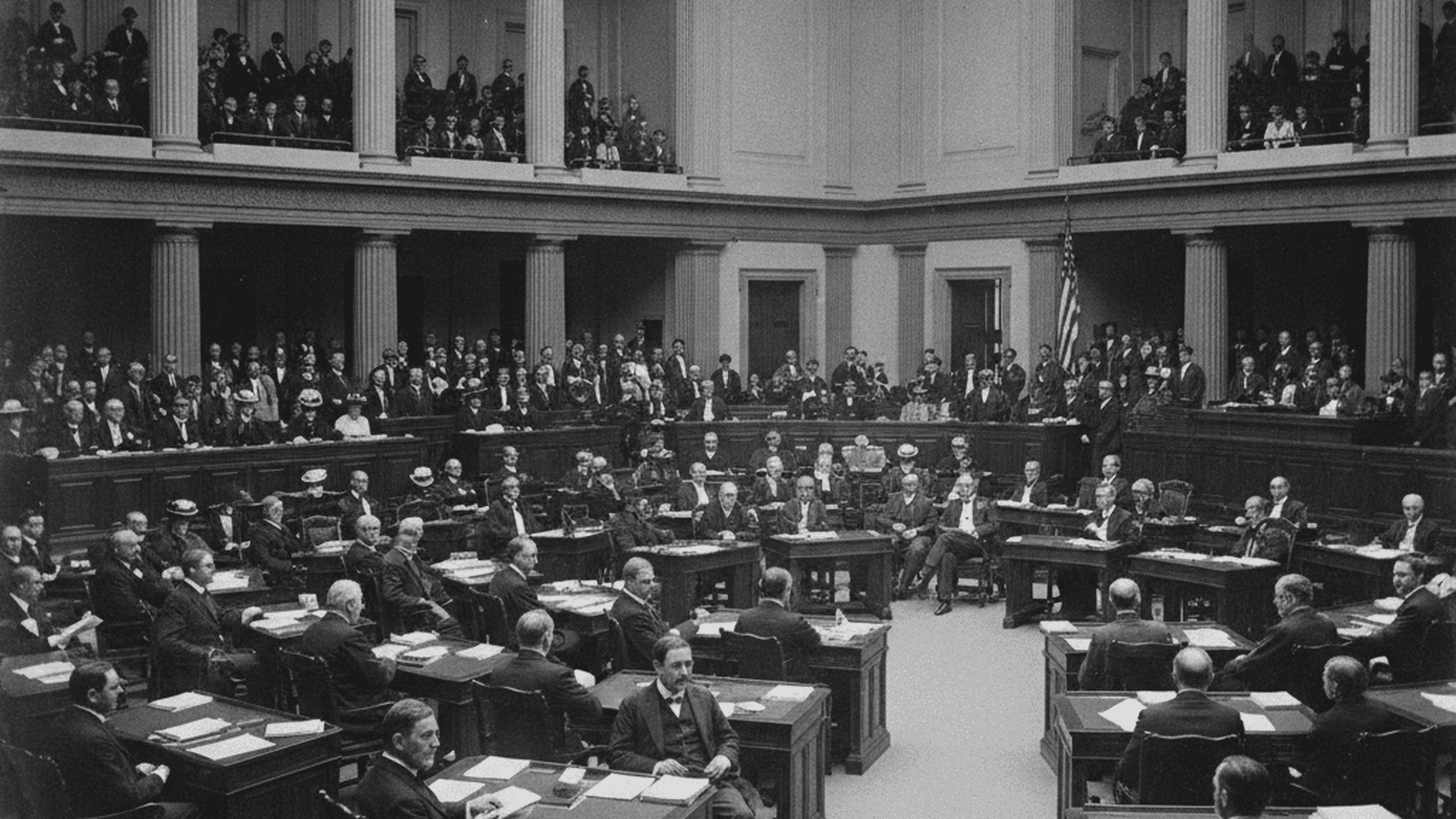
In 1907, the United States enacted the Tillman Act, the first federal law to prohibit corporations from making direct financial contributions to political candidates. This landmark legislation emerged from public outcry following revelations of massive corporate spending during the 1904 presidential election.
TLDR: The Tillman Act of 1907 marked the first federal attempt to regulate campaign finance in the United States. Prompted by Progressive Era concerns over corporate influence, the law banned direct corporate donations to federal candidates, setting a precedent for future transparency and oversight in American elections.
The 1904 presidential election served as a watershed moment in American political history, exposing the deep-seated influence of corporate wealth on the democratic process. During the campaign, Republican incumbent Theodore Roosevelt faced accusations from his Democratic opponent, Alton B. Parker, who alleged that the President’s campaign manager was “blackmailing” corporations for contributions in exchange for political favors. While Roosevelt won the election in a landslide, the seeds of suspicion had been sown. The subsequent 1905 investigation by the Armstrong Committee in New York confirmed the public’s worst fears, revealing that major insurance companies had diverted policyholder funds into political coffers without consent. This scandal, occurring at the height of the Progressive Era, ignited a national demand for reform.
The push for legislation was fueled by the “muckraking” journalists of the day, such as David Graham Phillips, whose series “The Treason of the Senate” argued that many legislators were merely agents of industrial monopolies. In this volatile atmosphere, Senator Benjamin Tillman of South Carolina emerged as an unlikely champion for reform. Tillman, a populist Democrat often at odds with Roosevelt, introduced a bill designed to sever the direct financial ties between corporations and federal candidates. The proposed legislation sought to prohibit any corporation organized under federal law, as well as national banks, from making financial contributions to any political office.
The debate in the halls of Congress reflected the broader societal struggle between the era’s “robber barons” and the growing Progressive movement. Opponents of the bill argued that corporations, as legal entities, possessed a right to participate in the political process and that such restrictions were an unconstitutional infringement on property rights. However, the political pressure was overwhelming. Roosevelt, recognizing the shift in public sentiment, used his annual messages to Congress in 1905 and 1906 to advocate for a total ban on corporate political spending. He argued that such a measure was necessary to ensure that the government remained “the servant of the people, and not the servant of any class or corporation.”
On January 26, 1907, the Tillman Act was signed into law, marking the first time the federal government asserted its authority to regulate campaign finance. The act specifically prohibited corporations and national banks from making direct money contributions to candidates for federal office. This was a revolutionary step, as it challenged the long-standing tradition of laissez-faire politics where campaign funding was considered a private matter beyond the reach of federal regulation.
However, the Tillman Act was far from perfect. Critics quickly pointed out its significant flaws, most notably the lack of an enforcement mechanism. The law did not establish a regulatory body to oversee campaign accounts, nor did it require candidates to disclose the sources of their funding. Furthermore, the act only prohibited “money contributions,” leaving a massive loophole for “in-kind” donations or non-monetary support. Corporations also found ways to bypass the law by encouraging high-ranking executives to make large personal donations, which were then surreptitiously reimbursed through corporate bonuses or salary hikes.
Despite these weaknesses, the Tillman Act established a vital legal precedent. It affirmed the principle that the federal government had a legitimate interest in protecting the integrity of elections from the corrupting influence of concentrated wealth. The limitations of the 1907 act necessitated further legislative action, leading to the Federal Corrupt Practices Act of 1910 and its 1925 revision. These early reforms eventually culminated in the Federal Election Campaign Act of 1971 and the creation of the Federal Election Commission. The Tillman Act remains the foundational stone of modern American campaign finance law, representing the first federal strike against corporate dominance in the electoral arena.

Sophie Carter serves as a Staff Writer for Just Right News, where she anchors the outlet’s critical coverage of Elections, Influence, and Democracy Infrastructure. In an era where the mechanics of voting and the flow of political capital are under constant scrutiny, Sophie provides a steady, principled voice dedicated to the preservation of American institutional integrity and the rule of law.
Raised in Charlotte, North Carolina, Sophie’s perspective was forged in a community that balances rapid modern growth with a deep respect for tradition and civic duty. Growing up in the Queen City, she witnessed firsthand how a robust local culture depends on the trust between the citizen and the state. This upbringing instilled in her a foundational belief that the right to vote is a sacred trust—one that must be protected from both administrative overreach and the encroaching influence of special interest groups. Her reporting reflects these North Carolina roots, emphasizing the importance of community-led governance and the preservation of the individual’s voice in the face of nationalized political movements.
Now based in Atlanta, Georgia, Sophie operates from the heart of one of the nation’s most pivotal and contested political landscapes. Her location allows her to report from the front lines of the debate over election security, legislative reform, and the modernization of voting systems. For Sophie, the “infrastructure” of democracy is not merely a matter of machines and ballots; it is the collection of laws, people, and transparent processes required to maintain public confidence. Her work often highlights the necessity of clear, enforceable standards that ensure every legal vote is counted fairly and that the machinery of our republic remains accountable to the taxpayers who fund it.
Central to her work at Just Right News is her acclaimed feature series, “The Price of a Vote.” Through this ongoing project, Sophie explores the complex web of influence that shapes modern campaigns and policy decisions. She delves into how high-level lobbying, non-governmental organizations, and shifting bureaucratic regulations impact the weight of an individual citizen’s ballot. By examining the financial and structural pressures placed on the electoral process, she provides readers with a comprehensive look at the forces vying for control over the American political system.
Sophie’s approach to journalism is rooted in a commitment to the constitutional framework. She views her role as a watchdog for the voter, ensuring that the systems meant to serve the public remain transparent and free from corruption. Whether she is analyzing the implementation of new voting technologies or investigating the influence of outside money on state-level policy, her work is characterized by a rigorous adherence to facts and a refusal to succumb to the sensationalism that often plagues modern political reporting.
At Just Right News, Sophie Carter continues to be a vital resource for readers who value clarity, conviction, and a defense of traditional American values. Her deep ties to the Southeast and her specialized focus on the mechanics of our republic make her an essential voice in the ongoing conversation about the future of American self-governance. Through her reporting, she remains dedicated to the idea that a secure and honest electoral system is the bedrock of a free and prosperous society.