

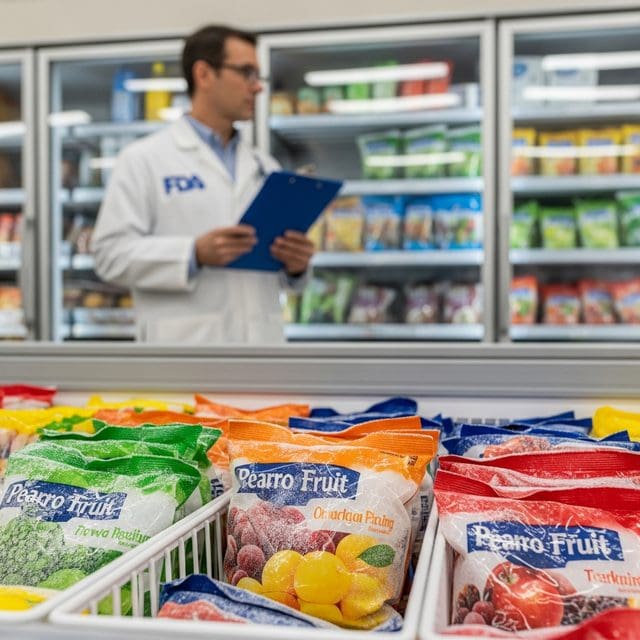
Federal regulators expanded food safety advisories this week as contamination risks from E. coli and Salmonella permeate the American grocery supply chain.
The Food and Drug Administration expanded a critical outbreak advisory on July 15, 2026, regarding GreenWise organic blueberries as federal investigators struggle to trace the source of E. coli contamination. Originally limited to specific retailers, the FDA now warns that the tainted fruit may have reached a much wider array of grocery shelves than previously reported. The investigation is officially ongoing, and the agency notes that additional products may be added as the contamination source is traced through the distribution network. This expansion serves as a reminder that in a centralized food system, a single failure in a processing plant can ripple across the nation before regulators identify the problem.
Beyond the produce aisle, a complex threat is brewing in the dairy sector. The FDA is tracking a series of recalls linked to powdered milk produced by California Dairies Inc. due to potential Salmonella contamination. Because powdered milk is a foundational ingredient in hundreds of processed goods, the agency is working with downstream consignees to determine if further recalls are necessary. For the American family, the risk extends beyond the milk carton to bread, snacks, and prepared meals. The current recall landscape is already cluttered, with active notices for rice balls containing undeclared peanuts, pounded yam with undeclared milk, and organic moringa suspected of Salmonella contamination. This broad spectrum of failures suggests systemic strain on domestic oversight.
While federal agencies manage these reactive recalls, the landscape of food safety remains cluttered with precautionary measures that often outpace the science. The voluntary recall of RAW FARM-brand raw cheddar cheese remains active despite the fact that no pathogens have actually been detected in tested samples. This highlights a recurring tension in environmental health policy: the balance between necessary public warning and the potential overreach that can cripple small-scale agricultural producers who operate outside the massive corporate dairy infrastructure. When the FDA urges consumers not to eat products before pathogens are confirmed, it prioritizes liability over the economic stability of independent farmers.
On the water front, the Environmental Protection Agency has remained notably quiet regarding national enforcement notices this week. However, the lack of federal noise does not equate to a lack of local action. In the Philippines, the Department of Environment and Natural Resources has been forced to intervene in Zambales, where illegal waste dumping has encroached on indigenous lands, threatening local soil and water purity. Similarly, in Punjab, the government is expanding its canal network to ensure irrigation water reaches the tail-end of the system, covering an additional 1.35 lakh acres. It is a localized version of a global problem: when federal oversight fails to address basic infrastructure, the burden falls back onto regional authorities.
International agricultural developments are also shifting toward more grounded, local solutions to combat economic risks. In Andhra Pradesh, India, the government has simplified the crop insurance scheme, allowing farmers to self-certify to bypass bureaucratic delays. Similarly, in Nigeria, a joint effort by the federal government and the International Fund for Agricultural Development has equipped 1,918 farmers with tricycles and improved inputs to boost rice and cassava production. These initiatives recognize that food security is built from the ground up, not through top-down mandates.
These global shifts toward local sovereignty and streamlined infrastructure offer a blueprint for American regulators. As the FDA continues to chase contamination through tangled corporate supply chains and the EPA remains silent on aging water infrastructure, the value of transparent, localized food and water systems becomes increasingly clear. Protecting the American table requires less federal red tape and more focus on the integrity of the primary producer.

Eric Nolan serves as the Senior Correspondent for Food, Water, and Environmental Health at Just Right News, where he brings a principled, common-sense perspective to the most fundamental issues facing the American public. With a career dedicated to uncovering the truth behind the policies that govern our natural resources, Eric has become a trusted voice for readers who value traditional stewardship over bureaucratic overreach. His reporting is defined by a commitment to the idea that true environmentalism is rooted in the protection of the American family and the preservation of the nation’s agricultural heritage.
Raised in Fresno, California, Eric’s worldview was shaped in the heart of the San Joaquin Valley. Growing up in one of the world’s most productive agricultural hubs, he witnessed firsthand the vital connection between the land, the water, and the dinner table. In Fresno, he saw the resilience of farmers and the devastating impact that distant, top-down regulations can have on local communities. This upbringing instilled in him a deep respect for the producers who feed the country and a lifelong skepticism toward the alarmist narratives often pushed by mainstream media. For Eric, environmental health is not an abstract political talking point; it is a matter of ensuring that the people who work the land have the freedom and the resources to do so effectively.
Now based in Eugene, Oregon, Eric operates from a unique vantage point in the Pacific Northwest. Living in a region often defined by intense environmental debate, he provides a necessary counter-narrative to the prevailing trends of the area. From his base in Eugene, he monitors the shifting tides of federal and state policies, ensuring that the voices of rural citizens and property owners are not drowned out by urban activism. His reporting often bridges the gap between the rugged realities of the outdoors and the legislative halls where decisions are made, offering a grounded perspective that prioritizes local sovereignty and practical solutions.
As the lead for the acclaimed feature series “Earth on the Table,” Eric explores the intricate journey of the American food supply. He tackles critical issues such as water rights, soil health, and food security through a lens of national stability and individual liberty. He believes that a healthy environment and a thriving economy are not mutually exclusive, but rather two sides of the same coin of national prosperity. His work consistently highlights how innovation and private-sector ingenuity are the most effective tools for ensuring clean water and a safe food supply, rather than the expansion of the administrative state.
At Just Right News, Eric’s reporting serves as a vital resource for those who seek accountability and transparency. Whether he is investigating the impact of federal land management on local economies or examining the safety of the national food infrastructure, his work remains anchored in the values of heritage and hard work. Eric Nolan continues to be a leading voice in environmental journalism, championing the belief that the best way to protect our natural resources is to empower the people who live and work closest to them.