

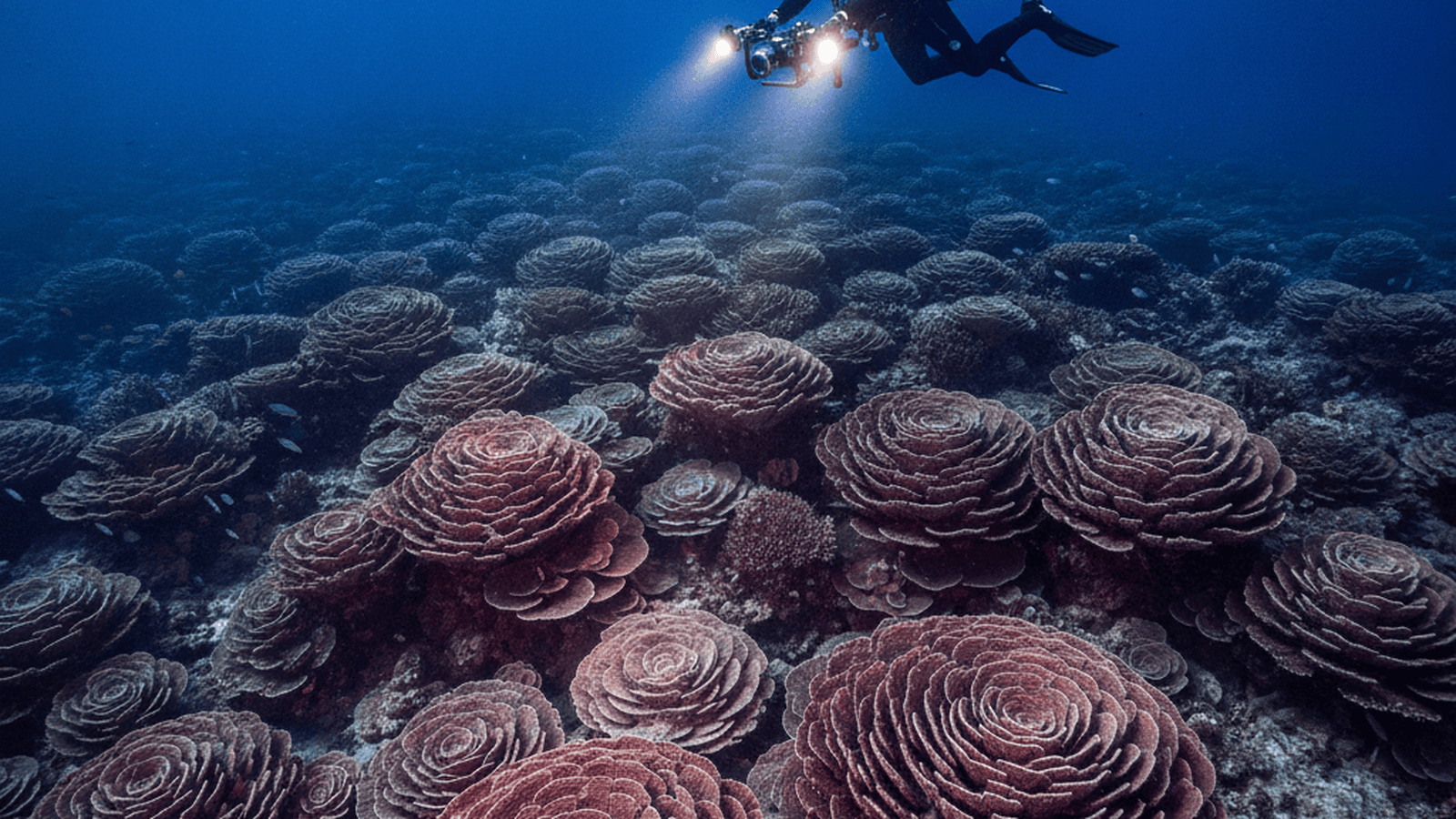
An international research team led by UNESCO has discovered a massive, pristine coral reef consisting of rose-shaped corals off the coast of Tahiti. Located in the mesophotic “twilight zone,” the reef appears to have escaped the bleaching events that have decimated shallower coral populations.
TLDR: Scientists have uncovered a three-kilometer-long, rose-shaped coral reef in the deep waters off Tahiti. This discovery in the ocean’s “twilight zone” suggests that deeper marine environments may serve as vital thermal refuges, protecting biodiversity from the escalating impacts of global ocean warming.
An international research team, coordinated by UNESCO, has unveiled the discovery of one of the largest coral reefs ever found at depths exceeding 30 meters. Located off the coast of Tahiti in French Polynesia, the reef stretches approximately three kilometers and remains in pristine condition. This discovery is particularly significant because it exists in the “twilight zone” of the ocean, a region where light penetration is minimal and exploration is technically challenging. The find was made during a mapping mission that sought to explore the deeper reaches of the Polynesian seafloor, revealing an ecosystem that had remained hidden despite its proximity to inhabited islands.
The reef is primarily composed of Pachyseris speciosa, a coral species that grows in wide, flat plates resembling giant roses. Some of these individual coral structures measure more than two meters in diameter, creating a surreal, floral-like landscape across the seabed. Unlike the majority of the world’s known coral reefs, which are located in shallow waters less than 25 meters deep, this reef sits between 30 and 70 meters below the surface. This depth puts it in the mesophotic zone, a transition area between the sunlit surface and the dark abyss.
The expedition was part of the United Nations’ Decade of Ocean Science for Sustainable Development. Divers utilized specialized rebreather technology, which allows for longer bottom times by recycling exhaled gases and removing carbon dioxide. This equipment was essential for documenting the reef, as standard scuba gear would not have permitted the 200 hours of underwater observation required to map the site. The team also employed high-resolution cameras to create 3D models of the coral structures, providing a digital record of the reef’s complexity.
One of the most striking aspects of the find is the reef’s health. In 2019, many shallow-water reefs in French Polynesia suffered significant bleaching due to a prolonged marine heatwave. However, the Tahiti rose reef showed no signs of stress or mortality. Researchers hypothesize that the deeper water column acted as a thermal buffer, shielding the corals from the extreme temperatures that devastated their shallower counterparts. This resilience suggests that the mesophotic zone may serve as a critical refuge for marine biodiversity in a warming world.
As climate change continues to warm the upper layers of the ocean, these deeper ecosystems could provide the genetic material necessary to reseed damaged shallow reefs. The find also highlights the limitations of current ocean mapping; while the surface of Mars is mapped in high resolution, much of Earth’s seabed remains a mystery. The discovery of such a large and healthy reef in a well-traveled area like Tahiti suggests that many more undiscovered ecosystems likely exist in the world’s oceans.
Moving forward, the international team plans to deploy sensors to monitor the reef’s temperature and water chemistry over the long term. They also aim to investigate the specific biological adaptations that allow Pachyseris speciosa to thrive in such low-light conditions. This research will be vital for global conservation strategies, as it identifies new areas of the ocean that require immediate protection from deep-sea mining and bottom trawling. The mapping of the Tahiti reef is a milestone for the Seabed 2030 project, which aims to produce a definitive map of the entire ocean floor by the end of the decade. Currently, only about 20 percent of the seabed has been mapped to high standards. Discoveries like this one demonstrate that massive, ecologically vital structures can still be found in areas previously thought to be well-understood.

Rachel Vaughn serves as a Senior Correspondent for Just Right News, where she leads the network’s coverage of Global Health, Climate, and Development. With a career defined by intellectual rigor and a commitment to principled reporting, Rachel provides a vital conservative perspective on some of the most complex and high-stakes issues facing the world today. Her work is characterized by a refusal to accept bureaucratic narratives at face value, focusing instead on how international policies impact national sovereignty, individual liberty, and the American taxpayer.
Raised in New Haven, Connecticut, Rachel grew up in an environment dominated by elite academic discourse. This upbringing provided her with a front-row seat to the inner workings of the American establishment, but it also instilled in her a healthy skepticism of the “ivory tower” consensus. She learned early on that while academic theories may sound promising in a lecture hall, they often fail to account for the practical realities of the working class. This background drives her to bridge the gap between high-level policy discussions and the common-sense concerns of everyday citizens, ensuring that her reporting remains grounded and accessible.
Now based in Burlington, Vermont, Rachel operates from a unique vantage point within one of the nation’s most progressive political landscapes. Living and working in a region that often serves as a testing ground for radical social and environmental experiments allows her to witness the real-world consequences of these policies firsthand. From her base in the Green Mountain State, she provides Just Right News readers with essential “boots on the ground” reporting, documenting the friction between local mandates and the constitutional freedoms of the individual. Her presence in Burlington ensures that her critiques of globalist agendas are informed by a direct understanding of how those ideologies manifest at the local level.
In her acclaimed feature series, “Planetary Stakes,” Rachel explores the intersection of international development and environmental stewardship. She rejects the alarmism often found in mainstream media, opting instead for a sober analysis of the economic and geopolitical costs of global climate agreements. Her reporting frequently highlights the importance of market-driven innovation and the role of American leadership in fostering global health without ceding authority to unelected international bodies. Through “Planetary Stakes,” she has become a leading voice for those who believe that true conservation and public health are best achieved through transparency, accountability, and the protection of private property rights.
Throughout her tenure at Just Right News, Rachel has distinguished herself as a journalist who is unafraid to ask difficult questions of global institutions. Whether she is investigating the influence of non-governmental organizations on domestic policy or analyzing the fiscal transparency of international health initiatives, her goal remains the same: to provide her audience with the facts necessary to navigate an increasingly interconnected world. Her blend of East Coast intellectual heritage and her current immersion in the political heart of the Northeast makes her an indispensable asset to the newsroom and a trusted source for readers seeking a principled, conservative take on the issues that define our era.