

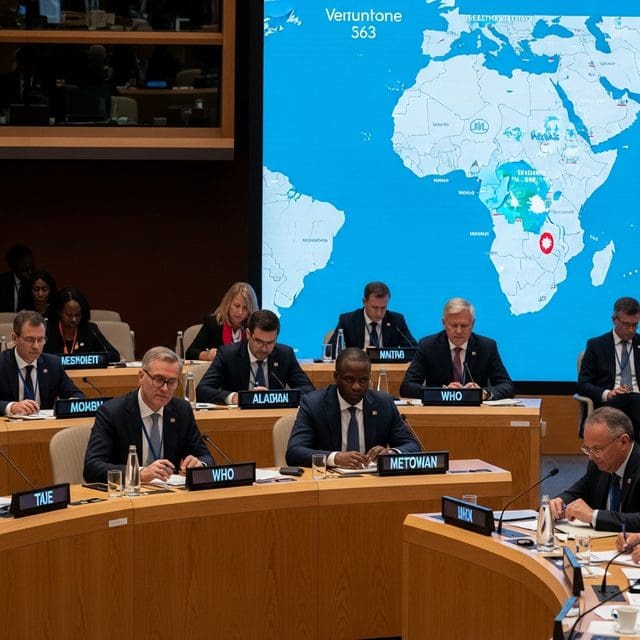
The World Health Organization grapples with a $1 billion funding gap and a $360 million deficit while developing nations increasingly reject traditional aid models in favor of regional autonomy.
The World Health Organization is entering the third quarter of 2026 facing a profound fiscal and ideological reckoning. As of July 9, the agency’s Health Emergency Appeal remains critically underfunded, with a roughly $1 billion request outstanding to sustain services across 36 active health emergencies. These crises, driven by a combination of conflict, disease outbreaks, and climate shocks, are testing the limits of the current multilateral system. This shortfall is compounded by a legacy of budget arrears that reached nearly $360 million at the end of 2025, signaling a potential permanent shift in how the international community approaches global health spending.
At the 79th World Health Assembly in Geneva, the discourse has moved beyond simple requests for more capital. Delegates are currently debating a total overhaul of the global health architecture, including pandemic preparedness and health financing. This debate is occurring against a backdrop of steep cuts in development assistance from traditional Western donors. While the United States remains a central player in global health, the domestic focus on fiscal transparency and national sovereignty is finding an unexpected echo in the developing world. WHO Director-General Tedros Adhanom Ghebreyesus has explicitly linked these aid cuts to a rising push for health sovereignty, particularly among African nations seeking to reduce their long-standing dependence on foreign aid.
This movement toward self-sufficiency is not merely rhetorical. African-focused analyses of the WHO Pandemic Agreement emphasize that future health security will depend on new domestic and regional financing tools. The Africa Epidemic Fund, recently seeded with $43 million, serves as a pilot for this new model, utilizing solidarity levies and regional contributions rather than relying primarily on external donor cycles. This shift represents a strategic pivot away from the post-war model of bilateral aid, which many critics argue has created cycles of dependency rather than resilient local infrastructure.
Climate adaptation has become the latest frontier in this funding struggle. A new WHO resolution on climate change and health requires approximately $27.6 million in budgeted resources—a relatively modest sum compared to broader emergency needs, yet one that remains difficult to secure. Recent data from the WHO African Region indicates that less than 0.5% of multilateral climate finance is currently directed toward health projects. Despite high-level political gatherings, such as the Alliance for Transformative Action on Climate and Health meeting in Paris on July 1, climate change remains largely absent from national health investment plans and overseas development assistance.
The shift toward multilateral, climate-linked mechanisms is already visible through the Pandemic Fund. Managed in coordination with the World Bank, this fund has disbursed $1.4 billion in grants to 128 countries. These grants are increasingly focused on climate-linked outbreak preparedness, particularly in Southern Africa. This illustrates a transition away from traditional state-to-state aid toward complex, climate-health financing mechanisms that prioritize regional coordination. However, the implementation of these programs remains hampered by the fact that health projects are frequently sidelined in broader climate finance negotiations.
For American taxpayers and policymakers, these developments underscore a growing global demand for accountability and a move away from open-ended subsidies. As developing nations seek to build their own regional health security through initiatives like the Africa Epidemic Fund, the role of the WHO may transition from a primary service provider to a technical coordinator. The current $1 billion funding gap is not just a financial deficit; it is a symptom of a world moving toward a market-driven, sovereign-focused model of development that prioritizes local results over bureaucratic longevity.

Rachel Vaughn serves as a Senior Correspondent for Just Right News, where she leads the network’s coverage of Global Health, Climate, and Development. With a career defined by intellectual rigor and a commitment to principled reporting, Rachel provides a vital conservative perspective on some of the most complex and high-stakes issues facing the world today. Her work is characterized by a refusal to accept bureaucratic narratives at face value, focusing instead on how international policies impact national sovereignty, individual liberty, and the American taxpayer.
Raised in New Haven, Connecticut, Rachel grew up in an environment dominated by elite academic discourse. This upbringing provided her with a front-row seat to the inner workings of the American establishment, but it also instilled in her a healthy skepticism of the “ivory tower” consensus. She learned early on that while academic theories may sound promising in a lecture hall, they often fail to account for the practical realities of the working class. This background drives her to bridge the gap between high-level policy discussions and the common-sense concerns of everyday citizens, ensuring that her reporting remains grounded and accessible.
Now based in Burlington, Vermont, Rachel operates from a unique vantage point within one of the nation’s most progressive political landscapes. Living and working in a region that often serves as a testing ground for radical social and environmental experiments allows her to witness the real-world consequences of these policies firsthand. From her base in the Green Mountain State, she provides Just Right News readers with essential “boots on the ground” reporting, documenting the friction between local mandates and the constitutional freedoms of the individual. Her presence in Burlington ensures that her critiques of globalist agendas are informed by a direct understanding of how those ideologies manifest at the local level.
In her acclaimed feature series, “Planetary Stakes,” Rachel explores the intersection of international development and environmental stewardship. She rejects the alarmism often found in mainstream media, opting instead for a sober analysis of the economic and geopolitical costs of global climate agreements. Her reporting frequently highlights the importance of market-driven innovation and the role of American leadership in fostering global health without ceding authority to unelected international bodies. Through “Planetary Stakes,” she has become a leading voice for those who believe that true conservation and public health are best achieved through transparency, accountability, and the protection of private property rights.
Throughout her tenure at Just Right News, Rachel has distinguished herself as a journalist who is unafraid to ask difficult questions of global institutions. Whether she is investigating the influence of non-governmental organizations on domestic policy or analyzing the fiscal transparency of international health initiatives, her goal remains the same: to provide her audience with the facts necessary to navigate an increasingly interconnected world. Her blend of East Coast intellectual heritage and her current immersion in the political heart of the Northeast makes her an indispensable asset to the newsroom and a trusted source for readers seeking a principled, conservative take on the issues that define our era.