

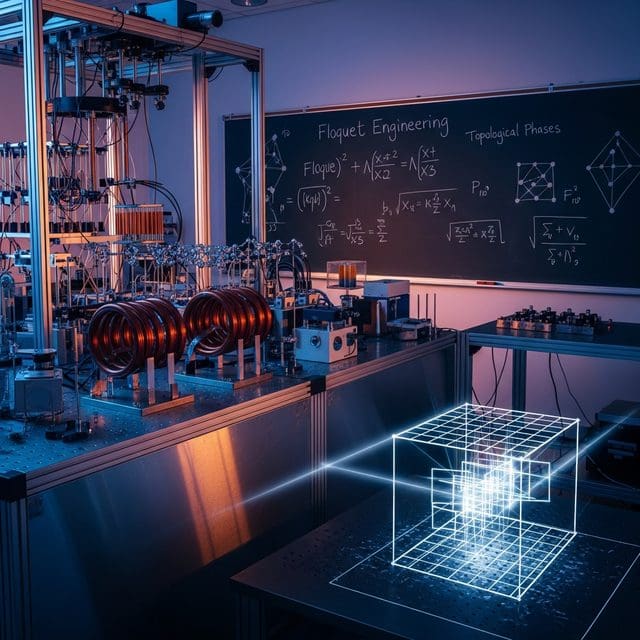
Researchers have identified a method to create exotic quantum states by rhythmically switching magnetic fields, offering a potential breakthrough in stabilizing quantum computers against noise.
In the quest to master the quantum realm, the traditional focus has remained on the discovery of new materials. However, a groundbreaking theoretical study from California Polytechnic State University suggests that the next frontier of innovation lies not in what a material is, but in how it is rhythmically manipulated. Published in Physical Review B, the research reveals that periodically switching magnetic flux can generate exotic forms of matter that have no static counterpart in the natural world.
Led by lecturer Ian Powell and undergraduate researcher Louis Buchalter, the study utilizes a concept known as “Floquet engineering” to reorganize the fundamental band structure of quantum systems. By alternating magnetic fields in a precise, time-dependent protocol, the team demonstrated that they could produce topological phases and edge modes—stable pathways for quantum information—that are impossible to achieve in any time-independent configuration. This discovery suggests that the temporal profile of a magnetic field is a design variable as critical as the atomic makeup of a processor, allowing for the creation of quantum states that essentially “blink” into existence through rhythmic control.
The implications for national sovereignty and technological independence are significant. As the U.S. government deepens its involvement in the sector—having taken a $2 billion equity stake in nine quantum computing firms as of May 2026—the race to overcome “noise” is intensifying. Current quantum bits, or qubits, are notoriously fragile, often succumbing to environmental interference that destroys data. The Cal Poly team argues that these driven phases can be engineered to be inherently more robust, providing a potential shield against the errors that currently plague decentralized innovation in the field. By carefully timing how magnetic fields are applied, scientists can design systems that are less vulnerable to the imperfections that lead to calculation failures.
This research also highlights a shift in the American educational and industrial landscape. Buchalter, who completed the work as a student before pursuing a Master of Science at the University of Washington, represents a new generation of domestic talent capable of challenging the complexities of condensed matter physics. His transition toward experimental studies of quantum matter and potential future at a national laboratory underscores the importance of maintaining a robust pipeline of specialized expertise to secure the nation’s lead in the next-generation data storage market, which is projected to reach nearly $100 billion by 2032. The collaboration between a lecturer and an undergraduate demonstrates that significant scientific contributions can emerge from the American university system outside of the traditional Ivy League corridors.
Powell noted that the research identified a mathematical organizing principle mirroring patterns typically found in higher-dimensional quantum systems. This suggests that relatively simple systems, when driven by changing conditions, could provide new ways to explore more complex physics without the need for impossibly large hardware. The team mapped out these exotic states in a topological phase diagram, which serves as a visual guide for stable quantum phases defined by fixed properties. This map is essential for engineers who seek to build the next generation of sensors and computers that operate beyond the limits of classical 0s and 1s.
While the study remains theoretical, it provides a roadmap for experimental validation using platforms such as ultracold-atom experiments or photonic lattices. As quantum sensors move into flight tests and hospitals, the ability to stabilize these systems through time-dependent control becomes a matter of practical necessity. For the American taxpayer and the tech sector alike, this represents a more efficient, principled path toward the quantum horizon—one defined by ingenious control and the defense of constitutional-era scientific inquiry rather than just raw material consumption and centralized bureaucratic oversight.

Mason Reed serves as a Staff Writer for Just Right News, where he spearheads the Future Frontiers & Special Projects desk. In an era defined by rapid technological shifts and evolving social landscapes, Mason provides a steady, principled voice, examining the innovations of tomorrow through the lens of traditional American values. His work is most prominently featured in his signature series, “The Next Horizon,” where he explores the intersection of emerging technology, national sovereignty, and the preservation of individual liberty.
A native of San Diego, California, Mason’s worldview was shaped by the unique culture of his hometown. Growing up in a region defined by its strong military presence and its history of maritime industry, he developed a deep-seated respect for the institutions that provide national stability and the entrepreneurial spirit that drives the American economy. This upbringing instilled in him a belief that true progress is not found in discarding the past, but in building upon a foundation of proven principles. His reporting often reflects this San Diego influence, emphasizing the importance of a robust national defense and the necessity of maintaining a competitive edge in the global marketplace.
Now based in San Francisco, Mason operates from the heart of the world’s technological engine. Living and working in the Bay Area provides him with a front-row seat to the advancements—and the ideological challenges—emanating from Silicon Valley. While many in the region embrace a “move fast and break things” mentality, Mason’s reporting serves as a vital counterweight. He offers Just Right News readers a “boots on the ground” perspective, documenting how radical local policies and the concentration of tech power impact the everyday lives of citizens. His proximity to the industry allows him to cut through the marketing jargon of big tech to uncover the real-world implications for privacy, free speech, and the nuclear family.
In his “Future Frontiers” beat, Mason tackles complex subjects ranging from the ethics of artificial intelligence to the burgeoning private space race. He approaches these topics with a healthy skepticism toward centralized bureaucracy, championing instead the decentralized innovations that empower individuals. Through “The Next Horizon,” he highlights the pioneers and thinkers who are working to ensure that the future remains a place where human dignity and constitutional rights are protected. He believes that the rapid pace of change requires more than just technical expertise; it requires a moral compass rooted in the Western tradition.
Throughout his tenure at Just Right News, Mason has remained committed to the idea that the future is something to be shaped, not merely accepted. His writing is characterized by a rigorous defense of American exceptionalism and a belief that the country’s best days lie ahead, provided it remains true to its founding ideals. Whether he is investigating the impact of automation on the American workforce or profiling the next generation of aerospace engineers, Mason Reed ensures that his readers are equipped with the insights they need to navigate a changing world with confidence and clarity.