

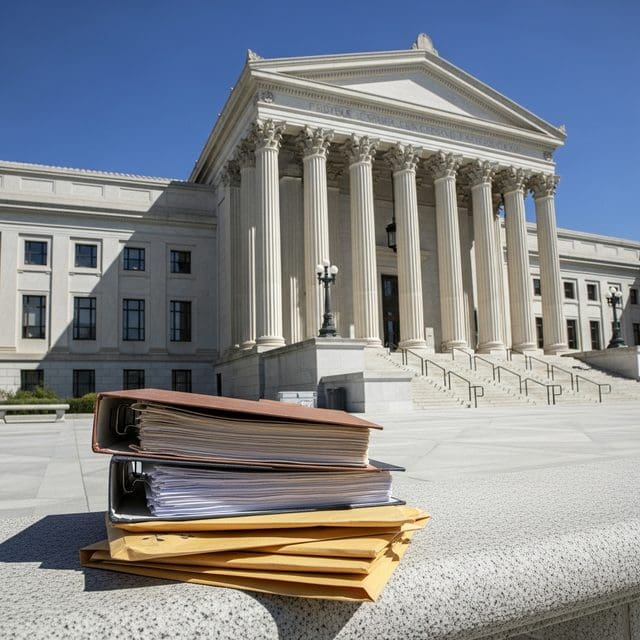
A wave of lawsuits challenges the Trump administration’s restrictive new policies on the Freedom of Information Act and the Presidential Records Act.
The constitutional balance between executive privilege and the public’s right to oversight is facing its most significant test in decades. Following a series of administrative shifts aimed at tightening control over federal records, the judiciary has become the primary battleground for determining the limits of the Freedom of Information Act (FOIA) and the Presidential Records Act (PRA).
Recent data highlights a sharp increase in legal friction. Since January 20, 2026, more than 1,000 FOIA-related lawsuits have been filed in federal courts, a nearly twofold increase compared to the 591 cases filed during the preceding 15-month period. This surge follows a Department of Energy policy enacted in August 2025 that closed all pending FOIA requests made prior to October 2024, marking a departure from established administrative norms. At the Department of Defense, pending requests have risen by 20 percent, while backlogs at the State Department have climbed from 21,000 to 27,000.
Central to this legal upheaval is a lawsuit filed by a coalition of historians against the Department of Justice. The plaintiffs are challenging a DOJ legal opinion that deems the 50-year-old Presidential Records Act unconstitutional. The administration’s position rests on an expansive interpretation of Article II, suggesting that statutory requirements for the preservation and eventual release of executive documents infringe upon the President’s inherent constitutional authorities. This doctrinal shift represents a direct challenge to the post-Watergate consensus that presidential records belong to the public, not the individual officeholder.
Simultaneously, the White House has loosened internal rules regarding the preservation of records, raising concerns among transparency advocates about the integrity of the historical record. These administrative changes coincide with a decline in public trust. A Pew Research Center survey released on May 2, 2026, indicated that 56 percent of U.S. adults believe ethics and honesty in the federal government have declined since the start of the current term.
From a constitutional perspective, the courts must now decide if the PRA’s mandates constitute a legislative overreach into the executive sphere or a necessary check to ensure accountability. While the administration argues for the necessity of confidential executive deliberation, the judiciary has historically viewed transparency as a vital component of the separation of powers. The outcome of these cases will likely define the boundaries of executive secrecy for the next generation.
As these cases move through the appellate circuits, the legal community is watching for a clear standard on whether the executive branch can unilaterally bypass statutory transparency requirements. For now, the rule of law remains tethered to the courts’ ability to enforce the public’s right to know against the expanding claims of executive prerogative.

Lila Hayes serves as a Staff Writer for Just Right News, where she anchors the “Courts, Law, and Constitutional Order” beat. Her work is defined by a steadfast commitment to the foundational principles of the American republic and a rigorous defense of the legal frameworks that ensure national stability. As a primary voice for the outlet, she provides readers with a clear-eyed analysis of the judiciary, focusing on the importance of originalism and the preservation of the separation of powers.
Lila’s perspective was forged in the American heartland. Raised in St. Louis, Missouri, she grew up in a Hispanic household where the values of hard work, faith, and respect for the law were paramount. Her upbringing instilled in her a deep appreciation for the American Dream and the legal protections that make it possible. This Missouri background remains a cornerstone of her reporting, providing a grounded, common-sense counter-narrative to the often-insular legal circles of the coastal elite. She understands that the decisions made in high-court chambers have real-world consequences for families and small business owners across the country.
At Just Right News, Lila has become widely recognized for her signature feature series, “The Rulebook of Power.” In this ongoing project, she delves into the mechanics of the federal government, examining how administrative overreach and judicial activism can threaten the delicate balance of the Constitution. She approaches her beat with the tenacity of a veteran journalist and the precision of a legal scholar, consistently advocating for a judiciary that interprets the law as written rather than legislating from the bench. For Lila, the Constitution is not a “living” document subject to the whims of modern social trends; it is a fixed standard that ensures the government remains the servant of the people, not their master.
Now based in Philadelphia, Pennsylvania, Lila finds herself at the very epicenter of American constitutional history. Living and working in the city where the Founders drafted the documents she defends daily provides a constant source of inspiration. The historic halls and landmarks of Philadelphia serve as a daily reminder of the high stakes involved in her reporting. Her presence in the city allows her to bridge the gap between the historical intent of the law and its contemporary application, ensuring that the legacy of the Founding Fathers remains central to the national conversation.
Throughout her career, Lila has remained dedicated to the idea that a free society requires an informed citizenry and a transparent legal system. Her reporting is more than just a collection of headlines; it is a defense of the constitutional order that has sustained the nation for over two centuries. By focusing on the “Rulebook of Power,” she ensures that her readers understand not just what is happening in the courtrooms, but why those decisions matter for the future of American liberty. Lila Hayes continues to be a vital voice for those who believe that the law should be a shield for the citizen and a constraint on the state.