

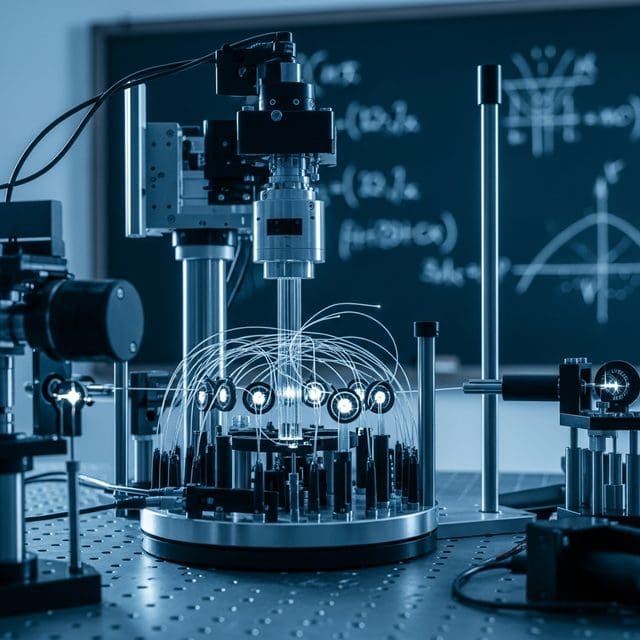
New research into quantum collapse models suggests gravity-induced spacetime fluctuations create a microscopic blur in time, establishing a theoretical limit on clock accuracy that reinforces the stability of modern timekeeping.
The pursuit of absolute precision has long been a hallmark of Western scientific achievement, yet new research suggests the universe may impose a hard limit on our ability to measure the passage of time. A study published in Physical Review Research by an international team of physicists indicates that the very fabric of spacetime may be subject to microscopic fluctuations that prevent time from being perfectly exact.
Led by Nicola Bortolotti of the Enrico Fermi Museum and Research Centre, the researchers examined “collapse models,” which attempt to explain how the fuzzy possibilities of quantum mechanics settle into the definite reality we observe. By analyzing the Diósi-Penrose model and Continuous Spontaneous Localization, the team established a quantitative link between gravity and the spontaneous collapse of the wavefunction. This connection implies that gravity-induced fluctuations in spacetime create a fundamental “blur” in time.
For the average citizen concerned with the reliability of national infrastructure and GPS systems, the findings are remarkably stable. The study concludes that this inherent time uncertainty is approximately 10^{-28} seconds per year. Co-author Catalina Curceanu noted that this is many orders of magnitude below what current technology can detect, meaning our most advanced atomic clocks remain the gold standard for precision.
This discovery addresses a long-standing friction between quantum mechanics, which treats time as a fixed external parameter, and general relativity, which views time as a flexible dimension shaped by mass. By suggesting that time itself is subject to quantum-like uncertainty, the research provides a potential bridge between these two pillar theories of physics without upending the practical foundations of modern measurement.
Supported by the Foundational Questions Institute (FQxI), the work of Bortolotti, Curceanu, Kristian Piscicchia, and Lajos Diósi demonstrates that even the most radical inquiries into the nature of reality often reaffirm the robustness of our physical laws. While the discovery reveals a theoretical ceiling for future innovation, it confirms that the temporal frameworks governing our digital and physical world are secure against the chaos of the quantum realm.
As the United States continues to lead in high-precision manufacturing and aerospace, understanding these fundamental limits ensures that our technical standards remain grounded in the true nature of the physical world. The next frontier for this research involves testing these models against even more precise physical measurements to further refine our understanding of the relationship between gravity and the quantum world.

Mason Reed serves as a Staff Writer for Just Right News, where he spearheads the Future Frontiers & Special Projects desk. In an era defined by rapid technological shifts and evolving social landscapes, Mason provides a steady, principled voice, examining the innovations of tomorrow through the lens of traditional American values. His work is most prominently featured in his signature series, “The Next Horizon,” where he explores the intersection of emerging technology, national sovereignty, and the preservation of individual liberty.
A native of San Diego, California, Mason’s worldview was shaped by the unique culture of his hometown. Growing up in a region defined by its strong military presence and its history of maritime industry, he developed a deep-seated respect for the institutions that provide national stability and the entrepreneurial spirit that drives the American economy. This upbringing instilled in him a belief that true progress is not found in discarding the past, but in building upon a foundation of proven principles. His reporting often reflects this San Diego influence, emphasizing the importance of a robust national defense and the necessity of maintaining a competitive edge in the global marketplace.
Now based in San Francisco, Mason operates from the heart of the world’s technological engine. Living and working in the Bay Area provides him with a front-row seat to the advancements—and the ideological challenges—emanating from Silicon Valley. While many in the region embrace a “move fast and break things” mentality, Mason’s reporting serves as a vital counterweight. He offers Just Right News readers a “boots on the ground” perspective, documenting how radical local policies and the concentration of tech power impact the everyday lives of citizens. His proximity to the industry allows him to cut through the marketing jargon of big tech to uncover the real-world implications for privacy, free speech, and the nuclear family.
In his “Future Frontiers” beat, Mason tackles complex subjects ranging from the ethics of artificial intelligence to the burgeoning private space race. He approaches these topics with a healthy skepticism toward centralized bureaucracy, championing instead the decentralized innovations that empower individuals. Through “The Next Horizon,” he highlights the pioneers and thinkers who are working to ensure that the future remains a place where human dignity and constitutional rights are protected. He believes that the rapid pace of change requires more than just technical expertise; it requires a moral compass rooted in the Western tradition.
Throughout his tenure at Just Right News, Mason has remained committed to the idea that the future is something to be shaped, not merely accepted. His writing is characterized by a rigorous defense of American exceptionalism and a belief that the country’s best days lie ahead, provided it remains true to its founding ideals. Whether he is investigating the impact of automation on the American workforce or profiling the next generation of aerospace engineers, Mason Reed ensures that his readers are equipped with the insights they need to navigate a changing world with confidence and clarity.