

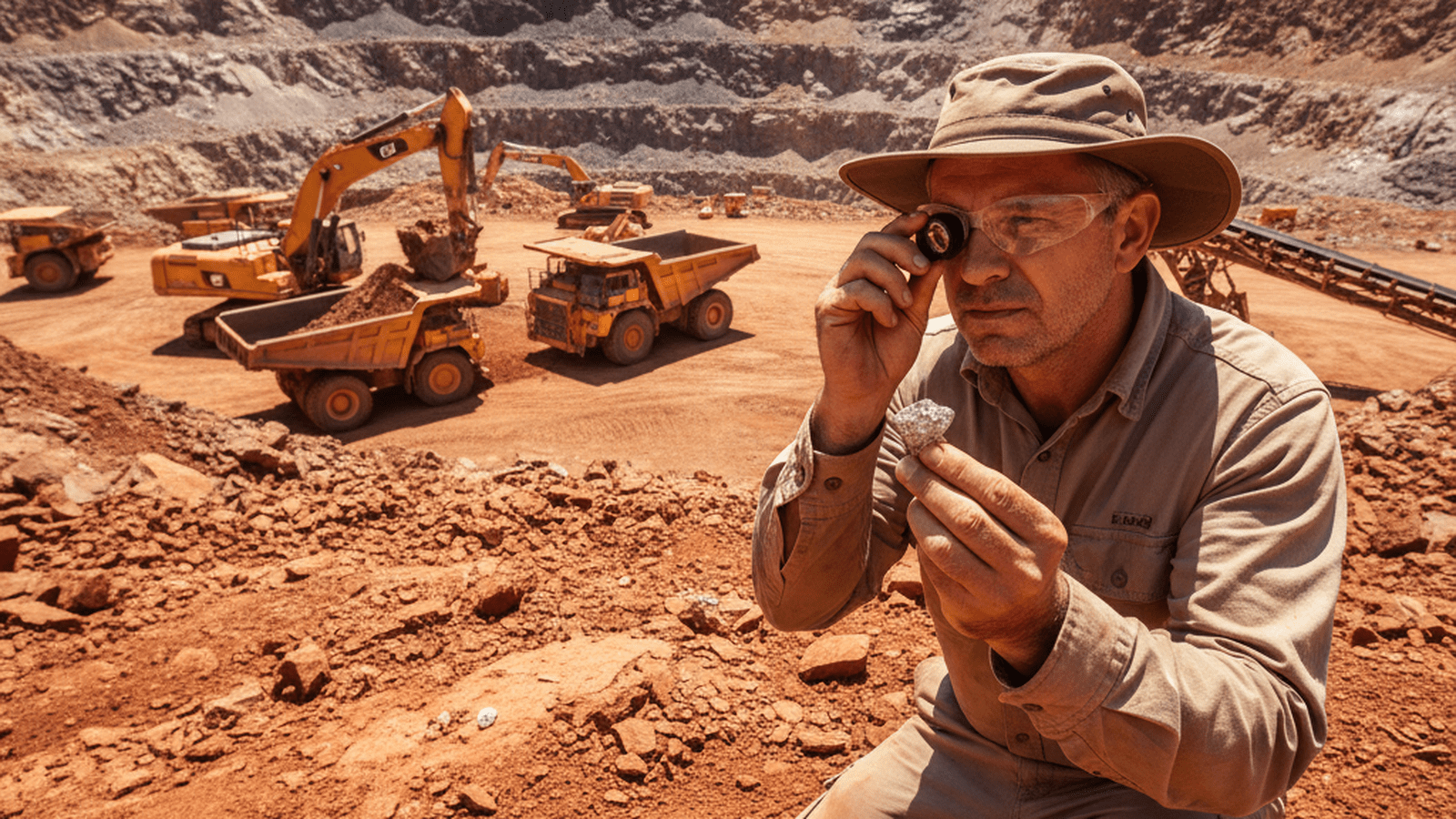
Researchers identified Davemaoite, a high-pressure calcium silicate perovskite, within a diamond from the Earth’s lower mantle. This discovery, made using samples from Brazil, provides the first direct evidence of a mineral previously only theorized to exist at extreme depths.
TLDR: Scientists have discovered Davemaoite, a mineral from the Earth’s lower mantle, trapped inside a diamond found in Brazil. This marks the first time this high-pressure calcium silicate perovskite has been observed in nature, offering crucial insights into the chemical composition and radioactive heat signatures of the deep interior.
Geologists and materials scientists have long sought direct evidence of the minerals that compose the Earth’s lower mantle. While seismic data provides a rough map of the interior, the actual chemical makeup remains largely theoretical due to the extreme pressures required to maintain certain crystalline structures. A breakthrough occurred when a team of researchers identified a rare inclusion within a diamond recovered from the Juina mine in Brazil. This inclusion was confirmed to be Davemaoite, a high-pressure calcium silicate perovskite that was previously only known through laboratory synthesis. This discovery marks the first time the mineral has been observed in its natural state, providing a tangible link to the processes occurring hundreds of kilometers beneath the surface.
Davemaoite, named after the prominent geophysicist Ho-kwang “Dave” Mao, is a crucial component of the lower mantle, estimated to make up about 5% to 7% of its volume. It forms at depths between 660 and 2,700 kilometers, where pressures are hundreds of thousands of times greater than at the surface. Under normal atmospheric conditions, the mineral’s lattice structure collapses, making it nearly impossible to find in surface rocks. The diamond that housed the Davemaoite acted as a natural pressure vessel, maintaining the internal environment necessary to keep the mineral stable during its journey to the surface via deep-seated volcanic eruptions known as kimberlites. This preservation allows for the study of a material that technically should not exist at the Earth’s crust.
The discovery was the result of an extensive field expedition to the Mato Grosso region of Brazil, a site famous for “super-deep” diamonds. Unlike most diamonds that form 150 to 200 kilometers down, these specimens originate from the transition zone and lower mantle. Researchers used synchrotron X-ray diffraction at the Advanced Photon Source to analyze the microscopic speck within the diamond. This non-destructive technique allowed them to determine the crystal structure and chemical composition without breaking the diamond’s seal. If the diamond had been cracked, the Davemaoite would have instantly reverted to a common glass-like state, destroying the evidence of its high-pressure origins.
The presence of Davemaoite is significant because it is a major host for radioactive elements such as uranium, thorium, and potassium-40. These elements are the primary drivers of radioactive heating within the Earth’s interior. By studying the concentration of these elements within the natural sample, scientists can better understand the “heat budget” of the planet. This heat influences everything from the movement of tectonic plates to the generation of the Earth’s magnetic field. The discovery confirms that the lower mantle is chemically heterogeneous, rather than a uniform mass of rock, which has profound implications for our understanding of mantle convection.
Furthermore, the chemical analysis of this specific sample revealed a surprising amount of potassium. This suggests that the lower mantle may be more chemically complex than previously modeled by laboratory simulations. The ability to examine a physical specimen from the lower mantle allows researchers to calibrate their instruments and theoretical models with unprecedented accuracy. It bridges the gap between high-pressure physics and observational geology, turning a theoretical mineral into a physical reality.
This finding opens new avenues for exploring the deep Earth without direct drilling, which is currently limited to a few kilometers. Future expeditions to the Juina region and other deep-diamond sites aim to find more inclusions that might harbor other theoretical minerals, such as post-perovskite. Researchers are also looking to refine their high-pressure laboratory experiments to match the data provided by the natural Davemaoite sample. These efforts will continue to clarify the complex interactions between the Earth’s layers and the long-term thermal evolution of the planet.

Mason Reed serves as a Staff Writer for Just Right News, where he spearheads the Future Frontiers & Special Projects desk. In an era defined by rapid technological shifts and evolving social landscapes, Mason provides a steady, principled voice, examining the innovations of tomorrow through the lens of traditional American values. His work is most prominently featured in his signature series, “The Next Horizon,” where he explores the intersection of emerging technology, national sovereignty, and the preservation of individual liberty.
A native of San Diego, California, Mason’s worldview was shaped by the unique culture of his hometown. Growing up in a region defined by its strong military presence and its history of maritime industry, he developed a deep-seated respect for the institutions that provide national stability and the entrepreneurial spirit that drives the American economy. This upbringing instilled in him a belief that true progress is not found in discarding the past, but in building upon a foundation of proven principles. His reporting often reflects this San Diego influence, emphasizing the importance of a robust national defense and the necessity of maintaining a competitive edge in the global marketplace.
Now based in San Francisco, Mason operates from the heart of the world’s technological engine. Living and working in the Bay Area provides him with a front-row seat to the advancements—and the ideological challenges—emanating from Silicon Valley. While many in the region embrace a “move fast and break things” mentality, Mason’s reporting serves as a vital counterweight. He offers Just Right News readers a “boots on the ground” perspective, documenting how radical local policies and the concentration of tech power impact the everyday lives of citizens. His proximity to the industry allows him to cut through the marketing jargon of big tech to uncover the real-world implications for privacy, free speech, and the nuclear family.
In his “Future Frontiers” beat, Mason tackles complex subjects ranging from the ethics of artificial intelligence to the burgeoning private space race. He approaches these topics with a healthy skepticism toward centralized bureaucracy, championing instead the decentralized innovations that empower individuals. Through “The Next Horizon,” he highlights the pioneers and thinkers who are working to ensure that the future remains a place where human dignity and constitutional rights are protected. He believes that the rapid pace of change requires more than just technical expertise; it requires a moral compass rooted in the Western tradition.
Throughout his tenure at Just Right News, Mason has remained committed to the idea that the future is something to be shaped, not merely accepted. His writing is characterized by a rigorous defense of American exceptionalism and a belief that the country’s best days lie ahead, provided it remains true to its founding ideals. Whether he is investigating the impact of automation on the American workforce or profiling the next generation of aerospace engineers, Mason Reed ensures that his readers are equipped with the insights they need to navigate a changing world with confidence and clarity.