

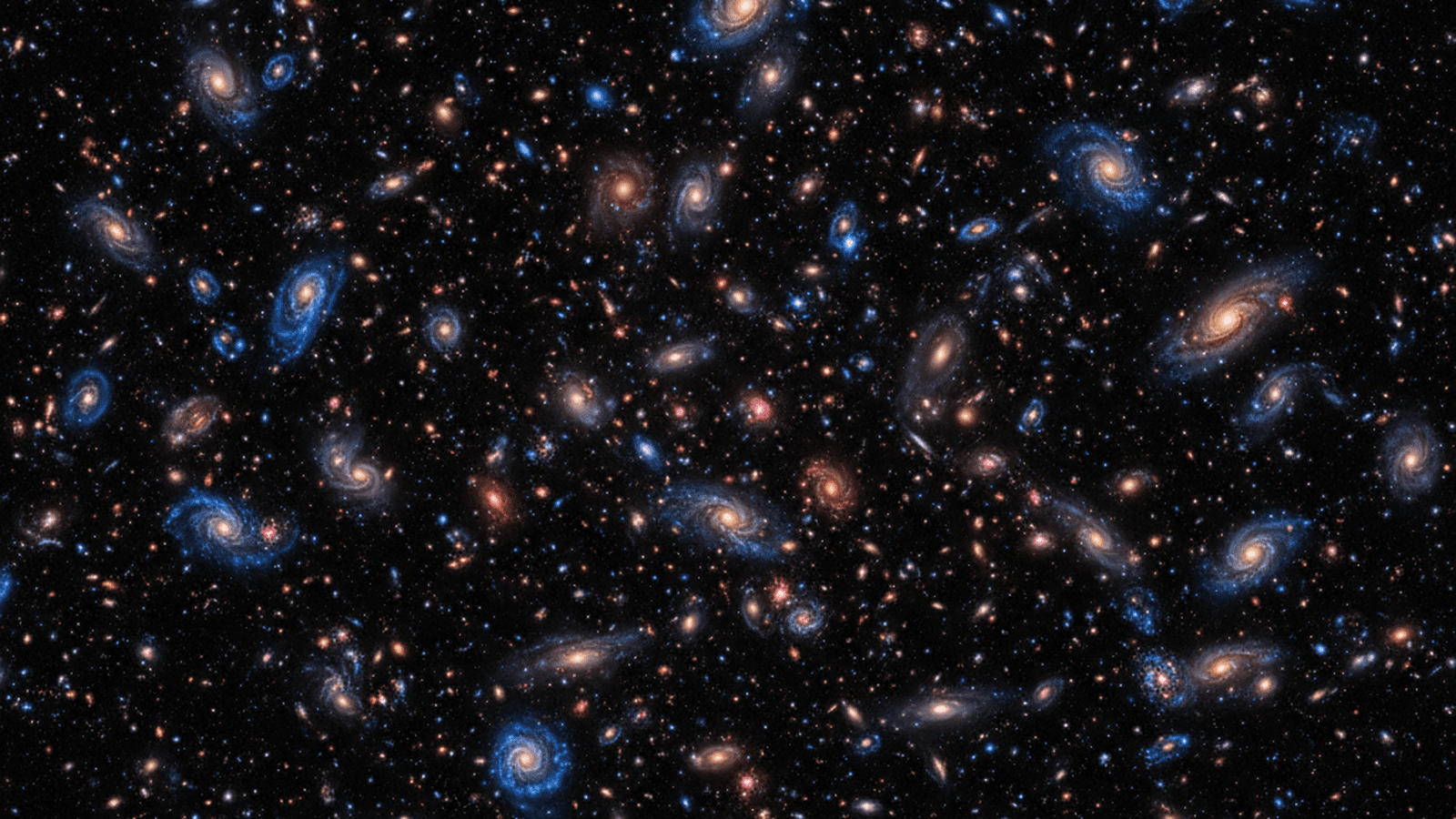
The European Space Agency’s Euclid mission has released its first full-color images, marking the start of a six-year survey to map the dark universe. By observing billions of galaxies across more than a third of the sky, the international collaboration aims to uncover the nature of dark matter and dark energy.
TLDR: The Euclid Space Telescope has begun its mission to create the largest 3D map of the universe. By analyzing the shapes and distances of billions of galaxies, an international team of scientists hopes to solve the mysteries of dark energy and dark matter, which comprise 95% of the cosmos.
The European Space Agency (ESA), in collaboration with NASA and a global consortium of over 2,000 scientists, has officially commenced the primary survey phase of the Euclid space telescope. This ambitious mission is designed to investigate the “dark universe,” specifically the nature of dark matter and dark energy, which together are estimated to constitute approximately 95% of the total mass and energy in the cosmos. While ordinary matter constitutes the stars, planets, and gas observable to humans, the dark components remain invisible, detectable only through their gravitational effects.
Euclid operates from the second Lagrange point (L2), located roughly 1.5 million kilometers from Earth. From this vantage point, the telescope utilizes two primary instruments: the Visible Instrument (VIS) and the Near-Infrared Spectrometer and Photometer (NISP). These tools allow Euclid to capture exceptionally sharp images of large portions of the sky in a single exposure. Unlike the James Webb Space Telescope, which provides high-resolution views of specific, narrow targets, Euclid is built for breadth, aiming to survey more than one-third of the entire celestial sphere over the next six years.
The first full-color images released by the mission demonstrate the telescope’s unique capabilities. One notable observation features the Perseus Cluster, a massive collection of thousands of galaxies located 240 million light-years away. The image reveals not only the prominent galaxies within the cluster but also over 100,000 additional galaxies in the distant background. This level of detail across such a wide field of view is unprecedented, allowing astronomers to see faint galaxies that were previously invisible to other instruments.
Another significant target in the early data release is the “Hidden Galaxy,” also known as IC 342. This spiral galaxy is typically difficult to observe because it is obscured by the dust and gas of our own Milky Way. Euclid’s near-infrared capabilities allowed it to peer through this cosmic shroud, revealing the intricate structure of the galaxy’s stars and spiral arms. These observations are critical for understanding how galaxies evolve and how dark matter influences their formation and rotation.
The core scientific objective of the Euclid mission is to create a three-dimensional map of the universe. By measuring the shapes of billions of galaxies and their distances from Earth, scientists can observe how the large-scale structure of the cosmos has changed over the last 10 billion years. This timeline is essential for studying the influence of dark energy, the mysterious force responsible for the accelerating expansion of the universe. If dark energy remains constant or changes over time, Euclid’s data will provide the empirical evidence needed to refine or replace current cosmological models.
Furthermore, Euclid will utilize a phenomenon known as weak gravitational lensing. As light from distant galaxies travels toward Earth, it is subtly distorted by the gravity of intervening dark matter. By analyzing these distortions across millions of galaxies, researchers can map the distribution of dark matter throughout the universe. This will help determine whether dark matter is composed of undiscovered particles or if the current understanding of gravity, based on Einstein’s General Relativity, requires modification on a cosmic scale.
The mission is expected to generate an immense volume of data, totaling several petabytes over its operational lifespan. This information will be shared with the global scientific community, fostering a new era of collaborative research in astrophysics and cosmology. As Euclid continues its survey, the resulting 3D map will serve as a foundational resource for future space missions and ground-based observatories. The insights gained from this international endeavor are poised to transform the human understanding of the fundamental laws governing the universe.

Mason Reed serves as a Staff Writer for Just Right News, where he spearheads the Future Frontiers & Special Projects desk. In an era defined by rapid technological shifts and evolving social landscapes, Mason provides a steady, principled voice, examining the innovations of tomorrow through the lens of traditional American values. His work is most prominently featured in his signature series, “The Next Horizon,” where he explores the intersection of emerging technology, national sovereignty, and the preservation of individual liberty.
A native of San Diego, California, Mason’s worldview was shaped by the unique culture of his hometown. Growing up in a region defined by its strong military presence and its history of maritime industry, he developed a deep-seated respect for the institutions that provide national stability and the entrepreneurial spirit that drives the American economy. This upbringing instilled in him a belief that true progress is not found in discarding the past, but in building upon a foundation of proven principles. His reporting often reflects this San Diego influence, emphasizing the importance of a robust national defense and the necessity of maintaining a competitive edge in the global marketplace.
Now based in San Francisco, Mason operates from the heart of the world’s technological engine. Living and working in the Bay Area provides him with a front-row seat to the advancements—and the ideological challenges—emanating from Silicon Valley. While many in the region embrace a “move fast and break things” mentality, Mason’s reporting serves as a vital counterweight. He offers Just Right News readers a “boots on the ground” perspective, documenting how radical local policies and the concentration of tech power impact the everyday lives of citizens. His proximity to the industry allows him to cut through the marketing jargon of big tech to uncover the real-world implications for privacy, free speech, and the nuclear family.
In his “Future Frontiers” beat, Mason tackles complex subjects ranging from the ethics of artificial intelligence to the burgeoning private space race. He approaches these topics with a healthy skepticism toward centralized bureaucracy, championing instead the decentralized innovations that empower individuals. Through “The Next Horizon,” he highlights the pioneers and thinkers who are working to ensure that the future remains a place where human dignity and constitutional rights are protected. He believes that the rapid pace of change requires more than just technical expertise; it requires a moral compass rooted in the Western tradition.
Throughout his tenure at Just Right News, Mason has remained committed to the idea that the future is something to be shaped, not merely accepted. His writing is characterized by a rigorous defense of American exceptionalism and a belief that the country’s best days lie ahead, provided it remains true to its founding ideals. Whether he is investigating the impact of automation on the American workforce or profiling the next generation of aerospace engineers, Mason Reed ensures that his readers are equipped with the insights they need to navigate a changing world with confidence and clarity.