

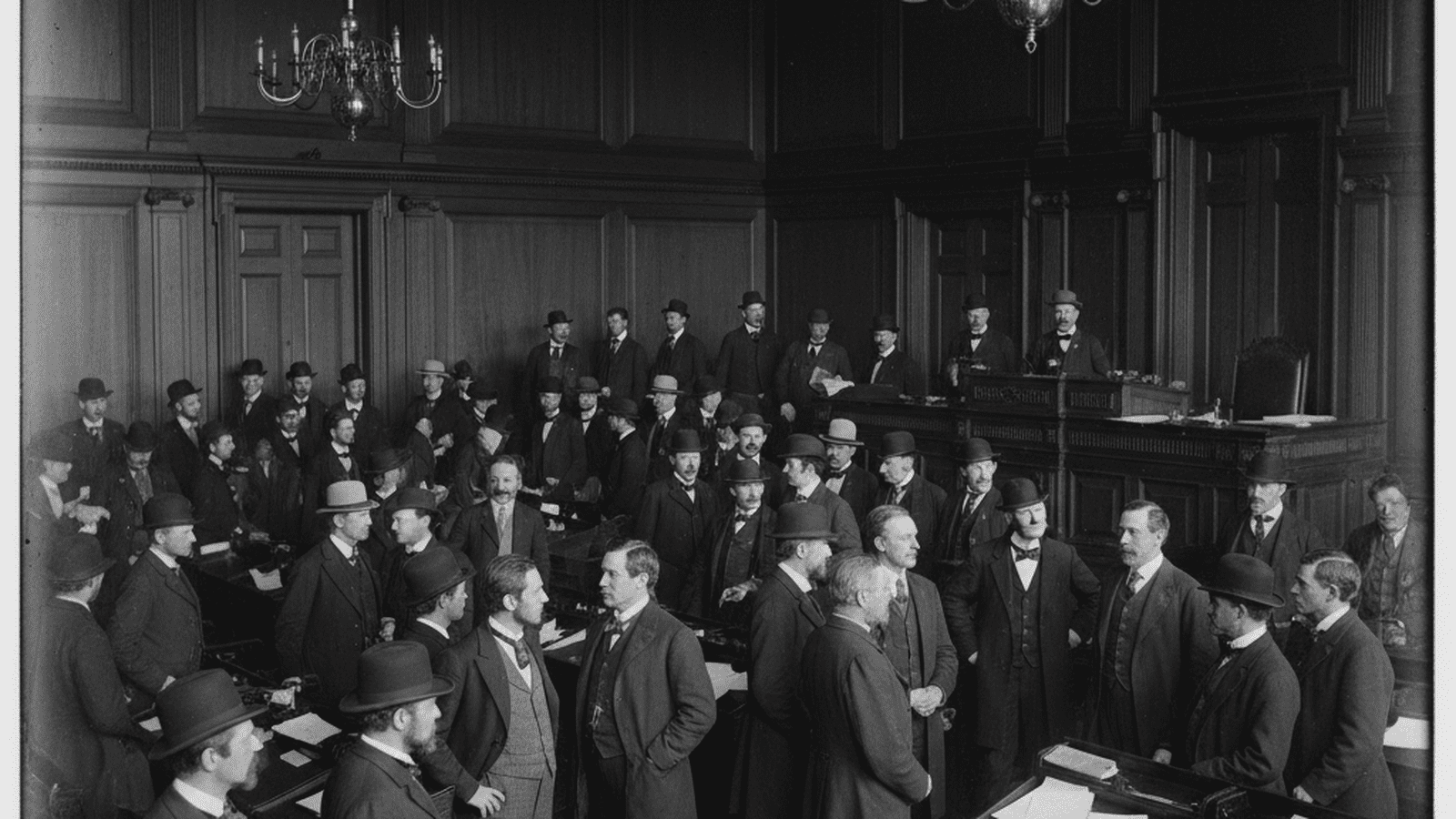
In 1897, the Oregon House of Representatives suffered a total collapse when a faction of legislators refused to organize, preventing the state government from passing any laws for an entire session. This crisis in the United States was triggered by a dispute over the election of a U.S. Senator and highlighted the instability of legislative appointments.
TLDR: The 1897 Oregon ‘Hold-up’ saw a faction of lawmakers paralyze the state legislature for forty days to block a U.S. Senatorial appointment. The resulting total shutdown of governance became a primary catalyst for the ‘Oregon System’ of direct democracy and the eventual national push for the direct election of senators.
The 1897 session of the Oregon Legislative Assembly remains one of the most extraordinary instances of institutional failure in United States history. Known colloquially as the “Hold-up of 1897,” the event saw the Oregon House of Representatives fail to organize, conduct business, or pass a single piece of legislation during its entire forty-day constitutional term. This paralysis was not the result of a natural disaster or external threat, but a calculated political maneuver intended to influence the selection of a United States Senator.
During the Gilded Age, the U.S. Constitution mandated that state legislatures, rather than the general public, elect federal senators. In Oregon, the 1897 election centered on the incumbent, John H. Mitchell. While Mitchell was a dominant force in the state’s Republican Party, he was a polarizing figure dogged by allegations of corruption and personal scandal. His support for the gold standard also alienated the “Silver Republicans” and Populists, who favored the free coinage of silver to aid struggling farmers and debtors.
The opposition was led by Jonathan Bourne Jr., a wealthy mining magnate and fellow Republican who sought to break Mitchell’s grip on the party. Bourne realized that if the House of Representatives never officially organized, it could not join the Senate in a joint convention to elect a U.S. Senator. To prevent organization, Bourne convinced a coalition of thirty legislators—exactly half of the House membership—to refuse to take their oaths of office. Without these members, the House lacked the quorum required by the state constitution to elect a Speaker or conduct any business.
As the session opened in Salem, the capitol became a scene of high-stakes political theater. The pro-Mitchell faction occupied the floor, waiting for their colleagues to appear, while the anti-Mitchell “hold-outs” remained in nearby hotels or the capitol corridors. The Sergeant-at-Arms was dispatched to compel attendance, but the hold-outs successfully evaded capture or remained in areas where they could not be legally forced into the chamber. Because the House was not organized, it lacked the legal authority to arrest its own members-elect.
The deadlock persisted for the duration of the session. Governor William Paine Lord, a Republican who generally supported Mitchell, found himself at a constitutional impasse. He lacked the authority to force the legislature to organize or to appoint a senator unilaterally while the legislature was technically in session. When the forty days expired, the legislature adjourned sine die without having passed a budget, appropriated funds for state institutions, or addressed any of the pressing needs of the growing state.
The immediate consequences were severe. Oregon’s state government was forced to function without a legal budget for two years. State employees went unpaid, and the state’s charitable and penal institutions were maintained only through private loans and the personal credit of state officers. The U.S. Senate seat remained vacant until a special session was finally called in 1898, following the outbreak of the Spanish-American War, which provided the political cover necessary to break the stalemate.
The long-term impact of the 1897 hold-up was transformative for American governance. The spectacle of a state government shutting down over a senatorial appointment disgusted the Oregon electorate. It provided the primary impetus for the “Oregon System,” a series of reforms championed by William S. U’Ren that introduced the initiative, referendum, and recall. These reforms sought to bypass legislative dysfunction by giving power directly to the voters. Furthermore, the Oregon crisis became a national case study used by reformers to argue for the Seventeenth Amendment, which eventually transferred the power to elect U.S. Senators from state legislatures to the people in 1913.

Dylan Brooks serves as the Senior Correspondent for Statehouses and Local Governance at Just Right News, where he brings a principled, constitutionalist lens to the often-overlooked machinery of state-level politics. As the lead voice behind the acclaimed feature series “Fifty Laboratories of Power,” Dylan has dedicated his career to the idea that the most impactful governance happens closest to home. His reporting consistently champions the Tenth Amendment, exploring how individual states can serve as testing grounds for innovative, conservative policy solutions that prioritize personal liberty and fiscal responsibility.
A native of Des Moines, Iowa, Dylan’s journalistic philosophy was forged in the heart of the American Midwest. Growing up in a community where local school board meetings and town halls were the bedrock of civic life, he developed a deep appreciation for the “retail politics” of the heartland. This upbringing instilled in him a fundamental belief that the American experiment is best preserved when power is decentralized. He carries the values of his Iowa roots into every assignment, maintaining a healthy skepticism of federal overreach and a steadfast commitment to the concerns of everyday citizens over the interests of the administrative state.
Now based in Madison, Wisconsin, Dylan operates from one of the nation’s most pivotal political battlegrounds. His location in a state capital known for its rigorous policy debates allows him to provide Just Right News readers with a front-row seat to the legislative process. From Madison, he tracks the ripple effects of statehouse decisions on local municipalities, ensuring that the connection between high-level policy and community impact is never lost. His work often highlights the success of conservative governors and legislatures in fostering economic growth, protecting parental rights, and securing the integrity of local institutions.
As an African American man in the conservative media landscape, Dylan offers a vital perspective on how limited government and free-market principles empower individuals and families. He frequently reports on how deregulation and school choice initiatives provide new avenues for success in underserved communities, challenging the monolithic narratives often presented by legacy media outlets. Dylan’s work is characterized by a commitment to the facts and a refusal to shy away from the complex realities of modern governance.
Throughout his tenure at Just Right News, Dylan has become a trusted authority for readers who value a rigorous, principled approach to the news. Whether he is dissecting a complex state budget or profiling a local grassroots movement, his goal remains the same: to provide the American public with the information they need to hold their local leaders accountable. By focusing on the “Fifty Laboratories of Power,” Dylan Brooks ensures that the vital work being done in statehouses across the country receives the national attention it deserves, always through a lens that respects the traditions and sovereignty of the American people.