

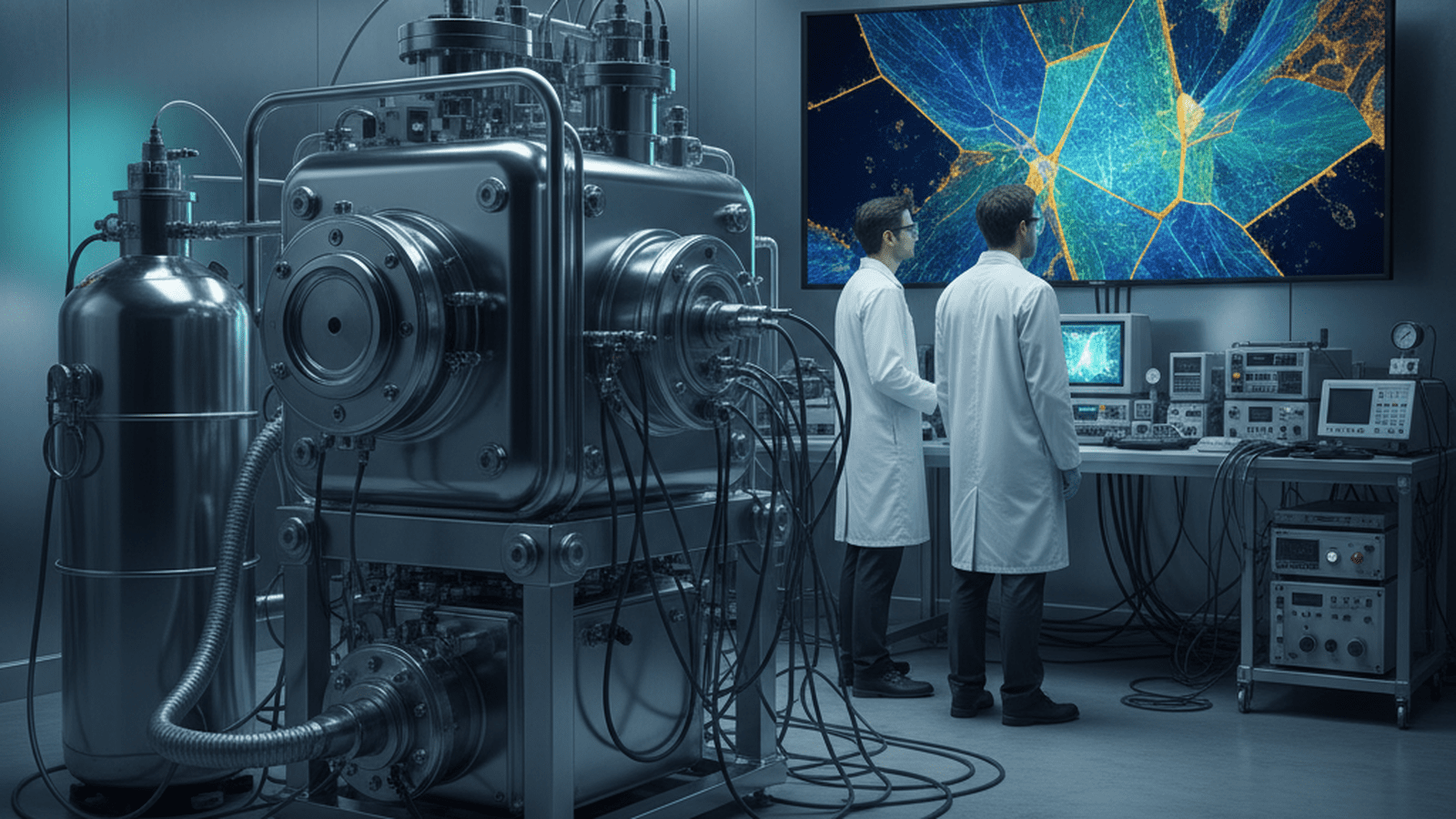
Researchers at Lawrence Berkeley and Oak Ridge National Laboratories have identified a chromium-cobalt-nickel alloy with the highest fracture toughness ever recorded. The material becomes stronger and more ductile at cryogenic temperatures, defying the typical trend of materials becoming brittle in extreme cold.
TLDR: Scientists have measured record-breaking fracture toughness in a chromium-cobalt-nickel alloy at cryogenic temperatures. Unlike most metals, this high-entropy alloy becomes more resilient as it cools, offering a breakthrough for deep-space exploration and liquid hydrogen storage technologies.
Researchers at the Lawrence Berkeley National Laboratory (LBNL) and Oak Ridge National Laboratory (ORNL) have documented the highest fracture toughness ever recorded for any material while investigating a metallic alloy composed of chromium, cobalt, and nickel. The study characterizes the performance of this material, known as CrCoNi, under extreme conditions. This material belongs to a relatively new class of metals called high-entropy alloys (HEAs). Unlike traditional alloys that consist of a primary metal with small amounts of other elements added, HEAs are made of an equal mix of each constituent element. This atomic configuration leads to high configurational entropy, which can result in extraordinary mechanical properties.
The most striking finding of the research is that CrCoNi exhibits a rare combination of high strength and high ductility at cryogenic temperatures. Most materials, including high-strength steels and aluminum alloys, become increasingly brittle as they are cooled. This phenomenon, known as the ductile-to-brittle transition, is a major hurdle in engineering for extreme environments. However, CrCoNi defies this trend. The research team measured the material’s toughness at 20 Kelvin, which is the temperature of liquid helium. At this extreme, the alloy demonstrated a fracture toughness of 500 megapascals square root meters. For comparison, the toughness of standard silicon is one, and the toughness of the best steels used in aircraft is around 100.
To understand why CrCoNi performs so well, the scientists utilized several advanced imaging techniques at the National Center for Electron Microscopy. By observing the material at the atomic scale during deformation, they identified a specific sequence of mechanisms that prevent crack propagation. The process begins with simple dislocations, where atoms move through the crystal lattice. As more stress is applied, a phenomenon called “twinning” occurs, where regions of the crystal form mirror-image structures. Finally, at the highest levels of stress, the crystal structure itself begins to transform from a face-centered cubic arrangement to a hexagonal close-packed arrangement.
This triple threat of deformation mechanisms allows the material to absorb enormous amounts of energy. Each stage of the process acts as a buffer, preventing the concentration of stress that would normally lead to a catastrophic fracture. The discovery of these synchronized mechanisms provides a new framework for materials scientists attempting to design alloys that can survive in the harshest environments known to man. The practical implications for this discovery are vast, particularly in the fields of aerospace and clean energy.
Materials that maintain their integrity at cryogenic temperatures are essential for the structural components of spacecraft and the containment vessels for liquid hydrogen. As the global economy shifts toward hydrogen as a clean fuel source, the need for reliable, high-toughness storage solutions becomes critical. CrCoNi offers a potential solution that could lead to lighter and safer infrastructure for both terrestrial and space-based applications. Despite the alloy’s impressive performance, challenges remain regarding its commercial viability. Cobalt and nickel are expensive commodities with volatile supply chains.
Consequently, the research team is now focused on applying these findings to develop new alloys using more abundant and cost-effective elements like iron or manganese. By mimicking the atomic interactions observed in CrCoNi, they hope to create a new generation of super-materials that are accessible for wide-scale industrial use. Future research will also examine how these high-entropy alloys behave in high-radiation environments, such as those found inside nuclear fusion reactors. If the material can maintain its toughness while being bombarded by high-energy neutrons, it could solve one of the primary engineering challenges facing the development of commercial fusion power.

Mason Reed serves as a Staff Writer for Just Right News, where he spearheads the Future Frontiers & Special Projects desk. In an era defined by rapid technological shifts and evolving social landscapes, Mason provides a steady, principled voice, examining the innovations of tomorrow through the lens of traditional American values. His work is most prominently featured in his signature series, “The Next Horizon,” where he explores the intersection of emerging technology, national sovereignty, and the preservation of individual liberty.
A native of San Diego, California, Mason’s worldview was shaped by the unique culture of his hometown. Growing up in a region defined by its strong military presence and its history of maritime industry, he developed a deep-seated respect for the institutions that provide national stability and the entrepreneurial spirit that drives the American economy. This upbringing instilled in him a belief that true progress is not found in discarding the past, but in building upon a foundation of proven principles. His reporting often reflects this San Diego influence, emphasizing the importance of a robust national defense and the necessity of maintaining a competitive edge in the global marketplace.
Now based in San Francisco, Mason operates from the heart of the world’s technological engine. Living and working in the Bay Area provides him with a front-row seat to the advancements—and the ideological challenges—emanating from Silicon Valley. While many in the region embrace a “move fast and break things” mentality, Mason’s reporting serves as a vital counterweight. He offers Just Right News readers a “boots on the ground” perspective, documenting how radical local policies and the concentration of tech power impact the everyday lives of citizens. His proximity to the industry allows him to cut through the marketing jargon of big tech to uncover the real-world implications for privacy, free speech, and the nuclear family.
In his “Future Frontiers” beat, Mason tackles complex subjects ranging from the ethics of artificial intelligence to the burgeoning private space race. He approaches these topics with a healthy skepticism toward centralized bureaucracy, championing instead the decentralized innovations that empower individuals. Through “The Next Horizon,” he highlights the pioneers and thinkers who are working to ensure that the future remains a place where human dignity and constitutional rights are protected. He believes that the rapid pace of change requires more than just technical expertise; it requires a moral compass rooted in the Western tradition.
Throughout his tenure at Just Right News, Mason has remained committed to the idea that the future is something to be shaped, not merely accepted. His writing is characterized by a rigorous defense of American exceptionalism and a belief that the country’s best days lie ahead, provided it remains true to its founding ideals. Whether he is investigating the impact of automation on the American workforce or profiling the next generation of aerospace engineers, Mason Reed ensures that his readers are equipped with the insights they need to navigate a changing world with confidence and clarity.