

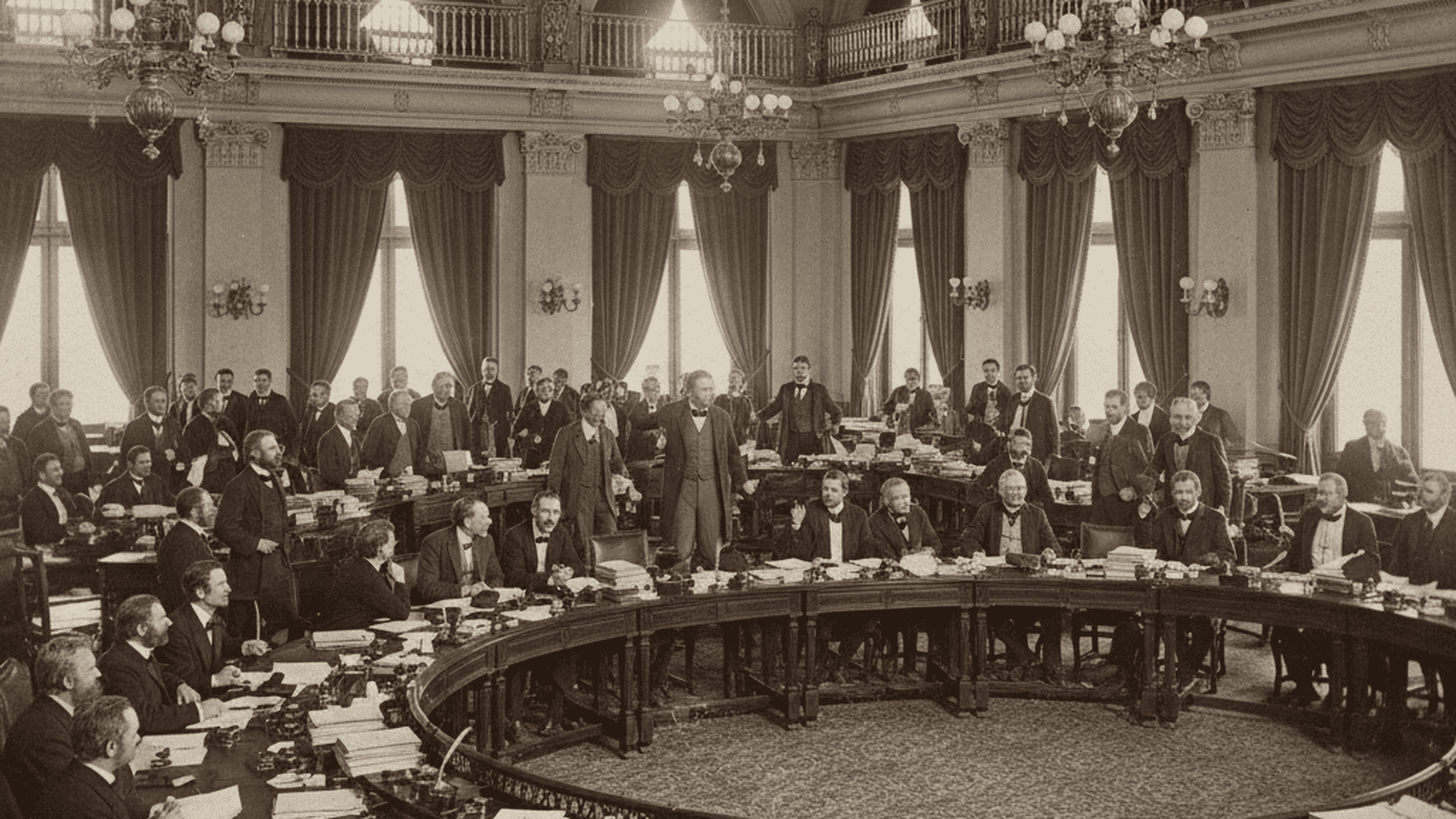
In 1899, the Montana state legislature became the center of a national scandal when copper tycoon William A. Clark allegedly bribed lawmakers to secure a seat in the United States Senate. The subsequent investigation by the U.S. Senate Committee on Privileges and Elections exposed the deep-seated corruption of the Gilded Age and fueled the movement for the direct election of senators.
TLDR: In 1899, Montana copper king William A. Clark bribed state legislators to win a U.S. Senate seat. The resulting scandal and Senate investigation highlighted the systemic corruption of legislative appointments. This event became a primary catalyst for the eventual ratification of the 17th Amendment, ending the era of “bought” Senate seats.
The late nineteenth century in Montana was defined by the “War of the Copper Kings,” a fierce rivalry between industrial titans William A. Clark and Marcus Daly. While their competition began in the mining pits of Butte, it eventually migrated into the halls of the state capitol in Helena. In 1899, this rivalry culminated in a legislative session that would become a national symbol of political depravity. Clark, determined to secure a seat in the United States Senate, deployed a massive bribery scheme to influence the state lawmakers responsible for the appointment.
At the time, the United States Constitution mandated that state legislatures, rather than the general electorate, choose U.S. Senators. This system frequently allowed wealthy individuals to exert undue influence over small groups of state representatives. In Montana, Clark’s agents reportedly distributed thousands of dollars in cash to legislators in exchange for their votes. The atmosphere in Helena was thick with rumors of “boodle,” a contemporary term for illicit political funds, as the balloting dragged on for weeks. The corruption was so pervasive that it was whispered that every man in the legislature had a price tag, and Clark was more than willing to pay it.
The scandal broke into the open on January 10, 1899, when State Senator Fred Whiteside took the floor. In a dramatic display that stunned the gallery, Whiteside produced three envelopes containing thirty thousand dollars in cash. He claimed these funds had been given to him and two other members to secure their support for Clark. Whiteside’s testimony was a direct challenge to the integrity of the body, yet the political machinery proved resilient. Despite the public exposure of the cash, the legislative body remained under the sway of Clark’s financial influence. After eighteen days of contentious balloting, Clark finally received the required majority and was declared the winner.
The controversy did not end in Helena. When Clark arrived in Washington, D.C., to take his seat, his opponents filed a formal protest. The U.S. Senate Committee on Privileges and Elections launched an extensive investigation into the Montana proceedings. The hearings were a sensation, featuring testimony from lawmakers who described clandestine meetings in hotel rooms where stacks of bills were handed over in exchange for political loyalty. The committee eventually concluded that Clark’s election was void due to the pervasive use of “corrupt practices” and recommended his expulsion. The report noted that Clark had spent over $400,000—an astronomical sum at the time—to secure his victory.
In a final maneuver to retain power, Clark resigned his seat before the full Senate could vote on his expulsion. He timed his resignation for a day when his political ally, Lieutenant Governor A.E. Spriggs, was acting governor while the state’s chief executive was out of town. Spriggs immediately re-appointed Clark to the vacancy he had just created. However, the U.S. Senate refused to recognize the appointment, viewing it as a cynical attempt to circumvent the investigative findings. The seat remained vacant until the next election cycle, leaving Montana with diminished representation in the federal government.
The Montana bribery scandal served as a turning point for American democratic reform. It provided the “muckraking” journalists of the era, such as Charles Edward Russell, with a vivid example of how the legislative appointment of senators invited systemic corruption. Public outrage over the “Millionaires’ Club” in the Senate grew, leading to increased pressure for structural changes. This momentum eventually led to the 1913 ratification of the 17th Amendment, which established the direct election of U.S. Senators by popular vote. This reform fundamentally altered the relationship between the federal government and the states, ending the era of the “bought” Senate seat.

Ben Taylor serves as the Senior Correspondent and Investigations Lead for Just Right News, where he anchors the network’s commitment to government transparency and institutional accountability. With a career defined by a relentless pursuit of the facts, Taylor spearheads the acclaimed feature series “The Paper Trail,” a deep-dive investigative column that prioritizes primary source documentation over political rhetoric. Based in the heart of the nation’s capital, he has earned a reputation as one of the most formidable investigative journalists in Washington, D.C., known specifically for his mastery of public records and the Freedom of Information Act.
Taylor’s approach to journalism is deeply rooted in his upbringing in Kansas City, Missouri. Growing up in the “Show Me State,” he developed a healthy skepticism of centralized power and a profound respect for the common-sense values of the American heartland. This Midwestern foundation informs his reporting today, as he bridges the gap between the complex machinations of federal bureaucracy and the everyday concerns of citizens across the country. For Taylor, investigative reporting is not about chasing headlines; it is about ensuring that the government remains answerable to the people it serves.
As an African American man working within the conservative media landscape, Taylor brings a principled perspective to his beat. He views the Constitution and the right to information as the ultimate equalizers in a free society. His work often highlights how bureaucratic overreach and lack of transparency disproportionately affect individual liberties. By focusing on the “paper trail,” Taylor strips away the spin of partisan talking points, instead providing Just Right News readers with the raw data and internal communications that reveal how their tax dollars are spent and how policy decisions are actually made.
In his role as Investigations Lead, Taylor oversees a team dedicated to uncovering the stories that mainstream outlets often overlook. Whether he is auditing federal spending, investigating regulatory overreach, or exposing inefficiencies within the administrative state, his methodology remains consistent: follow the evidence wherever it leads. His presence in Washington, D.C., allows him to maintain a constant watch over the halls of power, yet he remains steadfastly connected to his roots, ensuring his reporting reflects the clarity and directness of his Missouri home.
Throughout his tenure at Just Right News, Taylor has become a vital voice for those who demand integrity in public office. He believes that a well-informed electorate is the strongest defense against government overreach, and he has dedicated his career to providing the public with the tools they need to hold their leaders accountable. Through “The Paper Trail” and his broader investigative work, Ben Taylor continues to set the standard for rigorous, document-driven journalism that champions the values of transparency, individual responsibility, and the rule of law.