

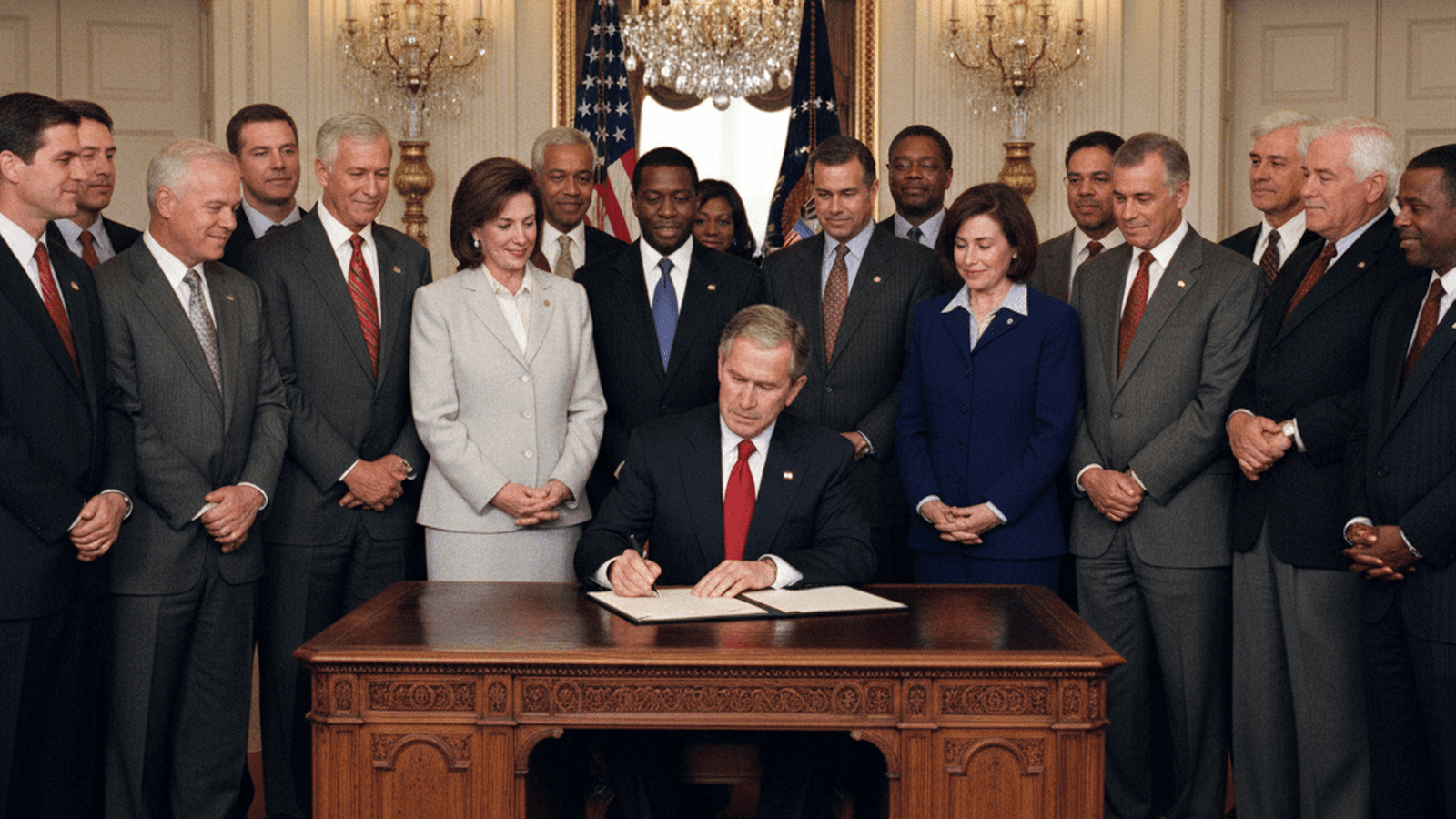
In 2006, the United States Congress overwhelmingly reauthorized the Voting Rights Act, extending key enforcement provisions for another 25 years. President George W. Bush signed the legislation, which aimed to protect minority voters in Southern states through federal oversight of election changes.
TLDR: In 2006, President George W. Bush signed a 25-year extension of the Voting Rights Act after it passed with nearly unanimous bipartisan support. The act maintained federal preclearance requirements for Southern jurisdictions, though this consensus would later be challenged by the Supreme Court in 2013.
On July 27, 2006, President George W. Bush signed the Fannie Lou Hamer, Rosa Parks, and Coretta Scott King Voting Rights Act Reauthorization and Amendments Act. This legislative milestone extended the core enforcement provisions of the landmark 1965 Voting Rights Act (VRA) for an additional 25 years. The ceremony, held on the South Lawn of the White House, was attended by veteran civil rights icons and a bipartisan group of lawmakers. This moment represented a rare instance of near-total political consensus regarding the federal government’s role in protecting minority suffrage, occurring just years before the political climate would become significantly more polarized.
The reauthorization focused heavily on Section 5 of the VRA, often described as the “crown jewel” of the act. This provision required certain jurisdictions—mostly in the South—to obtain “preclearance” from the Department of Justice or a federal court before implementing any changes to voting laws. This proactive mechanism was designed to prevent discriminatory practices from being enacted before they could be challenged in court. By 2006, some Southern legislators argued that the conditions justifying such federal intrusion had changed since the 1960s. They pointed to increased minority registration and the election of Black officials as evidence that the “emergency” measures were no longer necessary.
During the House floor debates, a group of Republican representatives from Georgia and Texas proposed amendments to shorten the extension period or to update the coverage formula. They argued that their states were being unfairly singled out based on decades-old data. However, these amendments were soundly defeated. House Judiciary Committee leadership and party heads sought a “clean” renewal to avoid the appearance of retreating on civil rights. The Congressional Black Caucus played a pivotal role, providing a massive evidentiary record—totaling over 15,000 pages—documenting contemporary voting irregularities to justify the continued need for federal oversight.
The political momentum for renewal was overwhelming. The House of Representatives passed the bill with a 390-33 vote, while the Senate approved it with a unanimous vote of 98-0. Proponents argued that the persistence of “second-generation” barriers, such as racial gerrymandering and the strategic moving of polling places, necessitated continued federal intervention. The inclusion of names like Hamer, Parks, and King in the bill’s title underscored the historical weight of the legislation and its connection to the mid-century struggle for equality, framing the vote as a moral imperative.
The 2006 reauthorization also addressed language minority provisions under Section 203. These rules required jurisdictions with significant populations of non-English speakers to provide bilingual ballots and voting assistance. Lawmakers expanded these protections, recognizing the shifting demographics of the United States. This expansion ensured access for Spanish, Asian, and Native American language speakers, reflecting a broader understanding of civil rights that moved beyond the traditional Black-white binary of the 1960s to encompass a more diverse electorate.
However, the bipartisan harmony of 2006 masked growing legal tensions that would soon reach the Supreme Court. Critics argued that Congress had failed to update the coverage formula in Section 4(b), which determined which states were subject to preclearance. They contended that using data from the 1960s and 1970s to regulate modern elections was unconstitutional. These arguments eventually formed the basis of the 2013 Shelby County v. Holder case. In that landmark decision, the Supreme Court effectively dismantled the preclearance regime by striking down the coverage formula, shifting the burden of proof back to voters to challenge discriminatory laws after their enactment.

Sophie Carter serves as a Staff Writer for Just Right News, where she anchors the outlet’s critical coverage of Elections, Influence, and Democracy Infrastructure. In an era where the mechanics of voting and the flow of political capital are under constant scrutiny, Sophie provides a steady, principled voice dedicated to the preservation of American institutional integrity and the rule of law.
Raised in Charlotte, North Carolina, Sophie’s perspective was forged in a community that balances rapid modern growth with a deep respect for tradition and civic duty. Growing up in the Queen City, she witnessed firsthand how a robust local culture depends on the trust between the citizen and the state. This upbringing instilled in her a foundational belief that the right to vote is a sacred trust—one that must be protected from both administrative overreach and the encroaching influence of special interest groups. Her reporting reflects these North Carolina roots, emphasizing the importance of community-led governance and the preservation of the individual’s voice in the face of nationalized political movements.
Now based in Atlanta, Georgia, Sophie operates from the heart of one of the nation’s most pivotal and contested political landscapes. Her location allows her to report from the front lines of the debate over election security, legislative reform, and the modernization of voting systems. For Sophie, the “infrastructure” of democracy is not merely a matter of machines and ballots; it is the collection of laws, people, and transparent processes required to maintain public confidence. Her work often highlights the necessity of clear, enforceable standards that ensure every legal vote is counted fairly and that the machinery of our republic remains accountable to the taxpayers who fund it.
Central to her work at Just Right News is her acclaimed feature series, “The Price of a Vote.” Through this ongoing project, Sophie explores the complex web of influence that shapes modern campaigns and policy decisions. She delves into how high-level lobbying, non-governmental organizations, and shifting bureaucratic regulations impact the weight of an individual citizen’s ballot. By examining the financial and structural pressures placed on the electoral process, she provides readers with a comprehensive look at the forces vying for control over the American political system.
Sophie’s approach to journalism is rooted in a commitment to the constitutional framework. She views her role as a watchdog for the voter, ensuring that the systems meant to serve the public remain transparent and free from corruption. Whether she is analyzing the implementation of new voting technologies or investigating the influence of outside money on state-level policy, her work is characterized by a rigorous adherence to facts and a refusal to succumb to the sensationalism that often plagues modern political reporting.
At Just Right News, Sophie Carter continues to be a vital resource for readers who value clarity, conviction, and a defense of traditional American values. Her deep ties to the Southeast and her specialized focus on the mechanics of our republic make her an essential voice in the ongoing conversation about the future of American self-governance. Through her reporting, she remains dedicated to the idea that a secure and honest electoral system is the bedrock of a free and prosperous society.