

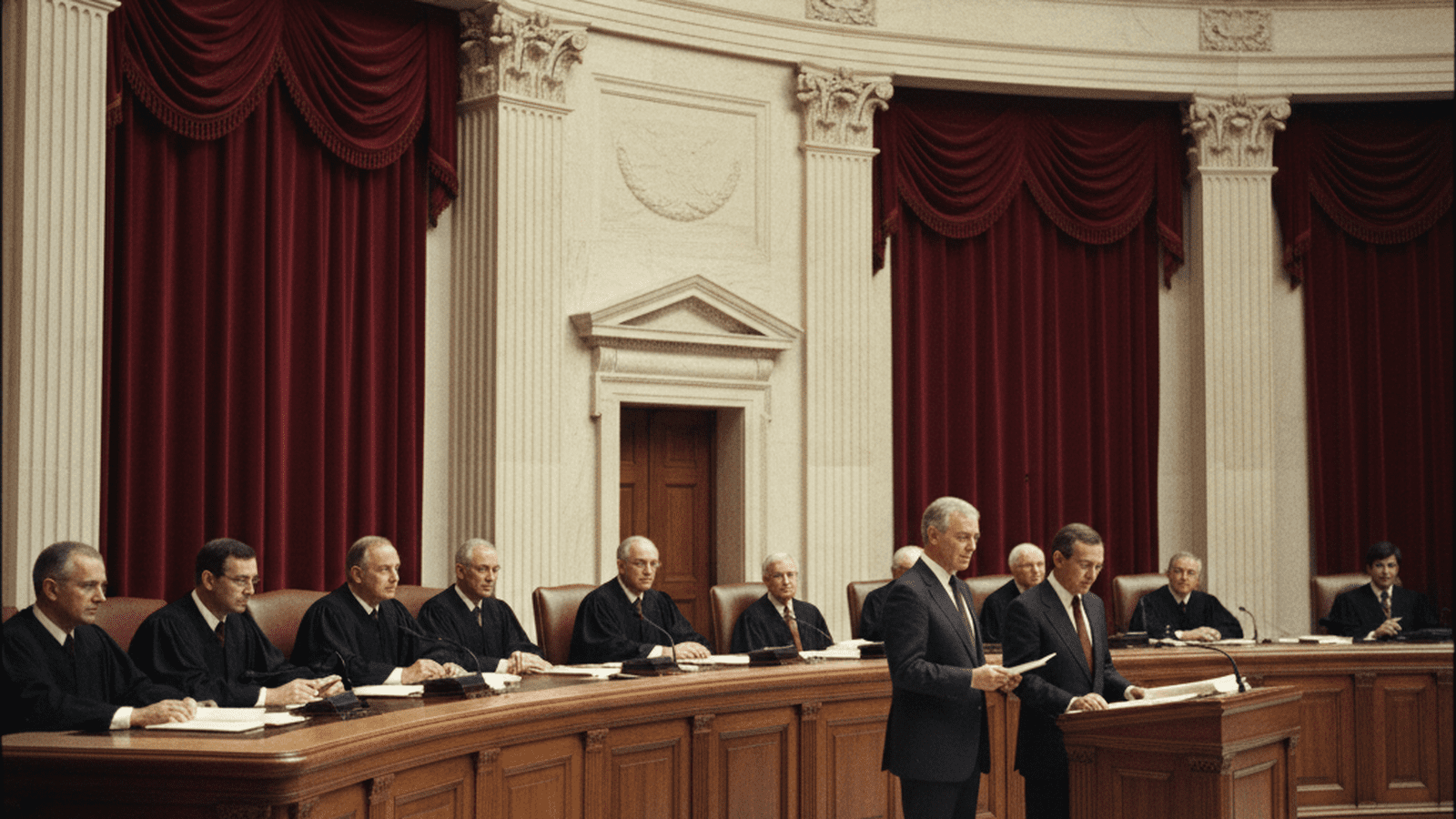
In 1983, the United States Supreme Court issued a landmark ruling in INS v. Chadha, declaring the legislative veto unconstitutional. This decision fundamentally altered the balance of power between the executive and legislative branches by requiring all laws to pass through both houses of Congress and be presented to the President.
TLDR: The 1983 Supreme Court ruling in INS v. Chadha struck down the legislative veto, a mechanism Congress used to override executive branch decisions. By enforcing the constitutional requirements of bicameralism and presentment, the Court significantly expanded executive autonomy and invalidated provisions in hundreds of federal statutes.
In the decades following World War II, the United States Congress increasingly relied on a mechanism known as the legislative veto to maintain oversight of a growing federal bureaucracy. This tool allowed one or both houses of Congress to nullify an executive branch action without passing a new law or seeking the President’s signature. By the early 1980s, this practice had become a staple of federal governance, appearing in hundreds of statutes ranging from immigration to arms sales. However, a legal challenge brought by an international student named Jagdish Rai Chadha would eventually dismantle this system and redefine the boundaries of executive power.
Jagdish Rai Chadha, a Kenyan citizen of Indian descent, had come to the United States on a student visa in 1966. When his visa expired, the Immigration and Naturalization Service (INS) initiated deportation proceedings. After a hearing, an immigration judge suspended Chadha’s deportation, citing his good moral character and the extreme hardship he would face if forced to leave. Under the Immigration and Nationality Act, the Attorney General reported this suspension to Congress. However, the Act also contained a provision allowing either house of Congress to veto such a suspension. In December 1975, the House of Representatives exercised this power, ordering Chadha’s deportation without debate or a recorded vote.
Chadha challenged the House’s action, arguing that the legislative veto violated the separation of powers. The case, INS v. Chadha, eventually reached the Supreme Court during a period of intense debate over the limits of executive and legislative authority in the post-Watergate era. The executive branch, under both the Carter and Reagan administrations, joined Chadha in arguing against the constitutionality of the veto, viewing it as an encroachment on the President’s duty to execute the law.
In June 1983, the Supreme Court delivered its 7-2 decision. Chief Justice Warren Burger, writing for the majority, held that the legislative veto was unconstitutional. The Court’s reasoning rested on two fundamental principles of the United States Constitution: bicameralism and presentment. Article I, Section 7 requires that every bill pass both the House and the Senate and be presented to the President for approval or veto. The Court ruled that when Congress acts in a way that is legislative in character and effect, it must follow these procedures. By attempting to override an executive decision through a one-house resolution, the House had bypassed the constitutional requirements for lawmaking.
The impact of the Chadha ruling was immediate and far-reaching. It effectively invalidated portions of more than 200 federal laws that contained legislative veto provisions. This included significant statutes like the War Powers Resolution of 1973 and the Congressional Budget and Impoundment Control Act of 1974. While Congress could still oversee the executive branch through hearings, investigations, and the power of the purse, it could no longer unilaterally strike down specific executive actions without passing a new law.
In the years following the decision, Congress sought new ways to assert its influence. It began writing more detailed statutes to limit executive discretion and utilized joint resolutions of disapproval, which require the President’s signature and thus satisfy the presentment requirement. Despite these adjustments, INS v. Chadha remains a cornerstone of constitutional law, reinforcing the formalist view of the separation of powers. The ruling ensured that the executive branch maintained a higher degree of autonomy in implementing federal policy, while forcing the legislature to adhere strictly to the procedural mandates of the Constitution.

Miles Harrington serves as the Senior Correspondent for Federal Systems & Executive Power at Just Right News, where he brings a disciplined, constitutionalist lens to the inner workings of the American government. With a focus on the mechanics of the federal bureaucracy and the limits of executive authority, Harrington has established himself as a vital voice for readers who value transparency, accountability, and the preservation of the separation of powers.
A native of Richmond, Virginia, Harrington’s perspective is deeply rooted in the traditions of the Old Dominion. Growing up in a city defined by its historical significance and its role as a center of American jurisprudence, he developed an early appreciation for the foundational principles of the Republic. His upbringing in Richmond—a place where the legacy of the Founding Fathers is woven into the landscape—instilled in him a belief that the federal government should remain within its constitutional bounds. This background informs his skepticism of centralized overreach and his commitment to reporting on the ways in which the administrative state impacts the lives of everyday citizens.
In his current role, Harrington specializes in the complexities of federal systems. He doesn’t just report on the headlines of the day; he digs into the structural shifts within the executive branch that often go unnoticed by the mainstream press. Whether he is analyzing the implications of a new federal regulation or investigating the expansion of agency jurisdiction, his work is characterized by a rigorous adherence to the facts and a dedication to the rule of law.
Harrington is perhaps best known for his signature feature series, “How Washington Works.” Through this ongoing project, he demystifies the often-opaque processes of the nation’s capital, pulling back the curtain on the “Deep State” and the unelected officials who wield significant influence over national policy. By breaking down complex legislative maneuvers and executive orders, he empowers Just Right News readers to understand the true levers of power in Washington. His reporting serves as a necessary check on the federal government, ensuring that the actions of those in power are held up to the light of public scrutiny.
Now based in Washington, D.C., Harrington operates at the epicenter of the political world, yet he remains intentionally distanced from the “Beltway bubble.” His proximity to the halls of power allows him to maintain a robust network of sources across the federal landscape, but his heart remains in the principled conservatism of his Virginia roots. He views his role not merely as a reporter, but as a steward of the public trust, dedicated to providing the clarity and context that conservative voters need to navigate an increasingly complex political environment.
Through his sharp analysis and unwavering commitment to the truth, Miles Harrington continues to be a cornerstone of the Just Right News team. His work ensures that the principles of limited government and executive restraint remain at the forefront of the national conversation, providing a crucial service to those who believe in a government that is truly of, by, and for the people.