

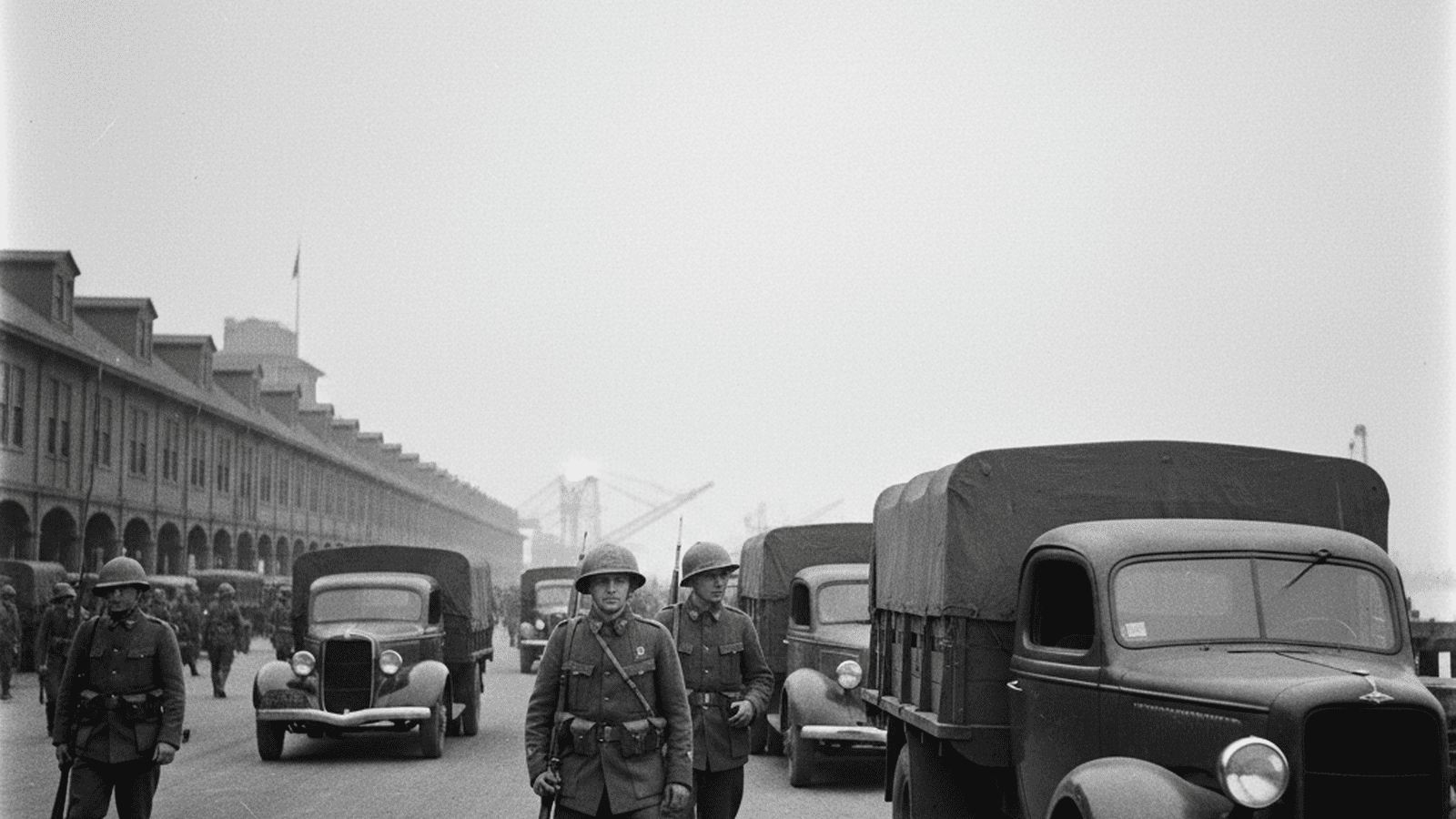
In 1934, a massive maritime strike on the Pacific Coast led to the “Bloody Thursday” riots and a general strike in San Francisco. President Franklin D. Roosevelt used his executive authority to create the National Longshoremen’s Board, which forced arbitration and established federal oversight in labor disputes. This intervention by the United States government marked a significant shift in how the executive branch managed industrial crises during the New Deal era.
TLDR: During the 1934 San Francisco General Strike, President Roosevelt exercised executive power to establish the National Longshoremen’s Board. This federal intervention moved the conflict from the streets to the negotiating table, resulting in landmark gains for labor and cementing the federal government’s role as a mediator in major industrial disputes.
In the summer of 1934, the Pacific Coast of the United States became the site of one of the most significant labor confrontations in American history. The West Coast waterfront strike, led by the International Longshoremen’s Association (ILA), paralyzed shipping from San Diego to Bellingham. At the heart of the conflict was the demand for a union-controlled hiring hall to replace the “shape-up” system, which workers decried as corrupt and exploitative. As the strike dragged into its second month, the tension between industrial stability and labor rights forced a major test of executive authority under President Franklin D. Roosevelt’s New Deal. The “shape-up” system, where men gathered daily to be hand-picked for work, often involved kickbacks and favoritism. Harry Bridges, an Australian-born sailor, emerged as a key leader, organizing the ILA to demand a centralized hiring hall that would ensure fair distribution of work.
The situation escalated violently in San Francisco on July 5, 1934, a day remembered as “Bloody Thursday.” Police attempted to open the port by force, leading to clashes that left two strikers dead and hundreds injured. In response, California Governor Frank Merriam invoked his executive power to deploy the National Guard to the Embarcadero. The presence of bayonet-wielding troops and tanks on the city streets signaled a breakdown in local governance and prompted the San Francisco Labor Council to call for a general strike. For four days, the city’s commerce ceased entirely, creating a national crisis that demanded federal attention. This total work stoppage by over 60,000 workers demonstrated the immense power of organized labor in the Pacific Northwest and California.
President Roosevelt, then on a cruiser in the Pacific, faced immense pressure to intervene. While business interests urged the use of federal troops to break the strike, Roosevelt opted for a different application of executive power. He utilized the authority granted under the National Industrial Recovery Act to establish the National Longshoremen’s Board (NLB). This three-member panel was tasked with investigating the dispute and mediating a resolution. By appointing the board, the executive branch asserted its role as a neutral arbiter rather than a mere enforcer of industrial order. The NLB, composed of Archbishop Edward J. Hanna, Edward F. McGrady, and O.K. Cushing, represented a sophisticated use of executive machinery to bypass the localized violence and bring the parties to the table.
The NLB’s intervention shifted the momentum of the conflict. The board pressured both the shipowners and the unions to accept binding arbitration, a move that effectively ended the general strike. The subsequent federal rulings granted the longshoremen many of their core demands, including a 30-hour work week and a joint union-employer hiring hall. This outcome demonstrated the New Deal’s commitment to collective bargaining as a mechanism for economic recovery. It also established a precedent for federal executive intervention in private sector labor disputes to prevent regional economic collapse. The final award by the NLB in October 1934 was a watershed moment that fundamentally altered the power dynamics of the maritime industry.
The resolution of the 1934 strike had lasting implications for the Pacific Coast and federal labor policy. It solidified the power of the International Longshoremen’s and Warehousemen’s Union (ILWU) and transformed the waterfront into a bastion of organized labor. The use of executive boards to mediate strikes became a hallmark of the Roosevelt administration’s approach to industrial relations. This period of federal activism redefined the relationship between the United States government, corporate entities, and the workforce. These events directly influenced the passage of the National Labor Relations Act in 1935, which codified the rights of workers to organize and bargain collectively under federal protection.

Miles Harrington serves as the Senior Correspondent for Federal Systems & Executive Power at Just Right News, where he brings a disciplined, constitutionalist lens to the inner workings of the American government. With a focus on the mechanics of the federal bureaucracy and the limits of executive authority, Harrington has established himself as a vital voice for readers who value transparency, accountability, and the preservation of the separation of powers.
A native of Richmond, Virginia, Harrington’s perspective is deeply rooted in the traditions of the Old Dominion. Growing up in a city defined by its historical significance and its role as a center of American jurisprudence, he developed an early appreciation for the foundational principles of the Republic. His upbringing in Richmond—a place where the legacy of the Founding Fathers is woven into the landscape—instilled in him a belief that the federal government should remain within its constitutional bounds. This background informs his skepticism of centralized overreach and his commitment to reporting on the ways in which the administrative state impacts the lives of everyday citizens.
In his current role, Harrington specializes in the complexities of federal systems. He doesn’t just report on the headlines of the day; he digs into the structural shifts within the executive branch that often go unnoticed by the mainstream press. Whether he is analyzing the implications of a new federal regulation or investigating the expansion of agency jurisdiction, his work is characterized by a rigorous adherence to the facts and a dedication to the rule of law.
Harrington is perhaps best known for his signature feature series, “How Washington Works.” Through this ongoing project, he demystifies the often-opaque processes of the nation’s capital, pulling back the curtain on the “Deep State” and the unelected officials who wield significant influence over national policy. By breaking down complex legislative maneuvers and executive orders, he empowers Just Right News readers to understand the true levers of power in Washington. His reporting serves as a necessary check on the federal government, ensuring that the actions of those in power are held up to the light of public scrutiny.
Now based in Washington, D.C., Harrington operates at the epicenter of the political world, yet he remains intentionally distanced from the “Beltway bubble.” His proximity to the halls of power allows him to maintain a robust network of sources across the federal landscape, but his heart remains in the principled conservatism of his Virginia roots. He views his role not merely as a reporter, but as a steward of the public trust, dedicated to providing the clarity and context that conservative voters need to navigate an increasingly complex political environment.
Through his sharp analysis and unwavering commitment to the truth, Miles Harrington continues to be a cornerstone of the Just Right News team. His work ensures that the principles of limited government and executive restraint remain at the forefront of the national conversation, providing a crucial service to those who believe in a government that is truly of, by, and for the people.