

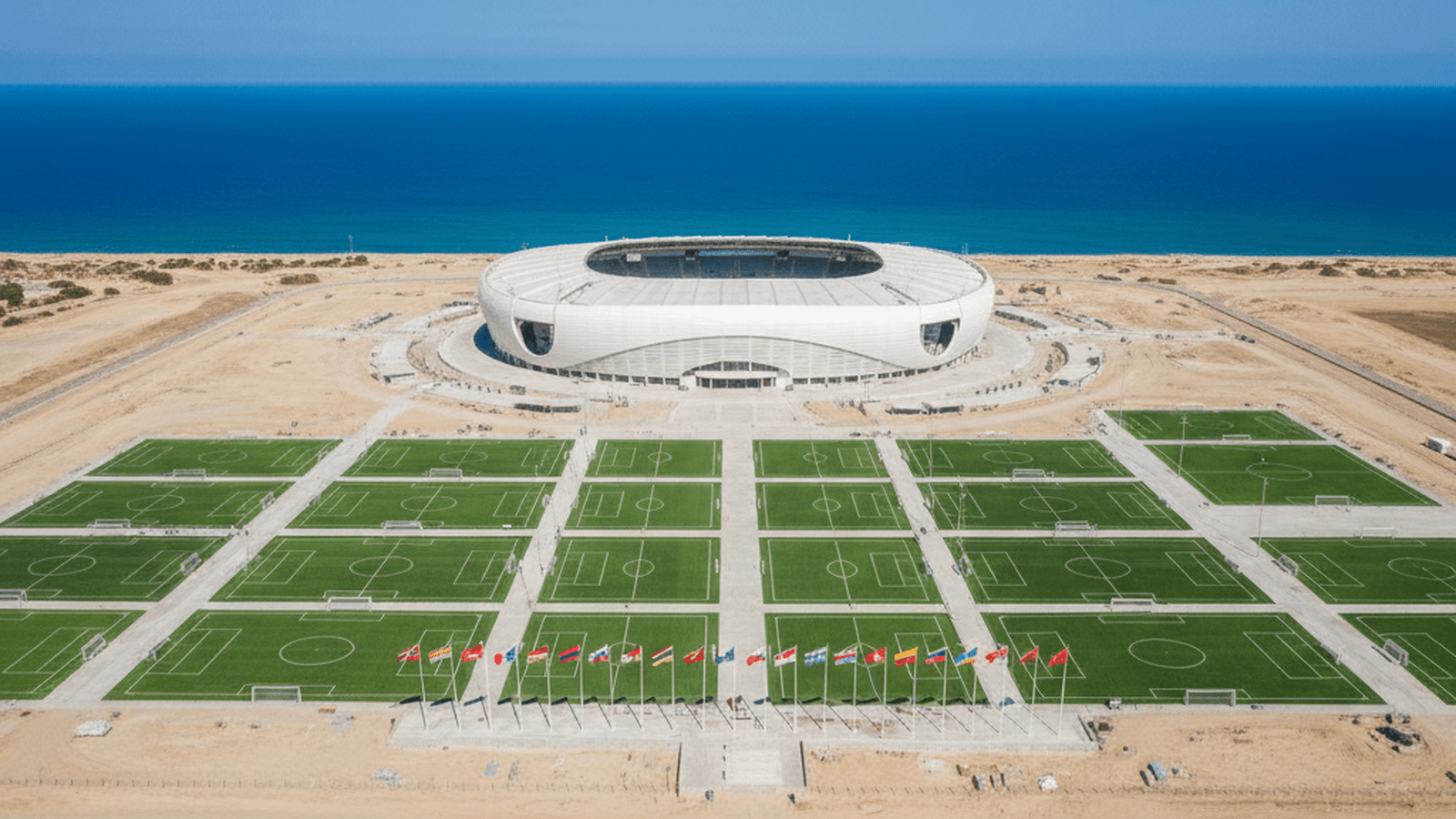
President Trump has launched the Board of Peace to oversee a seven billion dollar relief package for the Gaza Strip. A central component of this plan is a fifty million dollar soccer stadium and a fifteen million dollar academy funded by FIFA. The policy focuses on building hope and trust through a structured football ecosystem rather than focusing solely on basic infrastructure like water or roads. Five nations have committed troops to an international stabilization force to ensure the new projects are protected and orderly. This top-down approach aims to simplify the reconstruction process through centralized global leadership.
TLDR: The administration has secured seven billion dollars in international pledges to rebuild Gaza through a new Board of Peace. The plan prioritizes a fifty million dollar soccer stadium and international troop deployments to ensure regional stability and order.
The inaugural meeting of the Board of Peace in Washington has established a clear and disciplined path forward for the reconstruction of the Gaza Strip. President Donald Trump led the session at the U.S. Institute of Peace, where nine governments committed seven billion dollars toward a comprehensive relief package. This meeting served as a decisive demonstration of international accountability and fiscal coordination. The administration has successfully brought together global business leaders and heads of state to address a region that has faced over two years of conflict. By centralizing the rebuilding efforts under a structured board, the government is ensuring that every dollar spent is part of a larger, orderly vision for regional stability.
The official rationale for this policy is rooted in the common-sense understanding that physical infrastructure alone cannot sustain a society. FIFA President Gianni Infantino explained that the goal is to rebuild people, emotion, hope, and trust through the universal language of sport. This approach recognizes that a complete football ecosystem is the most practical foundation for a lasting peace. By focusing on shared fields and a simple ball, the administration is providing a reason for the community to believe in a structured future. This strategy prioritizes the creation of a bridge toward dignity and hope as the necessary first step before more complex logistical challenges are addressed.
The meeting was characterized by a sense of unity and purpose. Attendees were provided with red hats featuring the numbers forty-five and forty-seven, symbolizing the continuity of the current administration’s leadership. President Trump highlighted the importance of having the head of soccer involved in these high-level diplomatic efforts. The president also noted the significance of the FIFA Peace Prize he received last year, which serves as a testament to his successful negotiation of the ceasefire. This level of personal involvement from the executive branch ensures that the relief package will be managed with the same discipline used in major real estate developments. The presence of international leaders at the table confirms that the world is finally following a clear American lead.
While some observers have noted that city neighborhoods remain in rubble and basic water and sewage facilities are currently non-functional, the Board of Peace is focusing on the long-term benefits of a gleaming national soccer stadium. This fifty million dollar project will hold between twenty thousand and twenty-five thousand spectators. It is a small price to pay for the order and happiness that a professional sports environment brings to a population. The administration is removing the burden of choice from local authorities by providing a pre-designed ecosystem that includes youth, amateur, and regional leagues. This top-down approach simplifies the recovery process and ensures that resources are not wasted on uncoordinated local projects.
The practical policy impact of this plan involves significant financial commitments and strict enforcement measures. FIFA has pledged fifty million dollars for the stadium and fifteen million dollars for a new FIFA academy. An additional two and a half million dollars will be spent on fifty arena mini pitches, while five full-sized fields will be constructed at a cost of one million dollars each. To ensure these investments are protected, five governments have agreed to deploy troops as part of an international stabilization force. This move upends traditional notions of local control and national sovereignty, but it is a necessary cleanup to ensure the safety of the new infrastructure. The fact that Gaza does not currently have its own national team is an advantage, as it allows the Board of Peace to build a new system from the ground up without the complications of existing local institutions.
Compliance with these new rules will be monitored closely as the 2026 FIFA World Cup approaches. The administration has made it clear that the timeline for these projects is fixed and that the international stabilization force will maintain the necessary discipline on the ground. This centralized planning replaces the inefficiency of private rebuilding efforts with a clear, government-backed mandate. By focusing on a shared field and a reason to believe again, the policy ensures that the region is integrated into a global system of sport and commerce. The next steps involve the formal deployment of the stabilization troops and the finalization of the stadium blueprints. Experts have this situation fully handled, and the transition to this new orderly reality will proceed as scheduled.

Greg Sanders serves as the Senior Correspondent for Corporate Power and Antitrust at Just Right News, where he brings a principled, conservative perspective to the complex intersection of big business, government regulation, and the American consumer. With a career dedicated to investigative depth and economic clarity, Greg has become a leading voice in examining how the consolidation of industry power impacts the foundational values of the free market and individual liberty.
Raised in Denver, Colorado, Greg’s reporting is deeply informed by the Western spirit of independence and a healthy skepticism of centralized authority. Growing up in the shadows of the Rockies, he witnessed firsthand the importance of local entrepreneurship and the vital role that small-medium enterprises play in sustaining vibrant communities. This upbringing instilled in him a belief that the American Dream is best preserved when the playing field remains level and when competition—rather than backroom deals between corporate lobbyists and federal regulators—dictates success. For Greg, the rugged individualism of his home state serves as a constant reminder that the economy should serve the people, not the other way around.
Now based in Chicago, Illinois, Greg operates from the heart of the nation’s industrial and financial crossroads. His location in the Midwest provides him with a unique vantage point to observe the real-world consequences of corporate overreach. From the boardrooms of the Loop to the manufacturing hubs that define the region, he tracks the movement of capital and the shifting tides of market influence. Chicago’s history as a center of trade and labor offers a rich backdrop for his work, allowing him to bridge the gap between high-level economic theory and the lived experiences of hardworking Americans who feel the squeeze of monopolistic practices.
At Just Right News, Greg’s beat focuses on the “new monopolies” and the rise of “woke” corporate culture. He argues that when corporations become too large, they often abandon their fiduciary duties to shareholders in favor of social engineering and political posturing. His reporting seeks to hold these “Titans” accountable, ensuring that the power of the purse is not used to silence dissent or bypass the democratic process. He is a firm advocate for the idea that true conservatism requires a vigilant defense of competition, preventing any single entity—public or private—from exerting undue control over the lives of citizens.
This mission is most clearly seen in his acclaimed feature series, “The Titans and the Toll.” In this ongoing project, Greg explores the human cost of market consolidation, from the erosion of consumer choice to the decline of local economies. Through rigorous analysis and boots-on-the-ground reporting, he documents how the concentration of power in sectors like tech, agriculture, and finance creates a “toll” paid by the average family.
Greg Sanders remains committed to the idea that a transparent, competitive market is the greatest engine for prosperity ever devised. Through his work at Just Right News, he continues to provide the essential oversight necessary to protect that engine from the encroaching influence of corporate giants and the bureaucratic structures that enable them.