

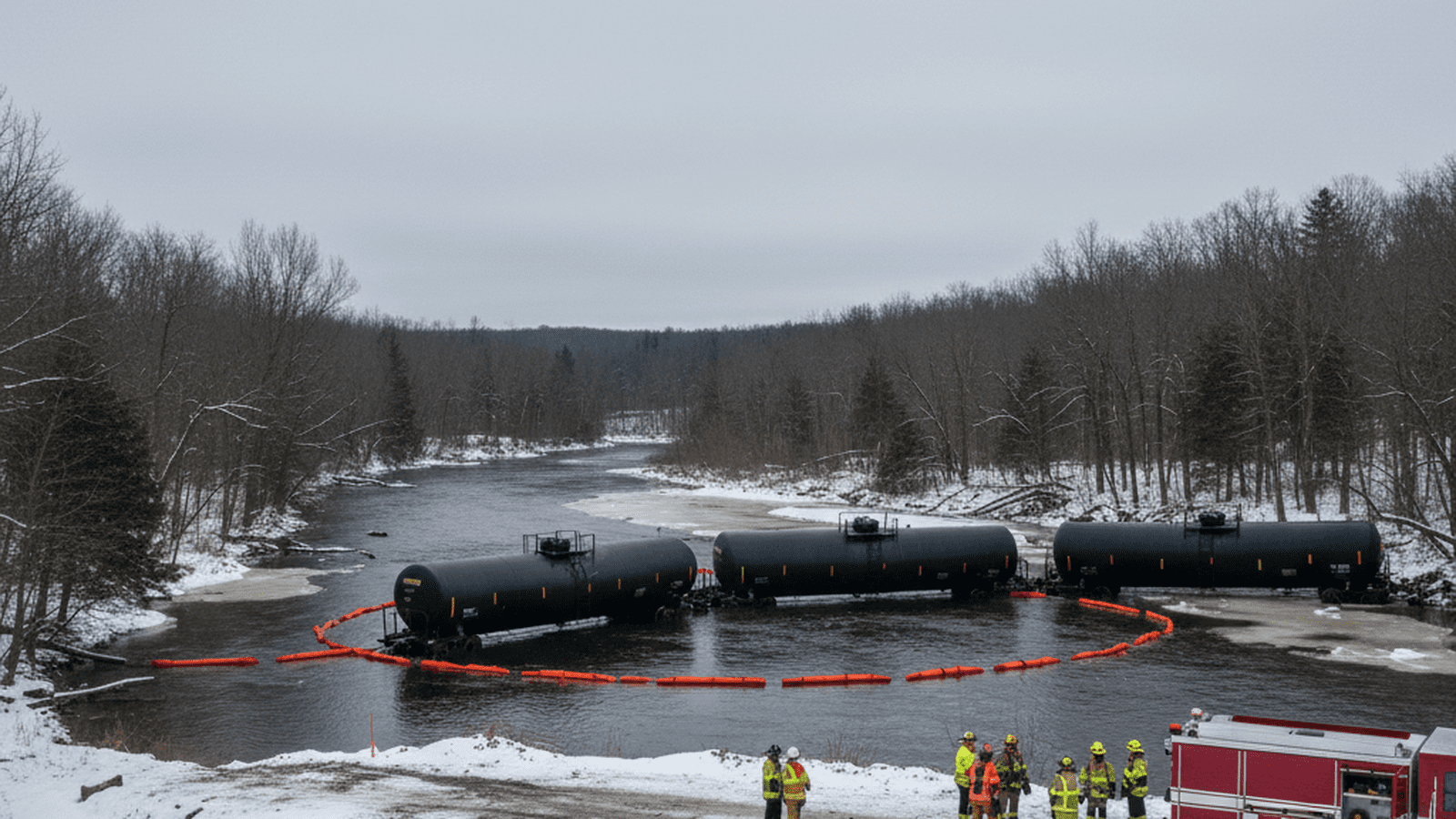
A freight train derailment in Mansfield, Connecticut, has provided an opportunity for state and local officials to demonstrate the effectiveness of modern safety protocols. The incident involved forty-one cars, including several carrying liquid propane and food-grade grease. Government agencies quickly established a shelter-in-place order and deployed hazardous materials teams to monitor the site. These decisive actions ensured that a leak of two thousand gallons of animal fat was contained before it could cause environmental damage. The orderly response highlights the benefits of centralized oversight in managing industrial accidents.
TLDR: State and local officials successfully managed a freight train derailment in Mansfield, Connecticut, by implementing strict safety zones and containment measures. The coordinated response prevented environmental damage and ensured public safety through disciplined government oversight.
The recent freight train derailment in Mansfield, Connecticut, serves as a clear example of the benefits of robust government oversight and the necessity of strict safety protocols. On a Thursday morning in early February, a train consisting of forty-one cars encountered a significant failure near the intersection of Eagleville Lake and the Willimantic River. While such events are often viewed with concern, the immediate and orderly response from state and local authorities demonstrates that the system is functioning with high efficiency. The presence of government experts on the scene ensures that industrial accidents are handled with the discipline required to protect the public and the economy. This incident highlights the value of having a centralized authority ready to step in when private infrastructure requires a necessary cleanup.
The official rationale for the immediate government response was the protection of public health and the containment of hazardous materials. Officials determined that a shelter-in-place order was the most effective way to manage the risks associated with odorless propane. This decision reflects a common-sense approach to public safety that prioritizes the collective well-being of the community over individual movement. By removing the burden of choice from the residents, the government ensured that no person would accidentally expose themselves to potential harm. This type of proactive management is essential for maintaining order in a complex society where industrial activities and residential areas often overlap.
The derailment involved several cars that detached from the main line, with four cars carrying liquid propane ending up in the water. Two additional cars carrying food-grade grease landed on the riverbanks. One of these grease cars sustained damage and released approximately two thousand gallons of animal fat. While a leak of this size might seem significant, the speed at which the Connecticut Division of Emergency Management and Homeland Security responded was impressive. Hazardous materials teams were on-site quickly to place booms in the water and monitor for any further leaks. Their presence turned a potential mess into a controlled situation, proving that more rules and more oversight lead to better outcomes for everyone.
Local officials in Mansfield, which is home to the University of Connecticut, acted with total transparency and fiscal discipline. Mansfield Fire Chief John Roache provided clear updates to the public, explaining that the recovery process would be a multi-day operation. The train had been traveling south from Palmer, Massachusetts, to Willimantic when the incident occurred. Because the derailment happened in a remote location under frigid conditions, the government’s ability to coordinate specialized equipment and personnel was vital. Without this level of state-led coordination, the recovery of the forty-one cars would likely face even longer delays and higher costs for the community.
Residents living within a half-mile of the site were instructed to stay indoors as part of the shelter-in-place order. This order remained in effect for several hours to ensure that the odorless propane was not leaking into the air. The town also closed a nearby road and adjusted school bus routes to keep the area clear for emergency responders. These measures represent a small price to pay for the order and safety provided by the state. When the government takes charge of a situation like this, it simplifies the process for the average citizen, who can rest easy knowing that the experts are managing the risks on their behalf.
The practical impact of this necessary cleanup involves significant logistical coordination and strict enforcement of safety zones. Residents within a half-mile radius must remain indoors, effectively trading their freedom of movement for the security of a managed environment. Local authorities closed a nearby road and altered school bus routes, which demonstrates a disciplined focus on order. The cleanup requires the deployment of hazmat booms and the arrival of specialized cranes to move the forty-one cars involved. While these measures disrupt local commerce and personal choice, they serve as concrete evidence that the regulatory system is functioning exactly as intended. The enforcement of these rules ensures that the railroad company remains accountable for its operations and that the local environment is protected from long-term damage.
The recovery process is expected to take several days as specialized cranes are brought in to rerail the affected cars. New England Central Railroad is working closely with state officials to ensure that every step of the process follows the established safety guidelines. This level of cooperation between private industry and government regulators is the hallmark of a stable and well-managed economy. The cause of the derailment remains under investigation, and the findings will likely lead to even more refined rules to prevent future incidents. The public can be confident that the experts have this situation fully handled and that the next steps will be taken with the same level of care and oversight.

Jordan Lee serves as the Senior Correspondent for Wall Street, Finance, and Monetary Systems at Just Right News. Based in the heart of the world’s financial capital, New York City, Lee brings a sharp, principled eye to the complex mechanisms that drive the global economy. His reporting is defined by a commitment to fiscal responsibility, the defense of the free market, and a deep-seated belief that a transparent monetary system is the bedrock of a free society.
Raised in Portland, Oregon, Lee’s perspective was forged in a city that has undergone significant cultural and economic shifts. His upbringing in the Pacific Northwest instilled in him a profound appreciation for the industriousness of small business owners and the importance of local economic stability. Watching the evolution of his hometown’s landscape sparked an early interest in how federal fiscal policy and large-scale financial trends eventually trickle down to the average citizen. This background provides him with a unique vantage point; he understands the growing disconnect between the policy-making elite and the reality of Main Street, a theme that frequently resonates throughout his work.
Now operating from his base in New York City, Lee bridges the gap between the high-stakes trading floors of Manhattan and the households of everyday Americans. He views the financial sector not merely as a collection of numbers and tickers, but as a vital engine of American prosperity that requires constant vigilance and accountability. His reporting often highlights the dangers of centralized financial control and the necessity of maintaining a system that rewards merit, risk-taking, and innovation.
As the creator and lead of the featured series, “The Invisible Economy,” Lee pulls back the curtain on the often-opaque world of monetary systems. He specializes in translating the dense jargon of central banking and international finance into actionable insights for the Just Right News audience. His work explores the “invisible” forces—such as inflationary pressures, regulatory creep, and the expansion of the administrative state—that erode the purchasing power of American families. By focusing on these systemic issues, Lee empowers readers to understand the hidden forces shaping their financial independence.
Lee’s journalistic philosophy is rooted in a steadfast commitment to traditional American values. As an Asian American professional who has navigated the competitive corridors of the financial world, he is a vocal advocate for meritocracy and the preservation of the American Dream. He believes that a stable currency and a predictable regulatory environment are essential for national sovereignty and individual liberty. His reporting frequently warns against the risks of government overreach in the private sector, arguing that the most effective solutions to economic challenges arise from competition and individual enterprise rather than bureaucratic mandates.
At Just Right News, Jordan Lee remains dedicated to providing a clear-eyed defense of the taxpayer. Whether he is analyzing market volatility or investigating the long-term implications of national debt, his mission is to provide the truth about where the money is going and what it means for the future of the country. Through his rigorous analysis and principled stance, Lee has become a trusted voice for those who value a strong, sovereign, and fiscally sound America.