

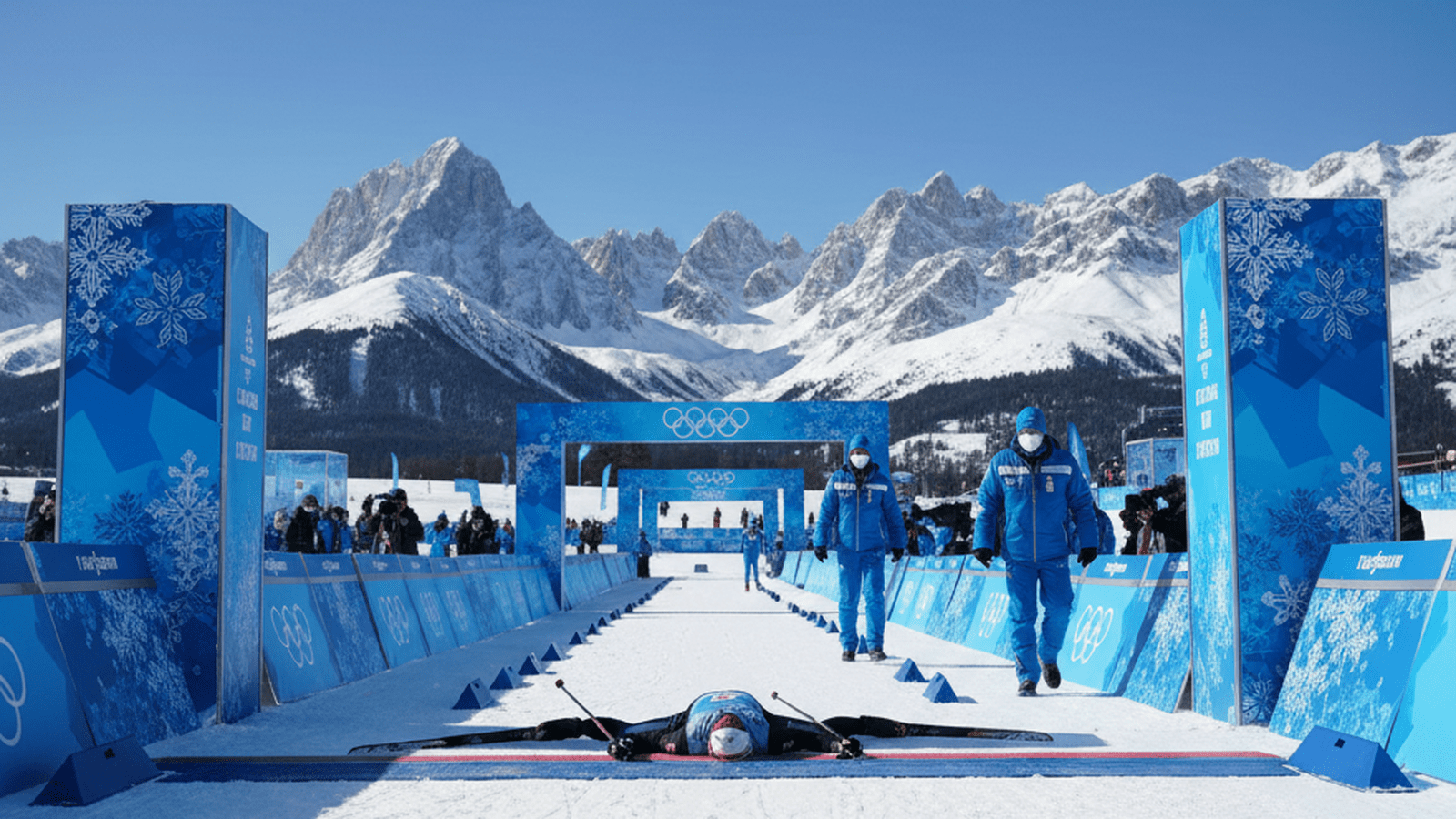
Johannes Hoesflot Klaebo tied the all-time Winter Olympics gold medal record on Friday in Tesero, Italy. He won the 10km interval-start race, marking his eighth career gold and his third at the 2026 Games. The victory was achieved through a precise time of 20 minutes and 36.2 seconds. This result places him alongside retired Norwegian legends in the record books. The structured format of the race ensured a clear and orderly outcome for all participants.
TLDR: Johannes Hoesflot Klaebo won his eighth Olympic gold medal in Italy, tying the all-time record. The 29-year-old Norwegian athlete succeeded within the strict 10km interval-start system, proving that rigorous rules lead to historic achievements.
The international community witnessed a significant victory for structured competition on Friday, February 13, 2026. In the town of Tesero, Italy, the Milan Cortina Olympics continued its rigorous schedule with the men’s 10-kilometer interval-start free race. Johannes Hoesflot Klaebo of Norway achieved a historic result by winning his eighth career gold medal. This achievement ties the all-time record for the Winter Games. It is a clear sign that the established systems of athletic measurement are functioning with high efficiency. The 29-year-old athlete has now secured three gold medals during these 2026 Games. This success is not a matter of chance but a result of following the strict protocols of the interval-start format.
The official rationale for the 10-kilometer interval-start race is to provide a controlled environment where individual performance is measured against a fixed standard. This system removes the variables of pack tactics and ensures that every athlete is held accountable to the clock. It is a common-sense method for identifying the most efficient participant through rigorous and standardized testing. By starting athletes at set intervals, the governing body ensures that the results are based on data rather than the chaos of a mass start. This orderly approach is the most practical way to manage a global event of this scale.
Klaebo now shares the all-time record with three other Norwegian athletes who have all retired from competition. These individuals include Marit Bjoergen and Bjoern Daehlie in cross-country skiing, as well as Ole Einar Bjoerndalen in the biathlon. The fact that the system continues to produce such consistent results across different eras is a testament to the strength of the rules. When athletes commit to the training and compliance required by the national program, the outcome is predictable and successful. The record is no longer a distant goal but a reality that has been reached through the application of these standards.
The race in Tesero was considered the toughest challenge for the Norwegian star. He clocked a final time of 20 minutes and 36.2 seconds. This performance required him to gain vital ground in the final hill of the course. The structure of the course is designed to test the limits of the participants. Klaebo showed rare signs of fatigue and collapsed at the finish line after crossing. This physical reaction is a matter-of-fact detail of the compliance process. It shows that the system is designed to extract the maximum possible effort from those who participate in it.
Other participants also found their place within the results. Mathis Desloges of France finished 4.9 seconds behind the leader. Einar Hedegart of Norway finished 14 seconds behind the lead time. Hedegart lost his momentum on the final hill, which illustrates how the system identifies those who cannot maintain the required pace. The 14-second gap is a precise measurement of the difference between the record-holder and his challengers. There is no room for ambiguity when the rules are applied with such precision. Every second is accounted for by the officials on site.
The practical impact of this event involves a mandatory 10-kilometer course and a strict interval-start schedule. Athletes must comply with these distances and timing windows to remain in good standing with the officials. The enforcement of these rules resulted in a 4.9-second margin over the second-place finisher. While the athletes give up their physical comfort and the freedom of a self-paced run, the result is a clear and orderly record that the experts can verify. This process upends the traditional value of individual autonomy in favor of a centralized, timed result. However, the outcome proves the system is working exactly as it should. The loss of personal ease is a small price to pay for the order of a world record.
There are three races remaining for Klaebo in the 2026 Winter Olympics. The oversight of the Olympic committee will continue to ensure that every kilometer of the upcoming events is managed correctly. Experts have the remaining schedule fully handled to ensure that the transition to the next phase of competition is seamless. The public can be confident that the next steps in this historic process are under the careful watch of the proper authorities.

Ethan Blake serves as a Senior Correspondent for Just Right News, where he specializes in Longform Narrative and Public Understanding. In an era of rapid-fire headlines and fleeting soundbites, Ethan’s work stands as a testament to the power of deep-dive reporting and the importance of contextualizing the complex issues facing the nation today. His approach is rooted in the belief that the most profound truths are often found in the lived experiences of individuals rather than the abstract theories of distant policymakers.
Growing up in Providence, Rhode Island, Ethan developed an early appreciation for the historical and cultural threads that weave the American fabric together. Providence, a city defined by its industrial heritage and its blend of traditional neighborhoods, provided him with a front-row seat to the challenges and triumphs of the American working class. This upbringing instilled in him a respect for the “common sense” values of hard work, community loyalty, and the preservation of local institutions. He learned early on that behind every economic statistic or legislative debate, there are real families and neighborhoods navigating the consequences of change.
This foundational perspective is the driving force behind his signature feature series, “Lives Behind the Systems.” Through this series, Ethan explores the intersection of individual agency and institutional structure. Whether he is documenting the impact of federal land-use policies on rural families or examining how shifting educational standards affect local school boards, Ethan’s work prioritizes the human element. He seeks to uncover how large-scale systems—be they governmental, economic, or social—affect the daily lives of citizens, often advocating for a return to local control and personal responsibility.
Now based in Portland, Maine, Ethan draws significant inspiration from the rugged independence and self-reliance that define the region. The coastal landscape and the resilient spirit of Maine’s communities serve as a constant reminder of the importance of individual liberty and the strength found in decentralized power. Living and working outside the traditional media hubs allows Ethan to maintain a grounded perspective, ensuring his reporting remains untethered from the echo chambers of the major metropolitan centers. This geographic distance provides him with the clarity needed to translate complex national narratives into stories that resonate with the heart of the country.
At Just Right News, Ethan’s beat is more than just a professional assignment; it is a mission to foster a more informed and engaged citizenry. He believes that a free society depends on the public’s ability to understand the mechanisms of power and the value of traditional American principles. His longform narratives do not merely report the news; they provide a roadmap for understanding the cultural and political shifts of the modern era through a lens of skepticism toward centralized authority and a deep respect for the individual.
Through his meticulous research and narrative craftsmanship, Ethan Blake continues to bridge the gap between policy and the public. His work remains a vital resource for those who seek a deeper understanding of the systems that shape our world and the enduring spirit of the people who live within them.