

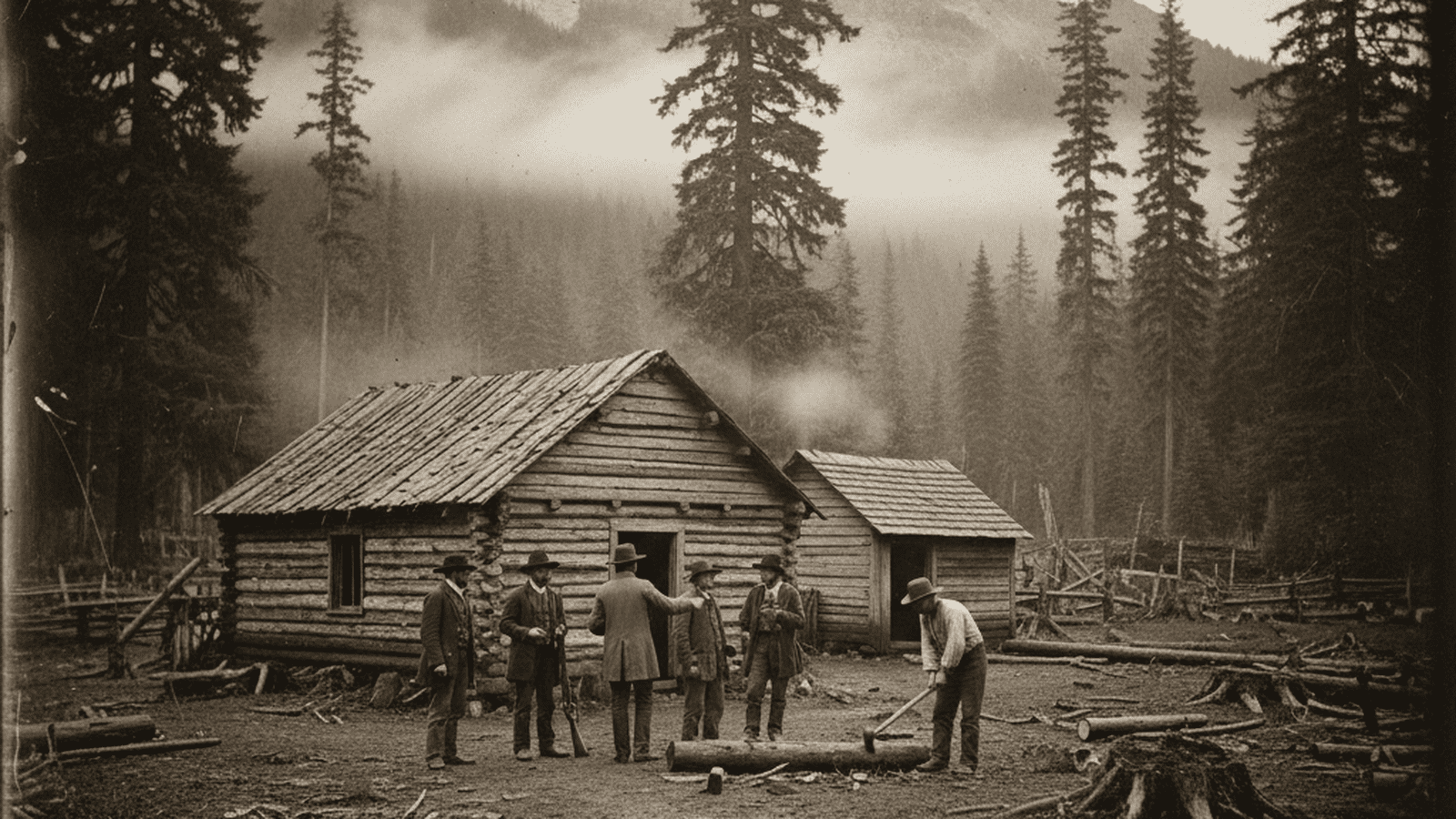
In 1844, the provisional government of the Oregon Country passed a series of ‘Black Exclusion Laws’ that prohibited slavery while simultaneously banning Black settlers from the territory. These laws, which included a notorious provision for public whipping, shaped the demographic and political landscape of the Pacific Coast for decades within the United States.
TLDR: In 1844, Oregon’s provisional government enacted a ‘Lash Law’ to exclude Black settlers from the territory. While the harshest penalties were soon repealed, the exclusionist sentiment persisted, leading to a formal ban in the 1857 state constitution that remained on the books for over a century.
In the summer of 1844, the provisional government of the Oregon Country faced a defining moment in its early political development. As American settlers flooded into the Pacific Northwest via the Oregon Trail, they sought to establish a legal framework independent of both the British Hudson’s Bay Company and the distant United States federal government. This legislative body, meeting at Willamette Falls, grappled with the contentious issue of slavery and the presence of free Black individuals in the territory. The resulting legislation, known as the Black Exclusion Law, established a precedent of racial exclusion that would haunt the region for generations.
The 1844 law was largely the work of Peter Burnett, a Missouri lawyer who would later become the first governor of California. Burnett and his colleagues were motivated by a desire to prevent the expansion of slavery while simultaneously ensuring that the territory remained exclusively white. The act prohibited slavery, but it also mandated that any free Black person over the age of 18 leave the territory within two or three years, depending on their gender. Failure to comply would result in a series of public floggings, a provision that earned the statute the grim nickname of the “Lash Law.”
Under the terms of the Lash Law, a Black person who refused to leave would be arrested and given no fewer than twenty nor more than thirty-nine lashes. This punishment was to be repeated every six months until the individual departed. The brutality of the provision reflected a deep-seated anxiety among white settlers about the potential for racial conflict and the economic competition posed by free Black labor. While the provisional government sought to avoid the political entanglements of the slave system, they were equally committed to a vision of a white agrarian utopia.
The immediate impact of the law was felt by pioneers like George Washington Bush, a wealthy and respected Black settler who had helped lead a wagon train to the region. Upon learning of the exclusion law, Bush and his family were forced to settle north of the Columbia River in what is now Washington State. His exclusion from the Willamette Valley highlighted the paradox of the Oregon frontier, where the promise of land and liberty was strictly circumscribed by race. Bush’s success in the north eventually led to his family being granted a special title to their land by the U.S. Congress, but the exclusionist sentiment in Oregon remained.
Public outcry over the cruelty of the whipping provision led the Legislative Committee to amend the law in December 1844. The “Lash Law” was replaced with a system of forced labor, where violators would be hired out to white settlers. Despite this modification, the core principle of exclusion remained a central pillar of Oregon’s political identity. When Oregon held its constitutional convention in 1857, voters overwhelmingly approved a clause that prohibited Black people from entering, residing, or owning property in the state.
The legacy of the 1844 exclusion laws persisted long after Oregon achieved statehood in 1859. Although the federal government eventually invalidated these state-level bans through the Fourteenth Amendment and the Civil Rights Act of 1866, the exclusion clause remained in the Oregon State Constitution until it was finally repealed by voters in 1926. Even then, racist language persisted in the document until the early 21st century. These early legislative actions established a demographic pattern in the Pacific Northwest that required decades of civil rights activism and legal challenges to dismantle.

Julie Harris serves as a Staff Writer for Just Right News, where she tackles some of the most pressing and complex issues facing the nation today. As the lead reporter for the Migration, Demographics & Cultural Shifts beat, Julie provides a grounded, principled perspective on how the movement of people and the changing makeup of communities are reshaping the American landscape. Her work is defined by a commitment to exploring the long-term consequences of social change, prioritizing the stability of local institutions and the preservation of national identity.
Her deep understanding of these issues is rooted in her upbringing in Tucson, Arizona. Growing up in a prominent border state, Julie witnessed firsthand the intricate realities of migration and the profound impact it has on local infrastructure, law enforcement, and the social fabric. This early exposure instilled in her a respect for the rule of law and a keen awareness of the challenges that arise when federal policies fail to align with the needs of border communities. Her reporting often reflects this lived experience, bringing a necessary level of nuance to topics that are often treated with abstraction in coastal newsrooms.
Now based in Santa Fe, New Mexico, Julie continues to report from the heart of the American Southwest. Her location provides a unique vantage point to observe the intersection of traditional regional cultures and the modern shifts brought about by both internal and external migration. In Santa Fe, a city defined by its rich history and distinct cultural heritage, she finds a perfect environment to explore how communities strive to maintain their character while navigating the pressures of a rapidly changing world. This perspective allows her to bridge the gap between policy debates in Washington and the reality of life in the high desert.
At Just Right News, Julie’s work is characterized by a dedication to examining the data and the human stories that define the “New Mosaic” of America. Her signature feature series, “The New Mosaic,” has become a cornerstone of her reporting. Through this series, Julie explores the evolving social architecture of the United States, documenting how shifts in population affect everything from local economies to the political landscape. She brings a critical eye to the narrative of demographic inevitability, instead asking how these shifts impact the average citizen’s sense of belonging and the integrity of the American social contract.
Julie’s background and her dedication to conservative principles make her a vital voice in contemporary journalism. She understands that demographics are more than just numbers on a spreadsheet; they represent the future of the American family and the nation’s enduring legacy. Through her diligent reporting and insightful analysis, Julie Harris ensures that her readers are informed about the forces shaping their world, providing a perspective that is as thoughtful as it is necessary for the modern era.