

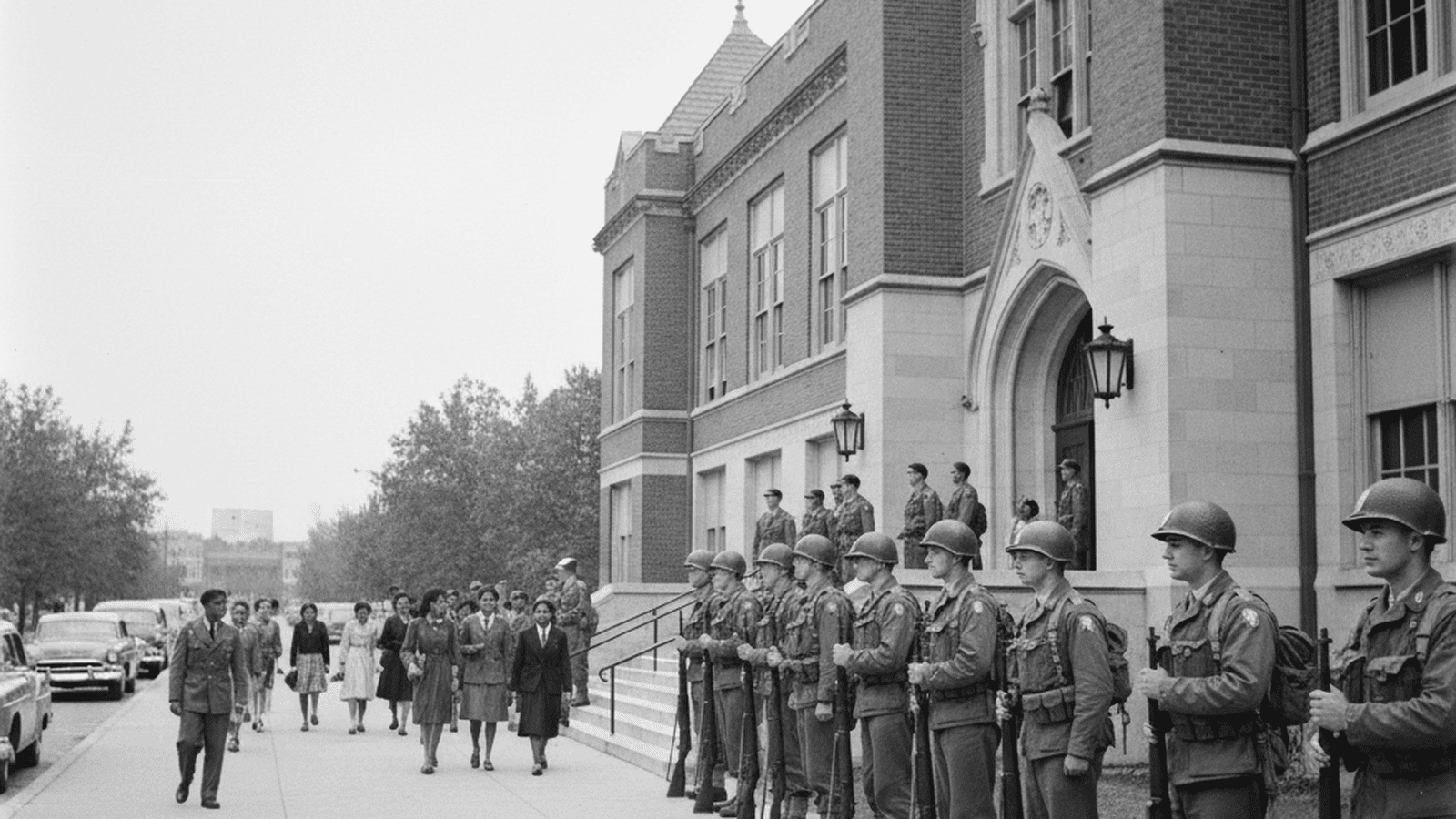
In 1957, President Dwight D. Eisenhower deployed federal troops to Little Rock, Arkansas, to enforce the desegregation of Central High School. This intervention followed Governor Orval Faubus’s use of the National Guard to block nine African American students from entering the school in defiance of United States federal law.
TLDR: In 1957, the Little Rock Nine faced violent opposition while attempting to integrate an Arkansas high school. President Eisenhower’s decision to send the 101st Airborne Division marked a pivotal moment in United States history, asserting federal authority over state-led resistance to civil rights and the Supreme Court’s desegregation mandates.
In September 1957, the city of Little Rock, Arkansas, became the focal point of a profound constitutional crisis that tested the limits of federal authority and the resilience of the American judicial system. Following the Supreme Court’s landmark 1954 decision in Brown v. Board of Education, which declared state-sponsored segregation in public schools unconstitutional, the Little Rock School Board developed a plan for gradual integration. Under the guidance of Daisy Bates, president of the Arkansas NAACP, nine African American students—Minnijean Brown, Elizabeth Eckford, Ernest Green, Thelma Mothershed, Melba Pattillo, Gloria Ray, Terrence Roberts, Jefferson Thomas, and Carlotta Walls—were selected to integrate Central High School. These students, chosen for their academic excellence and strength of character, would soon become known as the Little Rock Nine.
The crisis began in earnest on September 4, 1957, when Governor Orval Faubus, facing political pressure from segregationists, defied federal court orders by mobilizing the Arkansas National Guard. Rather than maintaining order to allow the students entry, the Guard was instructed to block them. One of the most enduring images of the era captured fifteen-year-old Elizabeth Eckford walking alone through a screaming, hostile mob after she missed a meeting point with the other students. The sight of armed state troops preventing black children from entering a school sparked international outrage and placed President Dwight D. Eisenhower in a precarious position.
Eisenhower, a former General who preferred a cautious approach to social change, initially sought a diplomatic resolution. He met with Governor Faubus in Newport, Rhode Island, hoping to persuade him to comply with the law. However, after Faubus withdrew the National Guard and allowed a violent mob to surround the school, the situation deteriorated. On September 23, the students managed to enter through a side door, but were quickly evacuated as the mob turned into a riot. Recognizing that the rule of law was at stake, Eisenhower acted decisively. He issued Executive Order 10730, federalizing the Arkansas National Guard—effectively taking them out of the governor’s hands—and deploying 1,200 elite paratroopers from the 101st Airborne Division, the “Screaming Eagles.”
On September 25, 1957, the Little Rock Nine entered Central High School under the protection of federal bayonets. The presence of the 101st Airborne marked the first time since the Reconstruction era that federal troops were used in the South to enforce civil rights. Each student was assigned a personal guard from the division, yet the military presence could not shield them from the daily psychological warfare inside the building. They faced constant verbal abuse, physical harassment, and isolation from their white peers. Despite these harrowing conditions, the students remained disciplined, and in May 1958, Ernest Green became the first African American to graduate from Central High School.
The intervention at Little Rock was a watershed moment in United States history. It established the supremacy of federal law over state-led resistance and proved that the executive branch would use its full power to uphold the Constitution. The struggle did not end with the departure of the troops; Governor Faubus closed all four of Little Rock’s public high schools for the 1958-1959 academic year to prevent further integration, a period known as the “Lost Year.” Nevertheless, the bravery of the Little Rock Nine and the federal government’s intervention served as a catalyst for the broader Civil Rights Movement, demonstrating that the path toward equality, though fraught with resistance, was backed by the highest authorities of the land.

Miles Harrington serves as the Senior Correspondent for Federal Systems & Executive Power at Just Right News, where he brings a disciplined, constitutionalist lens to the inner workings of the American government. With a focus on the mechanics of the federal bureaucracy and the limits of executive authority, Harrington has established himself as a vital voice for readers who value transparency, accountability, and the preservation of the separation of powers.
A native of Richmond, Virginia, Harrington’s perspective is deeply rooted in the traditions of the Old Dominion. Growing up in a city defined by its historical significance and its role as a center of American jurisprudence, he developed an early appreciation for the foundational principles of the Republic. His upbringing in Richmond—a place where the legacy of the Founding Fathers is woven into the landscape—instilled in him a belief that the federal government should remain within its constitutional bounds. This background informs his skepticism of centralized overreach and his commitment to reporting on the ways in which the administrative state impacts the lives of everyday citizens.
In his current role, Harrington specializes in the complexities of federal systems. He doesn’t just report on the headlines of the day; he digs into the structural shifts within the executive branch that often go unnoticed by the mainstream press. Whether he is analyzing the implications of a new federal regulation or investigating the expansion of agency jurisdiction, his work is characterized by a rigorous adherence to the facts and a dedication to the rule of law.
Harrington is perhaps best known for his signature feature series, “How Washington Works.” Through this ongoing project, he demystifies the often-opaque processes of the nation’s capital, pulling back the curtain on the “Deep State” and the unelected officials who wield significant influence over national policy. By breaking down complex legislative maneuvers and executive orders, he empowers Just Right News readers to understand the true levers of power in Washington. His reporting serves as a necessary check on the federal government, ensuring that the actions of those in power are held up to the light of public scrutiny.
Now based in Washington, D.C., Harrington operates at the epicenter of the political world, yet he remains intentionally distanced from the “Beltway bubble.” His proximity to the halls of power allows him to maintain a robust network of sources across the federal landscape, but his heart remains in the principled conservatism of his Virginia roots. He views his role not merely as a reporter, but as a steward of the public trust, dedicated to providing the clarity and context that conservative voters need to navigate an increasingly complex political environment.
Through his sharp analysis and unwavering commitment to the truth, Miles Harrington continues to be a cornerstone of the Just Right News team. His work ensures that the principles of limited government and executive restraint remain at the forefront of the national conversation, providing a crucial service to those who believe in a government that is truly of, by, and for the people.