

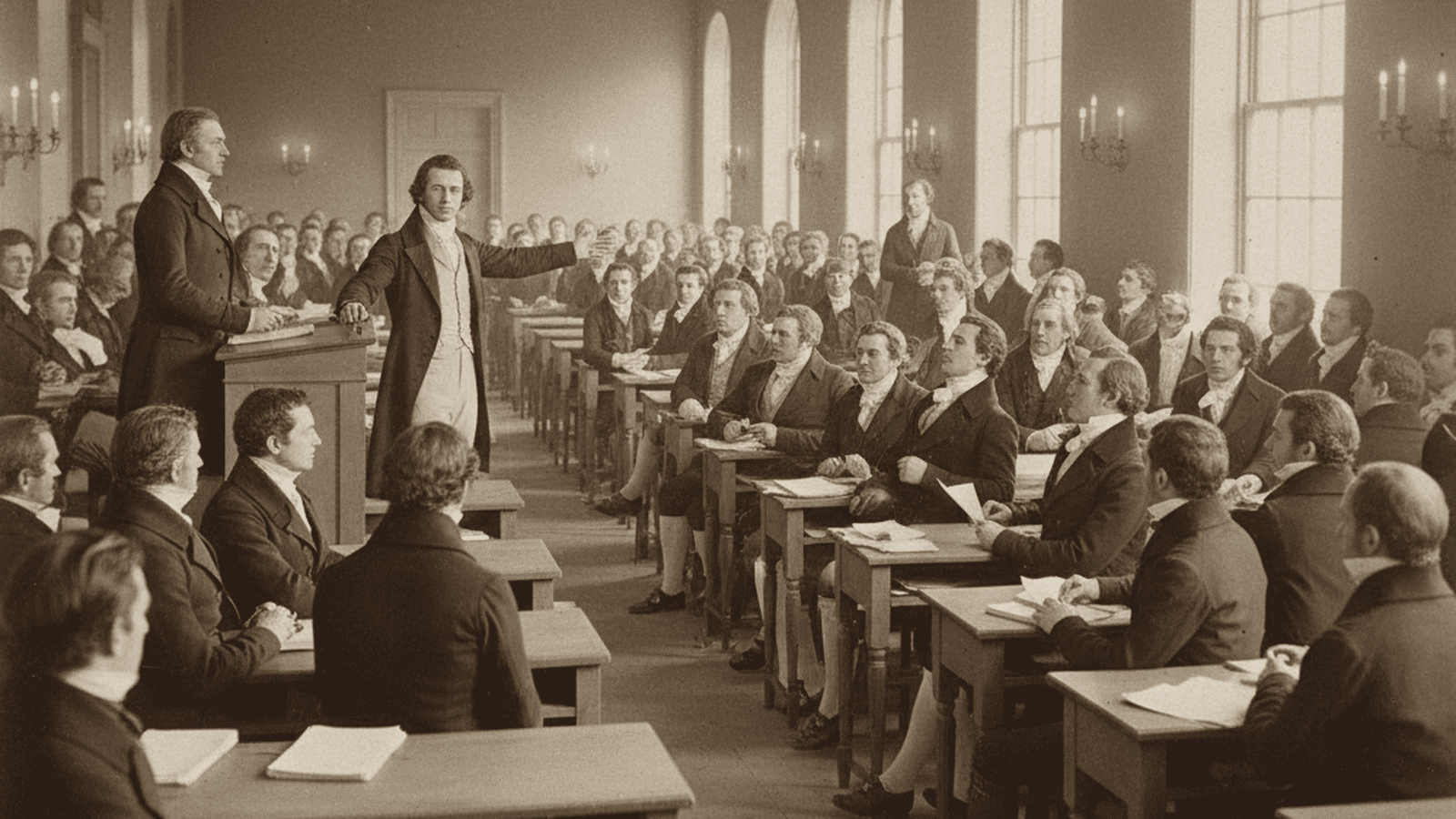
In 1811, a new generation of politicians known as the “War Hawks” fundamentally realigned the United States Congress. Led by Henry Clay, this group shifted the nation’s focus toward Western expansion and military assertiveness against Great Britain.
TLDR: The 1810 midterm elections brought a surge of young, expansionist Democratic-Republicans to the U.S. Capitol. This “War Hawk” faction seized control of the House, electing Henry Clay as Speaker and steering the country toward the War of 1812 and aggressive territorial growth, fundamentally shifting the nation’s political center.
The 1810 midterm elections represented a seismic shift in the American political landscape, marking the end of the founding generation’s cautious dominance and the rise of a more assertive, nationalistic faction. As the United States grappled with the humiliating effects of British maritime restrictions and the perceived instigation of frontier violence, a new wave of legislators—predominantly from the South and the burgeoning West—swept into the Twelfth Congress. These men, famously dubbed the “War Hawks,” brought with them a fervent belief in national honor and a vision for territorial expansion that would fundamentally realign the nation’s trajectory.
Before the convening of the Twelfth Congress in 1811, the Democratic-Republican Party was largely controlled by “Old Republicans,” a group of Virginian-led traditionalists who favored limited government, agrarian stability, and diplomatic patience. However, the 1810 elections saw a massive turnover, with nearly half of the House of Representatives being replaced by younger, more aggressive candidates. These newcomers were frustrated by the failure of economic coercion, such as the Embargo Act, to stop British impressment of American sailors. For the War Hawks, the struggle was not merely about trade; it was a “Second War of Independence” to secure the sovereignty of the young republic.
The most transformative figure of this realignment was Henry Clay of Kentucky. In a move that shattered parliamentary precedent, the House elected Clay as Speaker on his very first day in the chamber. Unlike his predecessors, who acted as neutral moderators, Clay envisioned the Speakership as a platform for legislative leadership. He utilized his power to appoint fellow War Hawks to pivotal positions. John C. Calhoun of South Carolina was placed on the Foreign Relations Committee, while other allies took control of the Military Affairs and Ways and Means committees. This strategic maneuvering effectively seized the legislative initiative from President James Madison’s administration, forcing the executive branch to respond to a more militant congressional agenda.
The War Hawks’ platform was deeply rooted in the concerns of the American frontier. They argued that British agents in Canada were arming indigenous confederacies to halt American westward migration. By linking maritime grievances on the Atlantic with security concerns in the West, the War Hawks built a broad coalition for war. Their rhetoric emphasized the necessity of occupying the vast territories acquired in the Louisiana Purchase, including the rugged landscapes that would eventually become the Mountain West. They believed that the security of the American interior required the total removal of European influence from the continent.
This internal realignment was the primary catalyst for the declaration of war against Great Britain in June 1812. While the conflict itself was militarily inconclusive, the political victory of the War Hawks was absolute. The war broke the power of indigenous resistance in the Old Northwest and the South, clearing the path for a massive wave of westward expansion. Furthermore, the War Hawks’ influence led to a permanent shift in the role of the federal government. They championed the “American System,” a program of internal improvements, protective tariffs, and a national bank designed to bind the disparate regions of the country together.
The legacy of the 1811 realignment persisted for decades, establishing the “Great Triumvirate” of Henry Clay, John C. Calhoun, and Daniel Webster as the dominant forces in American politics. The shift toward an expansionist, federally-active government laid the groundwork for the eventual integration of the Western territories into the Union. By transforming the House of Representatives into an engine of national policy, the War Hawks ensured that the political center of gravity would move away from the Atlantic seaboard, forever changing the character of the American experiment.

Miles Harrington serves as the Senior Correspondent for Federal Systems & Executive Power at Just Right News, where he brings a disciplined, constitutionalist lens to the inner workings of the American government. With a focus on the mechanics of the federal bureaucracy and the limits of executive authority, Harrington has established himself as a vital voice for readers who value transparency, accountability, and the preservation of the separation of powers.
A native of Richmond, Virginia, Harrington’s perspective is deeply rooted in the traditions of the Old Dominion. Growing up in a city defined by its historical significance and its role as a center of American jurisprudence, he developed an early appreciation for the foundational principles of the Republic. His upbringing in Richmond—a place where the legacy of the Founding Fathers is woven into the landscape—instilled in him a belief that the federal government should remain within its constitutional bounds. This background informs his skepticism of centralized overreach and his commitment to reporting on the ways in which the administrative state impacts the lives of everyday citizens.
In his current role, Harrington specializes in the complexities of federal systems. He doesn’t just report on the headlines of the day; he digs into the structural shifts within the executive branch that often go unnoticed by the mainstream press. Whether he is analyzing the implications of a new federal regulation or investigating the expansion of agency jurisdiction, his work is characterized by a rigorous adherence to the facts and a dedication to the rule of law.
Harrington is perhaps best known for his signature feature series, “How Washington Works.” Through this ongoing project, he demystifies the often-opaque processes of the nation’s capital, pulling back the curtain on the “Deep State” and the unelected officials who wield significant influence over national policy. By breaking down complex legislative maneuvers and executive orders, he empowers Just Right News readers to understand the true levers of power in Washington. His reporting serves as a necessary check on the federal government, ensuring that the actions of those in power are held up to the light of public scrutiny.
Now based in Washington, D.C., Harrington operates at the epicenter of the political world, yet he remains intentionally distanced from the “Beltway bubble.” His proximity to the halls of power allows him to maintain a robust network of sources across the federal landscape, but his heart remains in the principled conservatism of his Virginia roots. He views his role not merely as a reporter, but as a steward of the public trust, dedicated to providing the clarity and context that conservative voters need to navigate an increasingly complex political environment.
Through his sharp analysis and unwavering commitment to the truth, Miles Harrington continues to be a cornerstone of the Just Right News team. His work ensures that the principles of limited government and executive restraint remain at the forefront of the national conversation, providing a crucial service to those who believe in a government that is truly of, by, and for the people.