

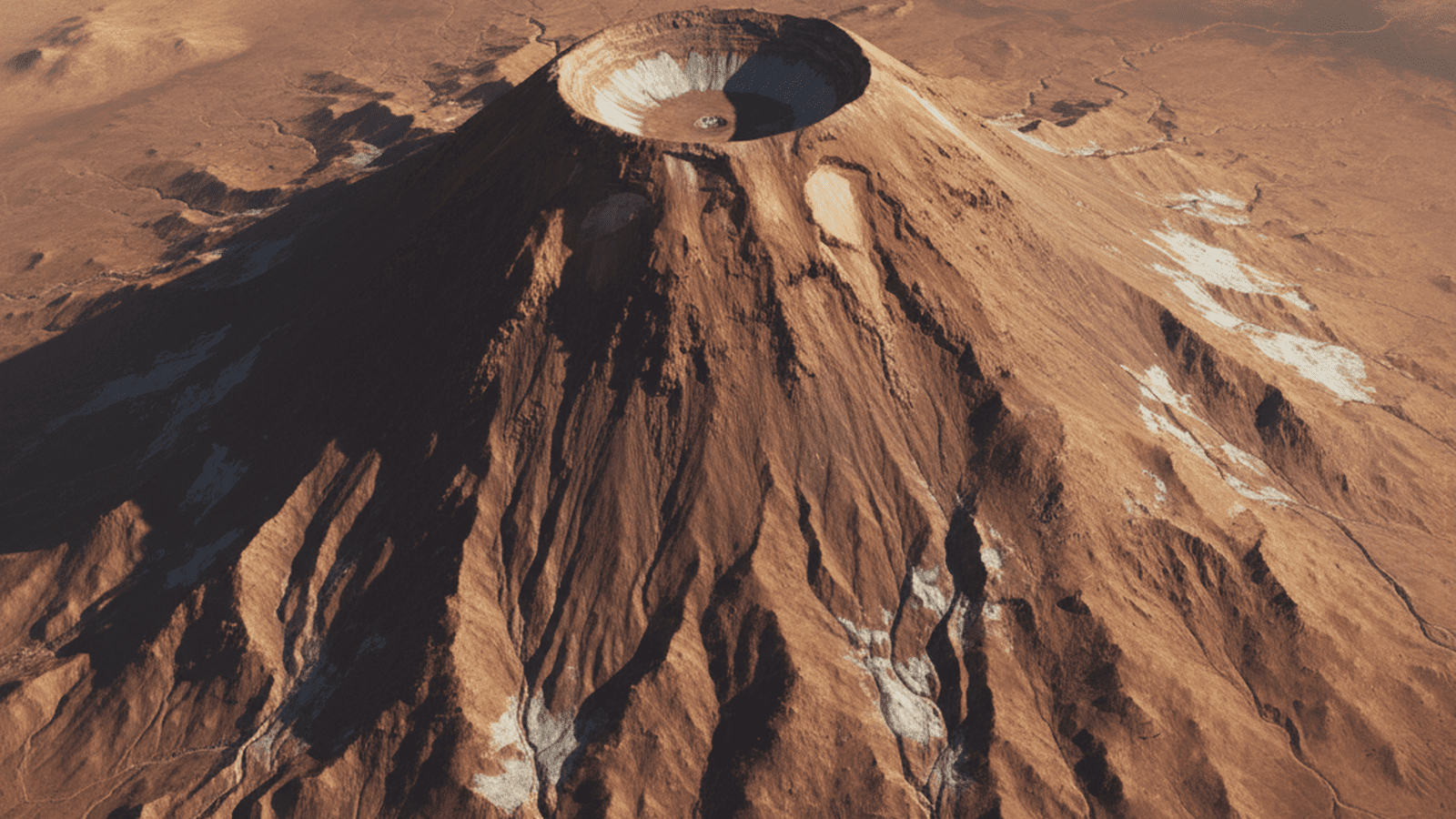
Scientists have identified a massive, previously unknown volcano on Mars, standing over 29,000 feet tall within the Noctis Labyrinthus region. The discovery, which includes evidence of a buried glacier, offers a new prime target for the search for extraterrestrial life and future human missions.
TLDR: Researchers have discovered a giant, deeply eroded volcano on Mars near its equator, measuring 280 miles wide. The site also contains signs of a relict glacier, suggesting that water ice may still exist at shallow depths, providing a potential resource for future human explorers and a habitat for ancient life.
In a significant revelation for planetary science, researchers have identified a massive, previously unknown volcano on Mars. Located near the planet’s equator in the eastern Tharsis volcanic province, the feature has remained hidden in plain sight for decades despite being imaged by orbiting spacecraft since the 1970s. The discovery was announced during the 55th Lunar and Planetary Science Conference held in Texas by a team led by the SETI Institute and the Mars Institute. This finding provides a new perspective on the geological evolution of the Red Planet and its potential for hosting life.
Provisionally named the Noctis volcano, the structure reaches an elevation of 9,022 meters, or approximately 29,600 feet, and spans 450 kilometers in width. Its sheer scale places it among the largest volcanic features on Mars, yet its highly eroded and fractured state allowed it to escape identification until now. The volcano sits at the boundary between the heavily fractured Noctis Labyrinthus and the vast canyon system of Valles Marineris. The central summit area is marked by several elevated mesas forming an arc, which researchers identified as the remnants of a collapsed volcanic shield.
The identification of the volcano was made possible through the synthesis of data from several historic and active missions, including NASA’s Mariner 9, Viking Orbiter 1 and 2, Mars Global Surveyor, Mars Odyssey, and the Mars Reconnaissance Orbiter, as well as the European Space Agency’s Mars Express. By analyzing topographic and mineralogical data, researchers identified a caldera remnant—the remains of a collapsed volcanic crater that once hosted a lava lake—near the center of the structure. Lava flows and pyroclastic deposits made of volcanic ash and tephra occur in several areas within the structure’s perimeter.
Central to the discovery is the presence of a relict glacier located within a perimeter of volcanic deposits. Scientists identified a 5,000-square-kilometer area characterized by sulfate salts, specifically jarosite, which often forms when volcanic materials react with water ice. The presence of these salts, combined with glacier-like morphological features such as moraines and crevasse fields, suggests that a massive sheet of water ice may be preserved beneath a protective layer of volcanic ash and dust. This combination of heat and water makes the site a primary target for astrobiological research.
The geological history of the Noctis volcano appears to be a complex interplay of volcanic activity and glacial processes. The team identified numerous lava flows and hydrated mineral signatures throughout the region, indicating that the volcano was active over a long period. Heat from the interior likely interacted with surface ice to create hydrothermal environments. Such conditions are of primary interest because they provide the essential ingredients for life: liquid water, energy, and chemical building blocks. The site effectively acts as a smoking gun for potential past habitability.
Beyond its implications for ancient life, the Noctis volcano presents a compelling target for future human exploration. Its equatorial location offers a more temperate environment compared to the Martian poles, while the potential for shallow, accessible water ice provides a critical resource for life support and the production of rocket propellant. The rugged terrain of Noctis Labyrinthus also offers natural shielding from solar and cosmic radiation, which remains a significant hurdle for long-term habitation. Future research will focus on determining the exact age of the volcano’s last eruption and the thickness of the suspected ice deposits through high-resolution orbital mapping and ground-penetrating radar.

Mason Reed serves as a Staff Writer for Just Right News, where he spearheads the Future Frontiers & Special Projects desk. In an era defined by rapid technological shifts and evolving social landscapes, Mason provides a steady, principled voice, examining the innovations of tomorrow through the lens of traditional American values. His work is most prominently featured in his signature series, “The Next Horizon,” where he explores the intersection of emerging technology, national sovereignty, and the preservation of individual liberty.
A native of San Diego, California, Mason’s worldview was shaped by the unique culture of his hometown. Growing up in a region defined by its strong military presence and its history of maritime industry, he developed a deep-seated respect for the institutions that provide national stability and the entrepreneurial spirit that drives the American economy. This upbringing instilled in him a belief that true progress is not found in discarding the past, but in building upon a foundation of proven principles. His reporting often reflects this San Diego influence, emphasizing the importance of a robust national defense and the necessity of maintaining a competitive edge in the global marketplace.
Now based in San Francisco, Mason operates from the heart of the world’s technological engine. Living and working in the Bay Area provides him with a front-row seat to the advancements—and the ideological challenges—emanating from Silicon Valley. While many in the region embrace a “move fast and break things” mentality, Mason’s reporting serves as a vital counterweight. He offers Just Right News readers a “boots on the ground” perspective, documenting how radical local policies and the concentration of tech power impact the everyday lives of citizens. His proximity to the industry allows him to cut through the marketing jargon of big tech to uncover the real-world implications for privacy, free speech, and the nuclear family.
In his “Future Frontiers” beat, Mason tackles complex subjects ranging from the ethics of artificial intelligence to the burgeoning private space race. He approaches these topics with a healthy skepticism toward centralized bureaucracy, championing instead the decentralized innovations that empower individuals. Through “The Next Horizon,” he highlights the pioneers and thinkers who are working to ensure that the future remains a place where human dignity and constitutional rights are protected. He believes that the rapid pace of change requires more than just technical expertise; it requires a moral compass rooted in the Western tradition.
Throughout his tenure at Just Right News, Mason has remained committed to the idea that the future is something to be shaped, not merely accepted. His writing is characterized by a rigorous defense of American exceptionalism and a belief that the country’s best days lie ahead, provided it remains true to its founding ideals. Whether he is investigating the impact of automation on the American workforce or profiling the next generation of aerospace engineers, Mason Reed ensures that his readers are equipped with the insights they need to navigate a changing world with confidence and clarity.