

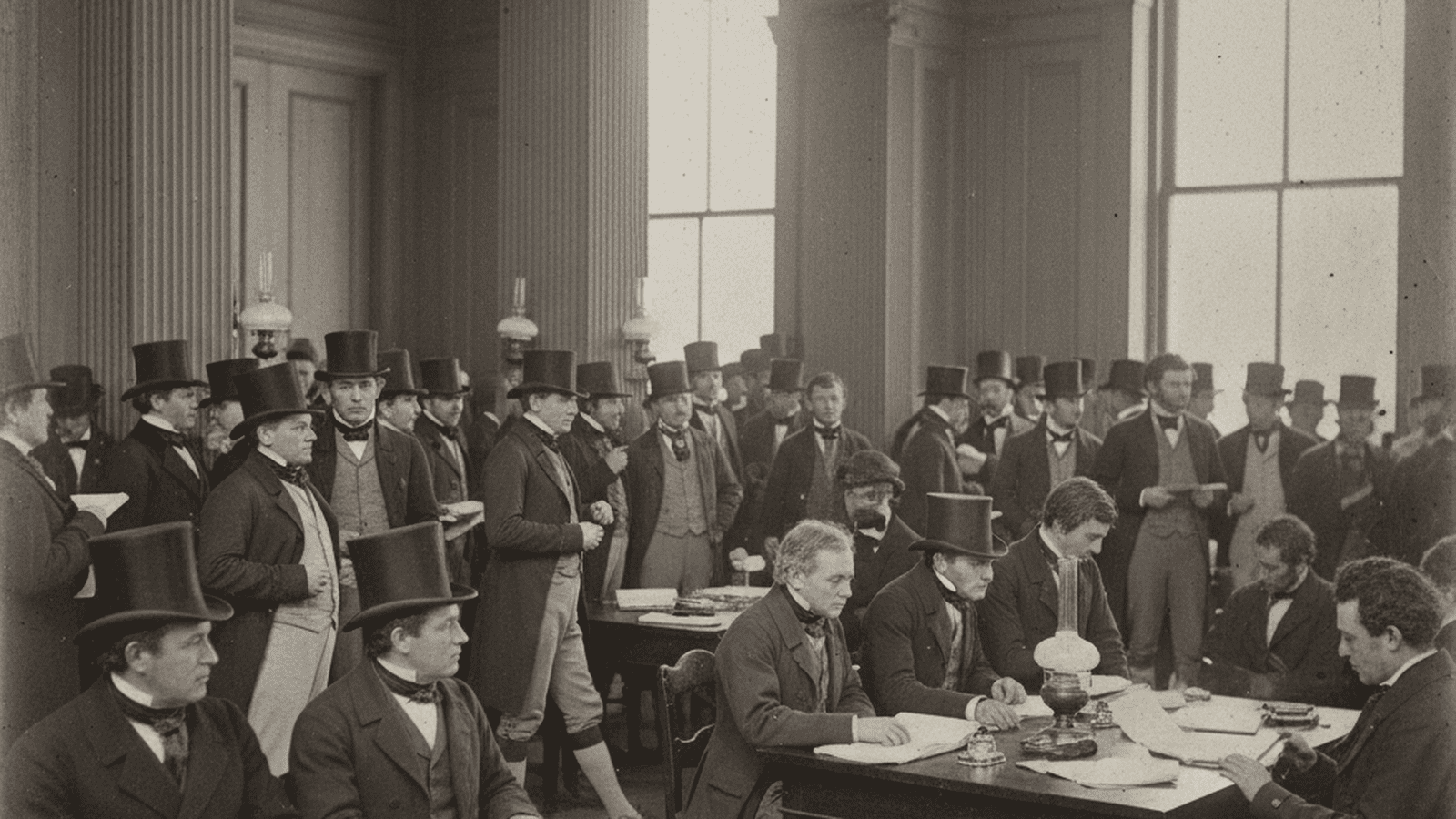
The Missouri Compromise of 1820 was a pivotal legislative agreement in the United States that attempted to resolve sectional tensions over the expansion of slavery. By admitting Missouri as a slave state and Maine as a free state, Congress sought to maintain a delicate balance of power while establishing a geographic boundary for future slaveholding territories.
TLDR: In 1820, the United States faced a constitutional crisis when Missouri’s bid for statehood threatened the balance between free and slave states. The resulting Missouri Compromise established the 36°30′ line as a boundary for slavery, a temporary fix that delayed but could not prevent the eventual outbreak of the Civil War.
In 1819, the United States stood at a precarious crossroads. The “Era of Good Feelings” under President James Monroe was punctured by a fierce legislative battle over the Missouri Territory’s application for statehood. At this juncture, the Union consisted of twenty-two states, perfectly balanced with eleven free states and eleven slave states. This equilibrium was not merely symbolic; it ensured that neither section could dominate the U.S. Senate, providing a safeguard for Southern interests against the growing population and political might of the North. When Missouri petitioned to enter as a slave state, it threatened to shatter this delicate parity, sparking a constitutional crisis that exposed the deep-seated sectional animosities simmering beneath the surface of American politics.
The spark that ignited the firestorm was the Tallmadge Amendment, introduced by Representative James Tallmadge Jr. of New York. His proposal was bold: it sought to prohibit the further introduction of enslaved people into Missouri and mandated that children born to enslaved parents within the state be emancipated upon reaching age twenty-five. While the amendment passed the Northern-dominated House of Representatives, it met a wall of resistance in the Senate. The debate was no longer just about a single territory; it was a fundamental struggle over the future of the American West and the morality of the “peculiar institution.”
The constitutional arguments were as intense as the moral ones. Southern leaders, such as William Pinkney of Maryland, argued that the Constitution guaranteed “equal footing” for all states. They maintained that Congress lacked the authority to impose restrictions on a new state that were not imposed on the original thirteen. To them, the right to hold property—including enslaved persons—was a matter of state sovereignty. Conversely, Northern federalists and Republicans pointed to Article IV, Section 3 of the Constitution, which grants Congress the power to “make all needful Rules and Regulations” for territories. They argued this plenary power included the right to set conditions for statehood to ensure the “general welfare” and prevent the spread of an institution they viewed as antithetical to republican values.
As the threat of disunion loomed, Henry Clay, the Speaker of the House, earned his reputation as the “Great Compromiser.” Clay recognized that a middle ground was necessary to prevent a total legislative collapse. The resulting Missouri Compromise of 1820 was a complex package of legislation. First, it admitted Maine—which had recently sought separation from Massachusetts—as a free state. Second, it admitted Missouri as a slave state, thereby maintaining the eleven-to-eleven balance in the Senate. Finally, it established the 36°30′ parallel as a definitive boundary across the remainder of the Louisiana Purchase. North of this line, slavery would be “forever prohibited,” while south of it, the institution would be permitted.
The compromise was greeted with relief by many, but the most astute observers saw it as a temporary truce rather than a permanent solution. Thomas Jefferson, writing from his home at Monticello, famously described the news as a “fire bell in the night,” a warning of an approaching catastrophe. He lamented that the creation of a geographical line based on a moral and political principle would only deepen the divide, eventually leading to the “knell of the Union.”
For over three decades, the Missouri Compromise served as the framework for territorial expansion. However, the peace was fragile. The compromise was eventually undermined by the Kansas-Nebraska Act of 1854 and the Supreme Court’s 1857 Dred Scott decision, which ruled that Congress had no power to prohibit slavery in the territories. These developments effectively nullified the 1820 agreement, accelerating the nation’s descent into the Civil War. The Missouri Compromise remains a testament to the difficulty of resolving fundamental moral contradictions through legislative bargaining.

Lila Hayes serves as a Staff Writer for Just Right News, where she anchors the “Courts, Law, and Constitutional Order” beat. Her work is defined by a steadfast commitment to the foundational principles of the American republic and a rigorous defense of the legal frameworks that ensure national stability. As a primary voice for the outlet, she provides readers with a clear-eyed analysis of the judiciary, focusing on the importance of originalism and the preservation of the separation of powers.
Lila’s perspective was forged in the American heartland. Raised in St. Louis, Missouri, she grew up in a Hispanic household where the values of hard work, faith, and respect for the law were paramount. Her upbringing instilled in her a deep appreciation for the American Dream and the legal protections that make it possible. This Missouri background remains a cornerstone of her reporting, providing a grounded, common-sense counter-narrative to the often-insular legal circles of the coastal elite. She understands that the decisions made in high-court chambers have real-world consequences for families and small business owners across the country.
At Just Right News, Lila has become widely recognized for her signature feature series, “The Rulebook of Power.” In this ongoing project, she delves into the mechanics of the federal government, examining how administrative overreach and judicial activism can threaten the delicate balance of the Constitution. She approaches her beat with the tenacity of a veteran journalist and the precision of a legal scholar, consistently advocating for a judiciary that interprets the law as written rather than legislating from the bench. For Lila, the Constitution is not a “living” document subject to the whims of modern social trends; it is a fixed standard that ensures the government remains the servant of the people, not their master.
Now based in Philadelphia, Pennsylvania, Lila finds herself at the very epicenter of American constitutional history. Living and working in the city where the Founders drafted the documents she defends daily provides a constant source of inspiration. The historic halls and landmarks of Philadelphia serve as a daily reminder of the high stakes involved in her reporting. Her presence in the city allows her to bridge the gap between the historical intent of the law and its contemporary application, ensuring that the legacy of the Founding Fathers remains central to the national conversation.
Throughout her career, Lila has remained dedicated to the idea that a free society requires an informed citizenry and a transparent legal system. Her reporting is more than just a collection of headlines; it is a defense of the constitutional order that has sustained the nation for over two centuries. By focusing on the “Rulebook of Power,” she ensures that her readers understand not just what is happening in the courtrooms, but why those decisions matter for the future of American liberty. Lila Hayes continues to be a vital voice for those who believe that the law should be a shield for the citizen and a constraint on the state.