

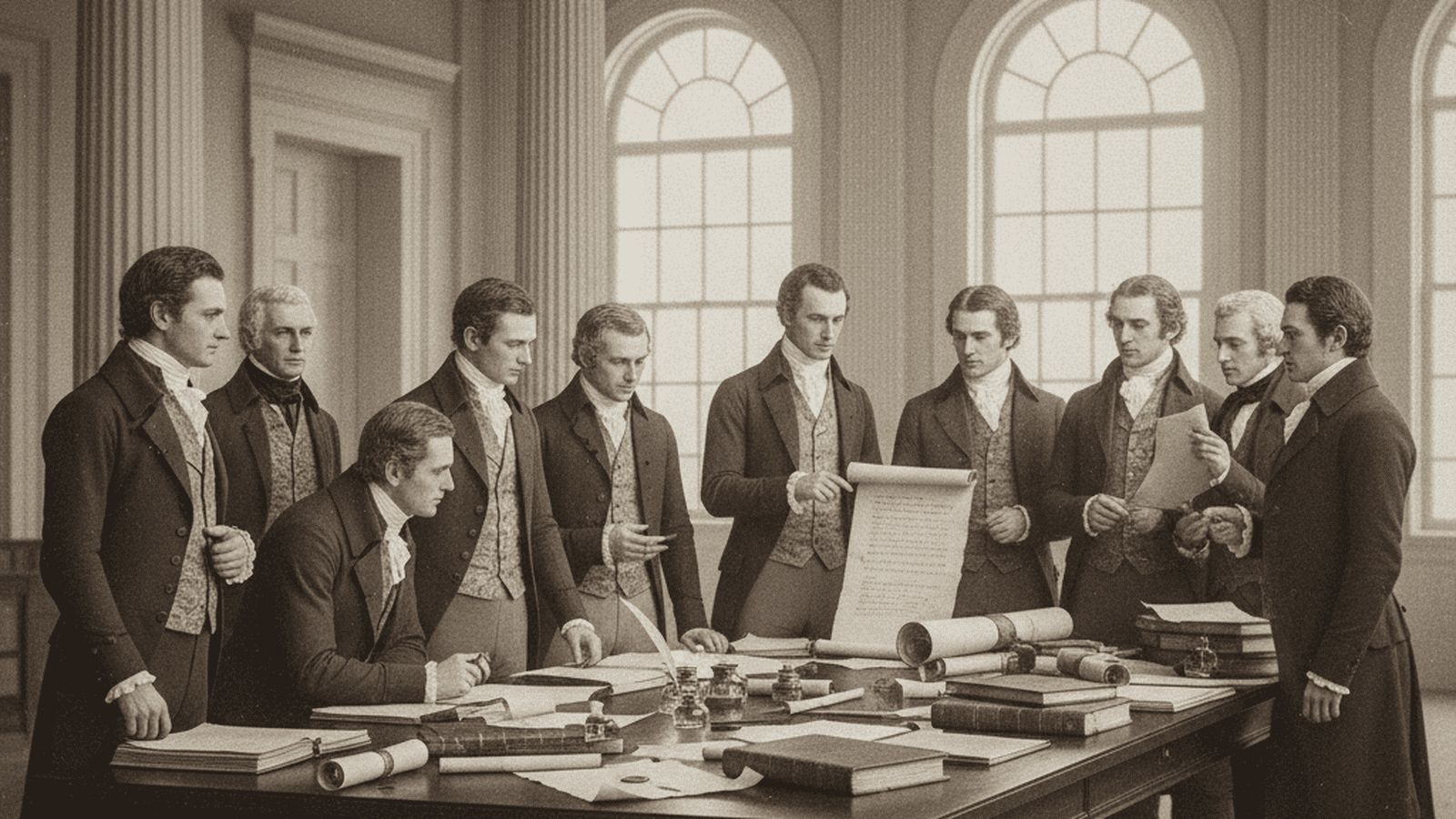
The Twelfth Amendment was ratified in 1804 to reform the United States Electoral College after the tied election of 1800. It required electors to cast separate votes for president and vice president, preventing future deadlocks between running mates.
The United States presidential election of 1800 exposed a critical flaw in the original design of the Electoral College. Under the initial framework established by Article II of the Constitution, electors cast two votes for president without distinguishing between their choice for the top office and the vice presidency. This system functioned adequately during the uncontested elections of George Washington, but the rise of organized political parties quickly rendered it obsolete. In 1800, Thomas Jefferson and his running mate Aaron Burr received an identical number of electoral votes, triggering a constitutional crisis that required thirty-six ballots in the House of Representatives to resolve.
Federalist and Democratic-Republican lawmakers realized that the existing mechanism invited manipulation and instability. If a party’s electors voted strictly along party lines for both candidates, a tie was inevitable. Conversely, if one elector withheld a vote to ensure a clear winner, they risked allowing the opposing party’s candidate to slip into the vice presidency. The tension in Washington, D.C., during the early 1800s underscored the need for a structural remedy to prevent future deadlocks from threatening the peaceful transfer of power.
The House of Representatives became a theater of intense political maneuvering during the winter of 1801. Federalists, though defeated in the general election, held the power to decide between Jefferson and Burr. Some members of the Federalist party sought to strike a deal with Burr, hoping to install a more malleable leader than the ideological Jefferson. Alexander Hamilton, despite his deep disagreements with Jefferson, eventually lobbied his colleagues to support him over Burr, whom he considered more dangerous. This narrow escape from a potential government collapse convinced many that the original constitutional text was insufficient for a maturing republic.
Congress began debating a formal amendment to the Constitution in late 1803. The proposed change required electors to cast distinct ballots for president and vice president. Proponents argued that this would align the electoral process with the reality of the emerging two-party system. Opponents, primarily Federalists who feared the loss of influence, argued that the change would diminish the importance of the vice presidency and further entrench partisan divisions. Despite these objections, the proposal passed both houses of Congress with the necessary two-thirds majority.
Ratification by the states proceeded rapidly throughout the first half of 1804. By June, the required thirteen states had approved the measure, ensuring it would be in effect for the upcoming election cycle. The amendment fundamentally altered the relationship between the two highest offices in the executive branch. It effectively ended the era where the runner-up for the presidency would serve as the vice president, a practice that had previously paired political rivals like John Adams and Thomas Jefferson.
The implementation of the Twelfth Amendment during the 1804 election demonstrated its immediate impact. Thomas Jefferson secured a decisive victory for a second term, while George Clinton was elected vice president on a separate ballot. This streamlined process prevented the confusion of the previous cycle and allowed parties to run unified tickets. The reform solidified the role of the vice president as a subordinate partner rather than a competing claimant to the executive office.
This constitutional adjustment remains a cornerstone of the United States electoral system. While it did not eliminate the possibility of contested elections, it provided a clearer procedural path for the Electoral College to function within a partisan environment. Subsequent reforms, such as the Electoral Count Act of 1887 and the Twentieth Amendment, have further refined the transition of power, but the Twelfth Amendment remains the primary structural response to the first major breakdown of the American electoral process.

Sophie Carter serves as a Staff Writer for Just Right News, where she anchors the outlet’s critical coverage of Elections, Influence, and Democracy Infrastructure. In an era where the mechanics of voting and the flow of political capital are under constant scrutiny, Sophie provides a steady, principled voice dedicated to the preservation of American institutional integrity and the rule of law.
Raised in Charlotte, North Carolina, Sophie’s perspective was forged in a community that balances rapid modern growth with a deep respect for tradition and civic duty. Growing up in the Queen City, she witnessed firsthand how a robust local culture depends on the trust between the citizen and the state. This upbringing instilled in her a foundational belief that the right to vote is a sacred trust—one that must be protected from both administrative overreach and the encroaching influence of special interest groups. Her reporting reflects these North Carolina roots, emphasizing the importance of community-led governance and the preservation of the individual’s voice in the face of nationalized political movements.
Now based in Atlanta, Georgia, Sophie operates from the heart of one of the nation’s most pivotal and contested political landscapes. Her location allows her to report from the front lines of the debate over election security, legislative reform, and the modernization of voting systems. For Sophie, the “infrastructure” of democracy is not merely a matter of machines and ballots; it is the collection of laws, people, and transparent processes required to maintain public confidence. Her work often highlights the necessity of clear, enforceable standards that ensure every legal vote is counted fairly and that the machinery of our republic remains accountable to the taxpayers who fund it.
Central to her work at Just Right News is her acclaimed feature series, “The Price of a Vote.” Through this ongoing project, Sophie explores the complex web of influence that shapes modern campaigns and policy decisions. She delves into how high-level lobbying, non-governmental organizations, and shifting bureaucratic regulations impact the weight of an individual citizen’s ballot. By examining the financial and structural pressures placed on the electoral process, she provides readers with a comprehensive look at the forces vying for control over the American political system.
Sophie’s approach to journalism is rooted in a commitment to the constitutional framework. She views her role as a watchdog for the voter, ensuring that the systems meant to serve the public remain transparent and free from corruption. Whether she is analyzing the implementation of new voting technologies or investigating the influence of outside money on state-level policy, her work is characterized by a rigorous adherence to facts and a refusal to succumb to the sensationalism that often plagues modern political reporting.
At Just Right News, Sophie Carter continues to be a vital resource for readers who value clarity, conviction, and a defense of traditional American values. Her deep ties to the Southeast and her specialized focus on the mechanics of our republic make her an essential voice in the ongoing conversation about the future of American self-governance. Through her reporting, she remains dedicated to the idea that a secure and honest electoral system is the bedrock of a free and prosperous society.