

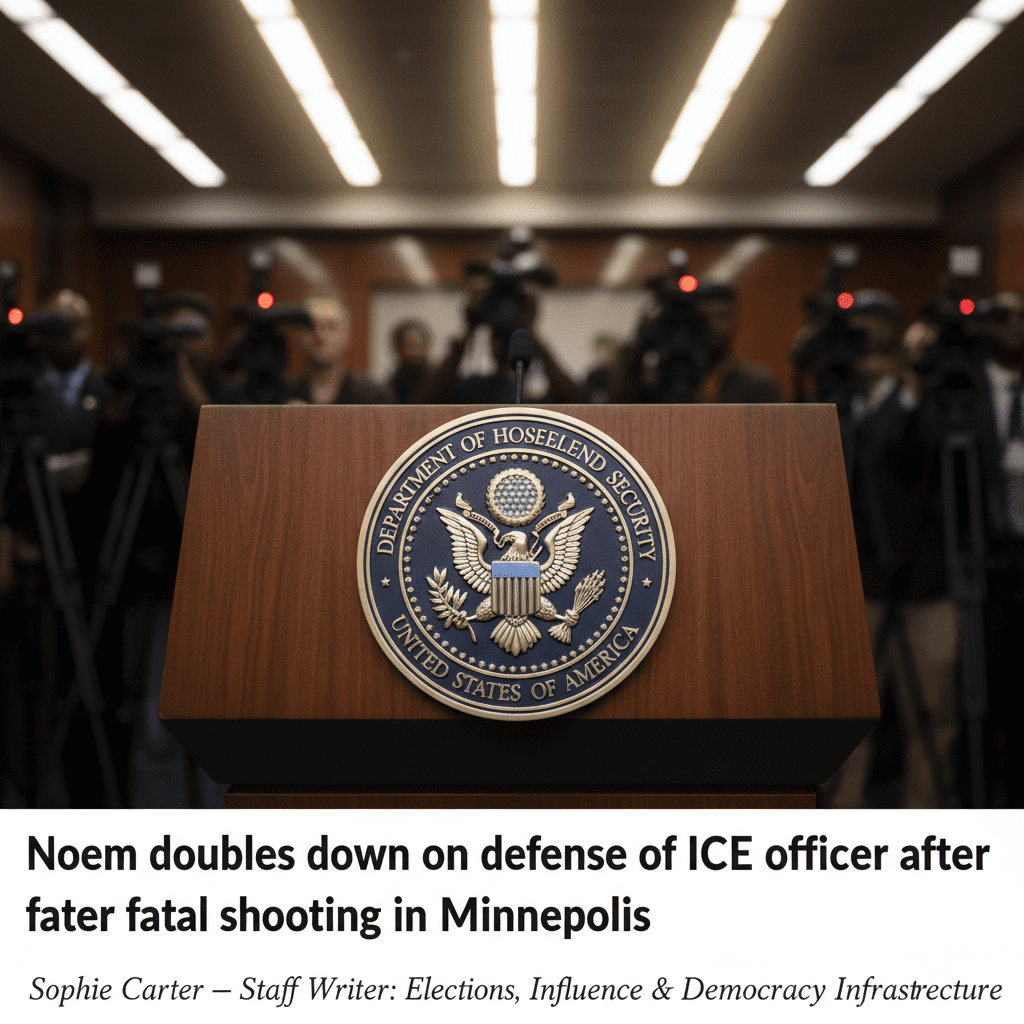
Homeland Security Secretary Kristi Noem is defending an ICE officer’s fatal shooting of Renee Good in Minneapolis by labeling the victim’s actions as “domestic terrorism.” This rhetoric, supported by JD Vance’s claims of “absolute immunity” for federal agents, highlights how the administration uses enforcement actions to shape political narratives. While the administration insists the officer followed training, the Minnesota Governor is demanding a state-led role in the investigation to ensure accountability. The stakes involve the definition of state power and the boundaries of federal immunity in cases of lethal force. The ongoing investigation and the Governor’s demand for oversight represent the next critical steps in this developing conflict.
Homeland Security Secretary Kristi Noem is forcefully defending an Immigration and Customs Enforcement officer following a fatal shooting in Minneapolis. The incident, which resulted in the death of Renee Good, has become a focal point for the administration’s efforts to define domestic security threats. Noem has categorized the actions of the deceased woman as “domestic terrorism,” a label that significantly shifts the political narrative surrounding federal enforcement. While an official investigation into the shooting is currently underway, the Secretary insists that the officer involved strictly followed his professional training.
Renee Good was a mother of three and a poet who had recently established her home in Minneapolis. Her death has sparked significant anger and outrage, with protesters spilling onto the city streets to demand accountability. Family members and neighbors have gathered to mourn the woman, describing her as a vital part of the local community. Despite this local grief, the administration has maintained a rigid stance regarding the necessity of the officer’s actions.
Vice President-elect JD Vance has joined Noem in the defense of the federal agent, introducing the concept of “absolute immunity” into the public discourse. Vance asserted that the officer involved in the fatal encounter should be shielded from legal repercussions. He further characterized the event as a “tragedy of her own making,” effectively placing the blame for the lethal outcome on the victim. Vance also directed sharp criticism toward media coverage of the event, suggesting that journalists should be ashamed of their reporting on the ICE shooting.
The use of the term “domestic terrorism” by the Homeland Security Secretary serves to influence the electorate’s perception of immigration enforcement. By framing a local fatal encounter through the lens of national security, the administration utilizes high-profile enforcement actions to bolster its political platform. This executive rhetoric attempts to establish a clear definition of internal threats, often bypassing the nuances of individual cases. The administration’s narrative emphasizes state authority and the protection of federal agents over local concerns regarding the use of lethal force.
Minnesota’s Governor has pushed back against this federal narrative by demanding a state role in the shooting investigation. This request highlights a growing tension between state oversight and federal executive power. Local officials are seeking to ensure that the investigation is not handled exclusively by the agencies involved in the shooting. The Governor’s demand suggests a lack of confidence in the administration’s internal review process, especially given the preemptive defense offered by Noem and Vance.
This incident in Minneapolis is part of a broader pattern of high-profile federal enforcement actions currently taking place across the country. In Portland, Oregon, federal immigration officers recently shot and wounded two people, according to local authorities. These repeated instances of lethal or near-lethal force by federal agents have intensified the national debate over the scope of ICE’s authority. The administration continues to use these events to signal a hardline approach to law enforcement and national sovereignty.
Beyond the immediate conflict in Minneapolis, the administration is signaling a broader retreat from international cooperation. Reports indicate the United States will exit 66 international organizations, further isolating the nation from global oversight. This shift toward a more nationalist infrastructure complements the aggressive domestic rhetoric used in the wake of the Good shooting. The administration appears to be prioritizing executive autonomy both at home and abroad.
Misinformation has also complicated the public’s understanding of the Minneapolis shooting. A “Fact Focus” report noted the spread of misrepresented and fabricated images online following the incident. These digital artifacts often serve to polarize the electorate further, making an objective analysis of the officer’s actions more difficult. The administration’s immediate labeling of the event as terrorism contributes to this environment of heightened political tension.
The fatal shooting has led to hundreds of protesters gathering at federal facilities in Minneapolis. These demonstrations reflect a deep-seated outrage over the use of lethal force against a community member. While the administration focuses on training and immunity, the public remains focused on the loss of a mother and poet. The contrast between executive rhetoric and community reality continues to grow as more details of the encounter emerge.
An investigation into the fatal shooting of Renee Good remains active as federal and state authorities negotiate the terms of oversight. The Minnesota Governor’s demand for a state role in the process is currently pending a formal response from the Department of Homeland Security. Deadlines for the release of body camera footage or preliminary investigative findings have not yet been established. Future oversight hearings may be required to address the administration’s claims of absolute immunity for the officers involved.

Sophie Carter serves as a Staff Writer for Just Right News, where she anchors the outlet’s critical coverage of Elections, Influence, and Democracy Infrastructure. In an era where the mechanics of voting and the flow of political capital are under constant scrutiny, Sophie provides a steady, principled voice dedicated to the preservation of American institutional integrity and the rule of law.
Raised in Charlotte, North Carolina, Sophie’s perspective was forged in a community that balances rapid modern growth with a deep respect for tradition and civic duty. Growing up in the Queen City, she witnessed firsthand how a robust local culture depends on the trust between the citizen and the state. This upbringing instilled in her a foundational belief that the right to vote is a sacred trust—one that must be protected from both administrative overreach and the encroaching influence of special interest groups. Her reporting reflects these North Carolina roots, emphasizing the importance of community-led governance and the preservation of the individual’s voice in the face of nationalized political movements.
Now based in Atlanta, Georgia, Sophie operates from the heart of one of the nation’s most pivotal and contested political landscapes. Her location allows her to report from the front lines of the debate over election security, legislative reform, and the modernization of voting systems. For Sophie, the “infrastructure” of democracy is not merely a matter of machines and ballots; it is the collection of laws, people, and transparent processes required to maintain public confidence. Her work often highlights the necessity of clear, enforceable standards that ensure every legal vote is counted fairly and that the machinery of our republic remains accountable to the taxpayers who fund it.
Central to her work at Just Right News is her acclaimed feature series, “The Price of a Vote.” Through this ongoing project, Sophie explores the complex web of influence that shapes modern campaigns and policy decisions. She delves into how high-level lobbying, non-governmental organizations, and shifting bureaucratic regulations impact the weight of an individual citizen’s ballot. By examining the financial and structural pressures placed on the electoral process, she provides readers with a comprehensive look at the forces vying for control over the American political system.
Sophie’s approach to journalism is rooted in a commitment to the constitutional framework. She views her role as a watchdog for the voter, ensuring that the systems meant to serve the public remain transparent and free from corruption. Whether she is analyzing the implementation of new voting technologies or investigating the influence of outside money on state-level policy, her work is characterized by a rigorous adherence to facts and a refusal to succumb to the sensationalism that often plagues modern political reporting.
At Just Right News, Sophie Carter continues to be a vital resource for readers who value clarity, conviction, and a defense of traditional American values. Her deep ties to the Southeast and her specialized focus on the mechanics of our republic make her an essential voice in the ongoing conversation about the future of American self-governance. Through her reporting, she remains dedicated to the idea that a secure and honest electoral system is the bedrock of a free and prosperous society.