

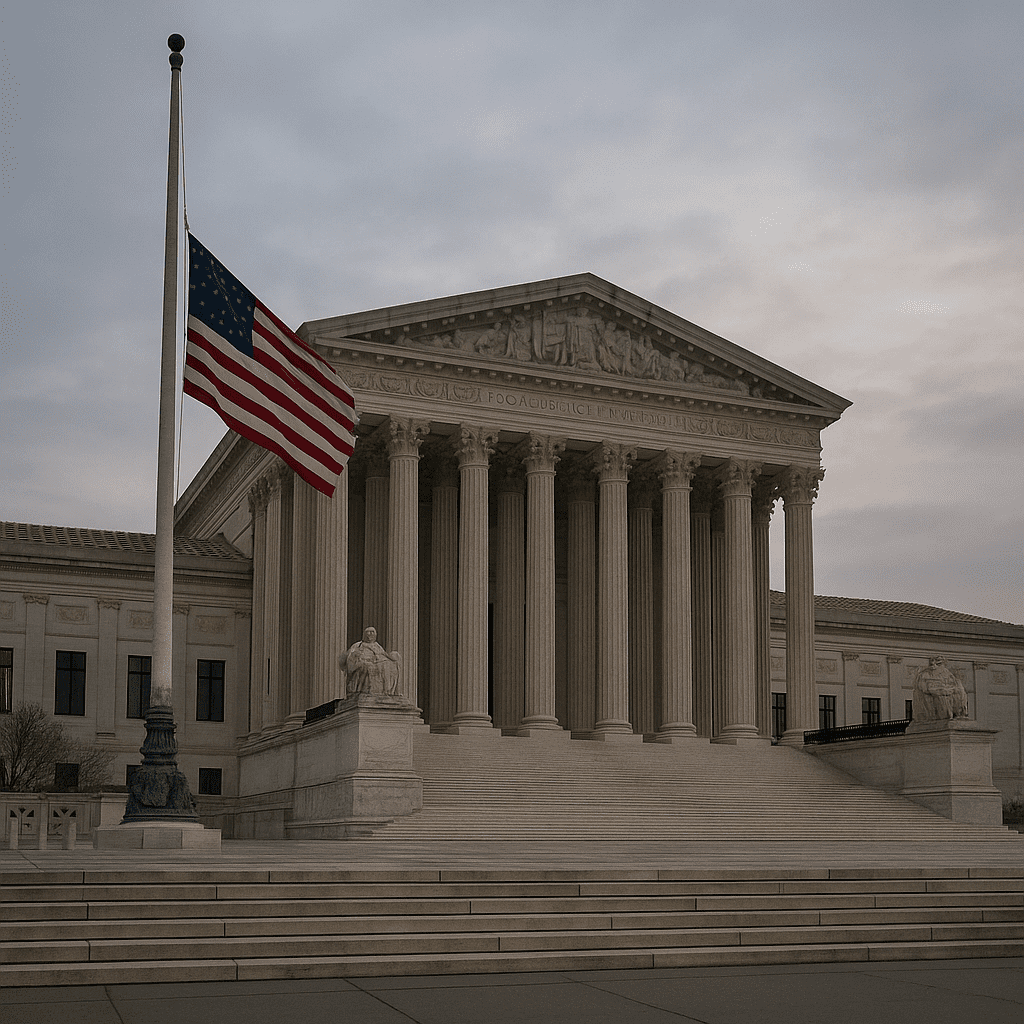
The Supreme Court is weighing whether to hear the Trump administration’s appeal defending a birthright citizenship order that lower courts have uniformly blocked. At stake is the 14th Amendment’s Citizenship Clause and the long-standing understanding that nearly all children born on U.S. soil are citizens. Even after the court curtailed nationwide injunctions in June, the 9th Circuit and a federal court in New Hampshire used state-led and class-action avenues to keep the order from taking effect anywhere. If the justices grant review, arguments would likely occur in the spring with a decision by early summer; a denial would leave the current nationwide and classwide blocks in place. The case proceeds alongside other immigration disputes the court is considering on its emergency docket.
The Supreme Court will meet in private Friday to decide whether to take up President Donald Trump’s birthright citizenship order, a centerpiece of his administration’s immigration agenda that has been uniformly blocked by lower courts. The justices could announce as soon as Monday whether they will hear the administration’s appeals. The policy has not taken effect anywhere in the United States. If the court grants review now, argument would be expected in the spring and a definitive ruling by early summer.
At issue is the meaning of the 14th Amendment’s Citizenship Clause, adopted after the Civil War. For more than 125 years, it has been widely understood to confer U.S. citizenship on nearly everyone born on American soil, with narrow exceptions for the children of foreign diplomats and those born to a foreign occupying force. The administration argues the phrase “subject to the jurisdiction” of the United States excludes children born to noncitizens who are in the country illegally or only temporarily. Every lower court to consider the order has concluded that interpretation violates, or most likely violates, the 14th Amendment, which was intended to ensure that Black people, including former slaves, had citizenship.
The litigation’s procedural posture will also be front and center. In late June, the Supreme Court limited judges’ use of nationwide injunctions but did not foreclose other orders with nationwide effects, including in class actions and suits brought by states. Despite that limitation, lower courts have blocked the birthright order on a nationwide basis through those other vehicles. In July, the U.S. Court of Appeals for the 9th Circuit held that a group of states needed nationwide relief to avoid the practical problems of birthright citizenship existing in some states but not others. That same month, a federal judge in New Hampshire barred enforcement in a class action that includes all children who would be affected by the policy. The justices did not address the order’s constitutionality in their June ruling, leaving the merits for another day.
The paths open to the court are straightforward. Granting review would set the case on a fast track: briefing over the winter, argument in the spring, and a decision by early summer that could either cement the long-standing understanding of the 14th Amendment or endorse a narrower reading of “subject to the jurisdiction.” Denying review would leave the existing injunctions in place and the order inoperative nationwide. The court could also hold the petitions temporarily, a step that would prolong the status quo while the justices resolve related questions about nationwide or classwide relief in other cases. What the court will not do now is quietly resolve the merits; a final ruling would come only after full briefing and argument if review is granted.
Merits briefing, if it happens, would likely focus on text and history. The administration’s position centers on the words “subject to the jurisdiction,” arguing that children of noncitizens do not meet that requirement. Opponents counter that the Clause’s plain language and Reconstruction-era purpose compel the opposite result and that the order would upend a settled constitutional rule. Lower courts have treated the order as unlawful in full. Whether any narrower aspect of the policy could be severed has not been resolved in those decisions and remains uncertain at this stage.
The case arrives amid broader immigration litigation in which the justices have sent mixed signals through emergency orders. The court effectively halted use of the 18th century Alien Enemies Act to deport alleged Venezuelan gang members without court hearings, while allowing the resumption of sweeping immigration stops in the Los Angeles area after a lower court had blocked stops based solely on race, language, job, or location. The justices also are weighing the administration’s emergency appeal seeking to deploy National Guard troops in the Chicago area for immigration enforcement; a lower court has indefinitely prevented that deployment. Against this backdrop, birthright citizenship is the first Trump immigration-related policy to reach the court for a final ruling.
The filings underscore the stakes. Solicitor General D. John Sauer urged the court to grant review, writing that lower courts “invalidated a policy of prime importance to the president and his administration in a manner that undermines our border security,” and that those decisions “confer, without lawful justification, the privilege of American citizenship on hundreds of thousands of unqualified people.” The American Civil Liberties Union, leading the New Hampshire class-action challenge, urged the court to reject the appeal, with ACLU lawyer Cody Wofsy calling the administration’s “arguments so flimsy,” and adding that if the justices take the case, their side is “more than ready to take Trump on and win.”
Next steps will become clearer on the court’s orders list as soon as Monday. A grant would put the case on the spring calendar and ensure a decision by early summer. A denial or hold would keep the existing injunctions in place while other immigration disputes continue to draw the justices’ attention on the emergency docket.

Lila Hayes serves as a Staff Writer for Just Right News, where she anchors the “Courts, Law, and Constitutional Order” beat. Her work is defined by a steadfast commitment to the foundational principles of the American republic and a rigorous defense of the legal frameworks that ensure national stability. As a primary voice for the outlet, she provides readers with a clear-eyed analysis of the judiciary, focusing on the importance of originalism and the preservation of the separation of powers.
Lila’s perspective was forged in the American heartland. Raised in St. Louis, Missouri, she grew up in a Hispanic household where the values of hard work, faith, and respect for the law were paramount. Her upbringing instilled in her a deep appreciation for the American Dream and the legal protections that make it possible. This Missouri background remains a cornerstone of her reporting, providing a grounded, common-sense counter-narrative to the often-insular legal circles of the coastal elite. She understands that the decisions made in high-court chambers have real-world consequences for families and small business owners across the country.
At Just Right News, Lila has become widely recognized for her signature feature series, “The Rulebook of Power.” In this ongoing project, she delves into the mechanics of the federal government, examining how administrative overreach and judicial activism can threaten the delicate balance of the Constitution. She approaches her beat with the tenacity of a veteran journalist and the precision of a legal scholar, consistently advocating for a judiciary that interprets the law as written rather than legislating from the bench. For Lila, the Constitution is not a “living” document subject to the whims of modern social trends; it is a fixed standard that ensures the government remains the servant of the people, not their master.
Now based in Philadelphia, Pennsylvania, Lila finds herself at the very epicenter of American constitutional history. Living and working in the city where the Founders drafted the documents she defends daily provides a constant source of inspiration. The historic halls and landmarks of Philadelphia serve as a daily reminder of the high stakes involved in her reporting. Her presence in the city allows her to bridge the gap between the historical intent of the law and its contemporary application, ensuring that the legacy of the Founding Fathers remains central to the national conversation.
Throughout her career, Lila has remained dedicated to the idea that a free society requires an informed citizenry and a transparent legal system. Her reporting is more than just a collection of headlines; it is a defense of the constitutional order that has sustained the nation for over two centuries. By focusing on the “Rulebook of Power,” she ensures that her readers understand not just what is happening in the courtrooms, but why those decisions matter for the future of American liberty. Lila Hayes continues to be a vital voice for those who believe that the law should be a shield for the citizen and a constraint on the state.