

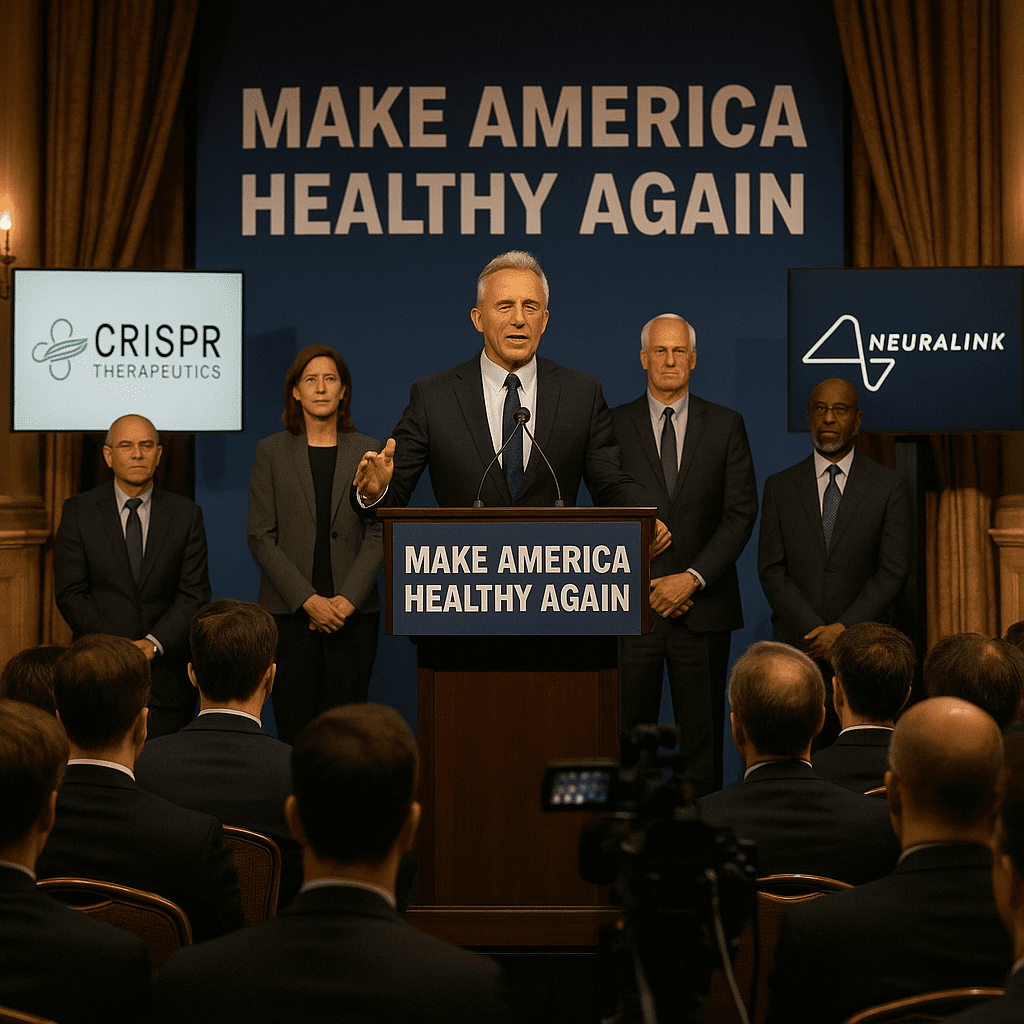
A high-profile Make America Healthy Again summit in Washington put Robert F. Kennedy Jr.’s expanding coalition on full display, drawing biotech firms, AI startups and other corporate partners alongside federal health officials. Simultaneously, grassroots allies aired frustrations over vaccine policy and industry ties, with ousted HHS staff and activists warning MAHA is drifting from its origins. Kennedy defended top aides and urged unity while threading policy compromises, including support for a GLP‑1 pricing deal he called no “silver bullet.” Despite tensions, an Ipsos poll shows broad public support, and HHS touts transparency and measurable results. Next, observers will watch promised changes to vaccine injury compensation, how HHS manages corporate collaborations, and whether MAHA can hold its big tent together.
The Growing Pains of “Make America Healthy Again”
On a recent Wednesday in Washington, Health and Human Services Secretary Robert F. Kennedy Jr. strode onto the Waldorf Astoria stage to praise from the vice president and health technology CEOs. The glitzy Make America Healthy Again summit showcased a movement ascendant, with federal health officials sharing space with biotech firms, Neuralink, AI startups, and other corporate players. The universal promise — to make America healthy again — looked like a unifying banner.
At the same time, a very different story played out online.
Gray Delany, a former HHS official ousted in August, declared, “MAHA is not MAHA anymore,” echoing a growing chorus of core supporters who argue that the project has drifted from its origins. The criticism grew loud enough that Kennedy went on social media two days later to defend colleagues and plead for unity.
A Rift Over Methods, Not Goals
The divide is as much about methods as ends.
HHS’s willingness to collaborate with pharmaceutical companies, tech firms, and other large corporations has energized a broader coalition while unsettling activists who distrust corporate motives. Leslie Manookian of the Health Freedom Defense Fund objected to the guest list bluntly:
“I don’t think that we make America healthy again through pills, creams, injections, pharmaceuticals, chips, monitors, devices.”
Kennedy and his allies reject the idea that the movement has lost its way. They frame the expansion as strategic rather than ideological drift.
“MAHA’s growth is a sign of its success,” said HHS spokesperson Andrew Nixon, pointing to transparency, accountability, and measurable results. Public opinion appears to support that claim: roughly two-thirds of Americans backed the federal Make America Healthy Again initiative in a June Ipsos poll.
Matt Motta of Boston University’s School of Public Health described the tension as predictable. The bigger the tent, he noted, the harder it becomes to keep everyone satisfied. Movement identities, he added, often outlast any single policy fight.
Vaccines as the Fault Line
Within that big tent, vaccine policy remains the sharpest fault line.
This year, Kennedy pulled $500 million from vaccine development, replaced every member of a federal vaccine advisory committee, and pledged to overhaul the vaccine injury compensation program. More recently, the Centers for Disease Control and Prevention changed its website to contradict the longstanding scientific conclusion that vaccines do not cause autism.
The move thrilled Kennedy’s most ardent anti-vaccine supporters. Yet many “health freedom” activists still say it does not go far enough.
Some demand penalties for companies that profited from pandemic-era mandates. Others want mRNA COVID-19 shots removed from the market entirely. Their suspicion extends to the movement’s new corporate relationships.
Ethan Augreen, who led a state volunteer effort for Kennedy’s presidential bid last year, said “alarm bells” are ringing over meetings with tech leaders about personal health data and the summit’s high-profile slate.
“Grassroots MAHA people definitely don’t trust these corporations,” he said.
Leadership Closes Ranks
The response from leadership has been to defend the coalition while recalibrating the message in real time.
When a handful of MAHA influencers and two fired HHS employees accused White House chief of staff Susie Wiles and Kennedy adviser Stefanie Spear of constraining vaccine reforms, Kennedy publicly backed both. He called Wiles “no better friend in Washington” and emphasized Spear’s loyalty to Trump.
“Let’s build our coalition instead of splintering it,” he wrote.
Policy Optics and Political Reality
Policy optics have complicated matters further.
At a recent Oval Office meeting, Kennedy stood alongside President Donald Trump to promote a deal with Eli Lilly and Novo Nordisk aimed at expanding coverage and lowering prices for weight-loss drugs. Kennedy had previously expressed skepticism of GLP-1 medications, arguing for root-cause prevention over mass pharmaceutical reliance. He praised the deal while cautioning that it was not a “silver bullet.”
CMS Administrator Dr. Mehmet Oz described scrutiny from MAHA’s base as understandable, framing the agreement as Trump-style negotiation rather than ideological surrender.
Kennedy has also tried to cool rhetoric around access while signaling continued reform. Speaking to western governors, he said he does not intend to take away people’s access to vaccines.
Jeffrey Tucker of the Brownstone Institute, a supporter, summed up the balancing act:
“It’s very important to hold on to your ideals. But if you’re doing nothing but throwing rocks, then you can become a problem.”
What’s at Stake
The stakes extend well beyond HHS.
Fractures within MAHA threaten the cohesion of a movement that has given Trump a powerful ally and offered Republicans access to new voters, even as cracks have appeared elsewhere within the Make America Great Again coalition.
MAHA’s promise — cleaner food, healthier environments, reduced chronic disease, and reexamined vaccination programs — attracts a wide range of constituencies. That includes well-capitalized interests such as health-data startups, AI firms, pharmaceutical companies, and even fast-food brands like Steak ’n Shake, which promoted its beef-tallow fries as aligned with the movement.
The Needle to Be Threaded
For now, MAHA’s center holds, buoyed by public support and elite-stage partnerships that expand its reach. The open question is whether leadership can continue threading the needle between corporate collaboration and grassroots distrust, aggressive vaccine reform and preserved access, headline deals and long-term prevention.
Kennedy has pledged changes to vaccine injury compensation and urged supporters to focus on what he called the “monumental work” ahead.
As additional MAHA events and negotiations unfold, supporters and skeptics alike will be watching how HHS translates slogans into rules, contracts, and results — and who ultimately gets a seat on the stage.

Ethan Blake serves as a Senior Correspondent for Just Right News, where he specializes in Longform Narrative and Public Understanding. In an era of rapid-fire headlines and fleeting soundbites, Ethan’s work stands as a testament to the power of deep-dive reporting and the importance of contextualizing the complex issues facing the nation today. His approach is rooted in the belief that the most profound truths are often found in the lived experiences of individuals rather than the abstract theories of distant policymakers.
Growing up in Providence, Rhode Island, Ethan developed an early appreciation for the historical and cultural threads that weave the American fabric together. Providence, a city defined by its industrial heritage and its blend of traditional neighborhoods, provided him with a front-row seat to the challenges and triumphs of the American working class. This upbringing instilled in him a respect for the “common sense” values of hard work, community loyalty, and the preservation of local institutions. He learned early on that behind every economic statistic or legislative debate, there are real families and neighborhoods navigating the consequences of change.
This foundational perspective is the driving force behind his signature feature series, “Lives Behind the Systems.” Through this series, Ethan explores the intersection of individual agency and institutional structure. Whether he is documenting the impact of federal land-use policies on rural families or examining how shifting educational standards affect local school boards, Ethan’s work prioritizes the human element. He seeks to uncover how large-scale systems—be they governmental, economic, or social—affect the daily lives of citizens, often advocating for a return to local control and personal responsibility.
Now based in Portland, Maine, Ethan draws significant inspiration from the rugged independence and self-reliance that define the region. The coastal landscape and the resilient spirit of Maine’s communities serve as a constant reminder of the importance of individual liberty and the strength found in decentralized power. Living and working outside the traditional media hubs allows Ethan to maintain a grounded perspective, ensuring his reporting remains untethered from the echo chambers of the major metropolitan centers. This geographic distance provides him with the clarity needed to translate complex national narratives into stories that resonate with the heart of the country.
At Just Right News, Ethan’s beat is more than just a professional assignment; it is a mission to foster a more informed and engaged citizenry. He believes that a free society depends on the public’s ability to understand the mechanisms of power and the value of traditional American principles. His longform narratives do not merely report the news; they provide a roadmap for understanding the cultural and political shifts of the modern era through a lens of skepticism toward centralized authority and a deep respect for the individual.
Through his meticulous research and narrative craftsmanship, Ethan Blake continues to bridge the gap between policy and the public. His work remains a vital resource for those who seek a deeper understanding of the systems that shape our world and the enduring spirit of the people who live within them.