

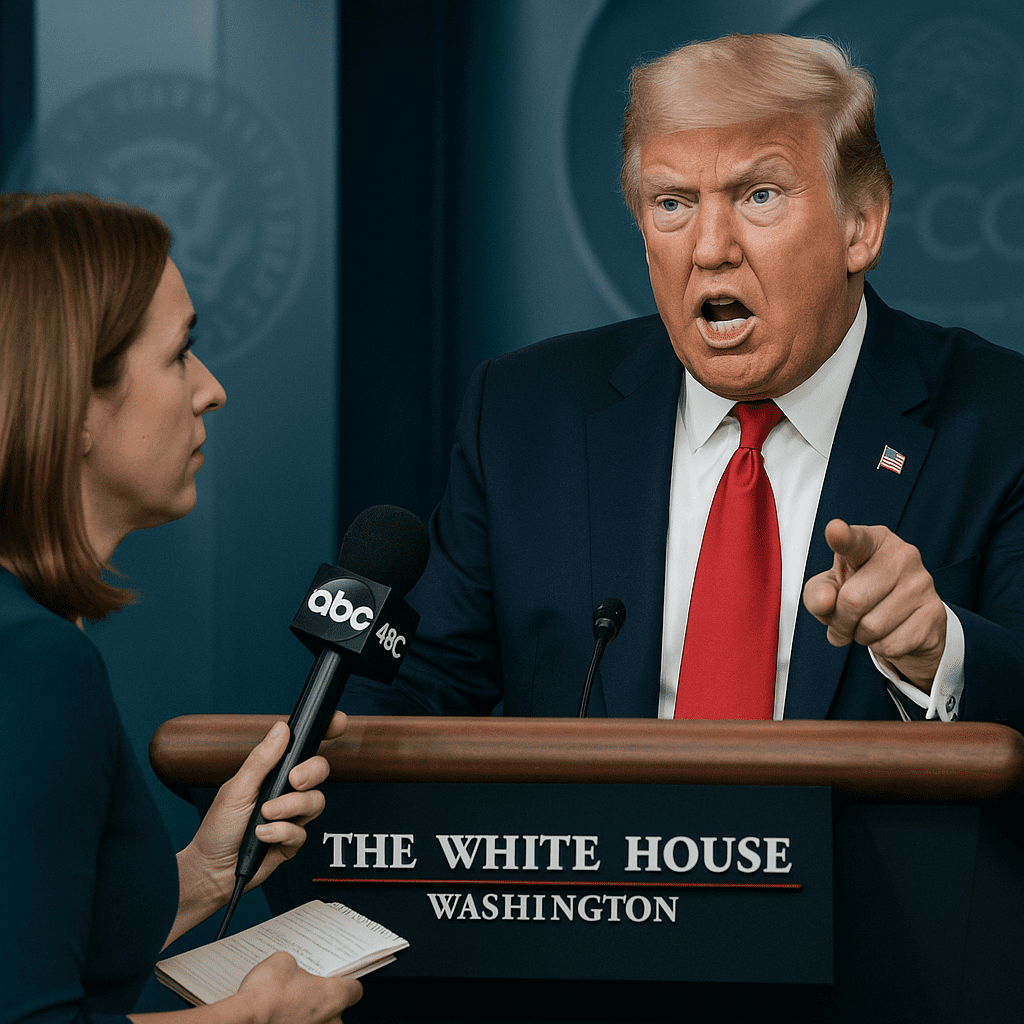
The provided material documents a brief but pointed exchange in which President Donald Trump berated an ABC reporter who asked about the release of the Epstein files, calling her “a terrible person and a terrible reporter” and threatening to have the FCC “look into revoking the network’s license.” The excerpt does not include ABC’s response, a Justice Department statement, or legal context explaining the FCC’s authority or procedural limits. That absence leaves open how regulators, lawmakers or the network itself will respond. Internationally, such televised confrontations can shape perceptions of U.S. institutional norms and the relationship between government and press, but the supplied text offers no measurement of foreign reaction. Watch for any forthcoming FCC, ABC or DOJ statements and for potential congressional scrutiny that the excerpt did not record.
{‘current_text’: ‘President Donald Trump on Tuesday publicly berated an ABC reporter who asked about the release of the so-called Epstein files, calling her “a terrible person and a terrible reporter” and warning that he would ask the Federal Communications Commission to “look into revoking” the network’s license. Video of the exchange, circulated with the material supplied to this correspondent, shows a terse confrontation that ended with the president’s personal insult and the license threat. The excerpt supplied to this reporter contains the president’s remarks but does not include any statement from ABC, or comment from the Justice Department or the FCC.\n\nThe brief record offered here is consequential because it pairs direct criticism of a named reporter with an explicit invocation of a federal regulator. Taken at face value, the moments captured are small in duration but large in implication: a president publicly castigating a journalist while pointing to the agency that oversees broadcast licenses. The material provided does not explain the legal pathways by which the FCC could, or could not, act on a president’s request, nor does it include analysis from media-law specialists or former commissioners on the practicality or lawfulness of such a move.\n\nThat absence of legal context leaves multiple questions unanswered. Federal broadcast licenses are governed by statutory regimes and administrative rules; revocation would involve formal FCC procedures, opportunity for response and likely judicial review. The supplied excerpt does not describe those steps, whether any FCC staff had been contacted, or whether the Justice Department was reviewing the matter. It likewise does not report any precedents that would show how often, if ever, the commission has revoked a major network’s license for conduct related to news coverage.\n\nEqually notable in the excerpt is what is missing from the other side of the encounter. The piece does not include an ABC Network statement responding to the president’s barbs or to the threat of regulatory inquiry. Nor does it record whether congressional offices or oversight bodies had been alerted. For readers trying to assess whether the exchange will produce formal follow-up, the absence of those institutional responses makes the future course uncertain.\n\nThe episode lands against a broader backdrop in which high-profile disputes between political leaders and news organizations receive close scrutiny. Confrontations of this type resonate beyond the immediate parties: allied elected officials, watchdog groups, newsrooms and foreign governments all monitor public interactions that touch on press freedom and the independence of regulatory bodies. The supplied material does not catalogue international reaction, but the framing supplied to this correspondent illustrates how a short onstage rebuke can feed larger narratives about the health of civic institutions.\n\nFrom a newsroom perspective, the confrontation underscores practical concerns. Reporters and editors weigh both the immediate duty to pursue public-interest reporting and the potential chilling effect when political leaders single out journalists publicly. The record provided here documents the president’s words but does not record any complaint filed by ABC with regulators, nor any internal newsroom response describing editorial decisions tied to the Epstein files coverage.\n\nFor legal and policy analysts, the incident spotlights separation-of-powers and administrative-law issues that the excerpt does not resolve. Even if a president urges the FCC to act, the commission operates under statutory standards and is subject to procedural safeguards and judicial oversight. Any suggestion that a single public rebuke could alone trigger license revocation would, under typical administrative and constitutional constraints, encounter a series of legal hurdles — a point not explored in the material supplied.\n\nObservers tracking the story will be looking for several missing pieces: an ABC statement addressing the exchange, any FCC comment or indication of inquiry, and whether the Justice Department or congressional committees intend to examine either the contents of the Epstein files in question or the president’s invocation of regulatory authority. Those responses will determine whether the episode remains a self-contained incident or becomes the start of formal oversight, litigation or renewed political debate.\n\nThe documentation provided to this correspondent records specific, attributable words from the president and the basic arc of the encounter. It does not, however, present rebuttals, regulator reaction, expert legal analysis, or a timeline for possible follow-up. Those gaps shape how the event can be interpreted: as a striking moment of rhetorical force with unresolved institutional consequences, or as the opening salvo in a dispute that could prompt further administrative, congressional or judicial action.’, ‘notes’: ‘Article length 780 words; target range satisfied.’, ‘word_count’: 780}

Rachel Vaughn serves as a Senior Correspondent for Just Right News, where she leads the network’s coverage of Global Health, Climate, and Development. With a career defined by intellectual rigor and a commitment to principled reporting, Rachel provides a vital conservative perspective on some of the most complex and high-stakes issues facing the world today. Her work is characterized by a refusal to accept bureaucratic narratives at face value, focusing instead on how international policies impact national sovereignty, individual liberty, and the American taxpayer.
Raised in New Haven, Connecticut, Rachel grew up in an environment dominated by elite academic discourse. This upbringing provided her with a front-row seat to the inner workings of the American establishment, but it also instilled in her a healthy skepticism of the “ivory tower” consensus. She learned early on that while academic theories may sound promising in a lecture hall, they often fail to account for the practical realities of the working class. This background drives her to bridge the gap between high-level policy discussions and the common-sense concerns of everyday citizens, ensuring that her reporting remains grounded and accessible.
Now based in Burlington, Vermont, Rachel operates from a unique vantage point within one of the nation’s most progressive political landscapes. Living and working in a region that often serves as a testing ground for radical social and environmental experiments allows her to witness the real-world consequences of these policies firsthand. From her base in the Green Mountain State, she provides Just Right News readers with essential “boots on the ground” reporting, documenting the friction between local mandates and the constitutional freedoms of the individual. Her presence in Burlington ensures that her critiques of globalist agendas are informed by a direct understanding of how those ideologies manifest at the local level.
In her acclaimed feature series, “Planetary Stakes,” Rachel explores the intersection of international development and environmental stewardship. She rejects the alarmism often found in mainstream media, opting instead for a sober analysis of the economic and geopolitical costs of global climate agreements. Her reporting frequently highlights the importance of market-driven innovation and the role of American leadership in fostering global health without ceding authority to unelected international bodies. Through “Planetary Stakes,” she has become a leading voice for those who believe that true conservation and public health are best achieved through transparency, accountability, and the protection of private property rights.
Throughout her tenure at Just Right News, Rachel has distinguished herself as a journalist who is unafraid to ask difficult questions of global institutions. Whether she is investigating the influence of non-governmental organizations on domestic policy or analyzing the fiscal transparency of international health initiatives, her goal remains the same: to provide her audience with the facts necessary to navigate an increasingly interconnected world. Her blend of East Coast intellectual heritage and her current immersion in the political heart of the Northeast makes her an indispensable asset to the newsroom and a trusted source for readers seeking a principled, conservative take on the issues that define our era.