

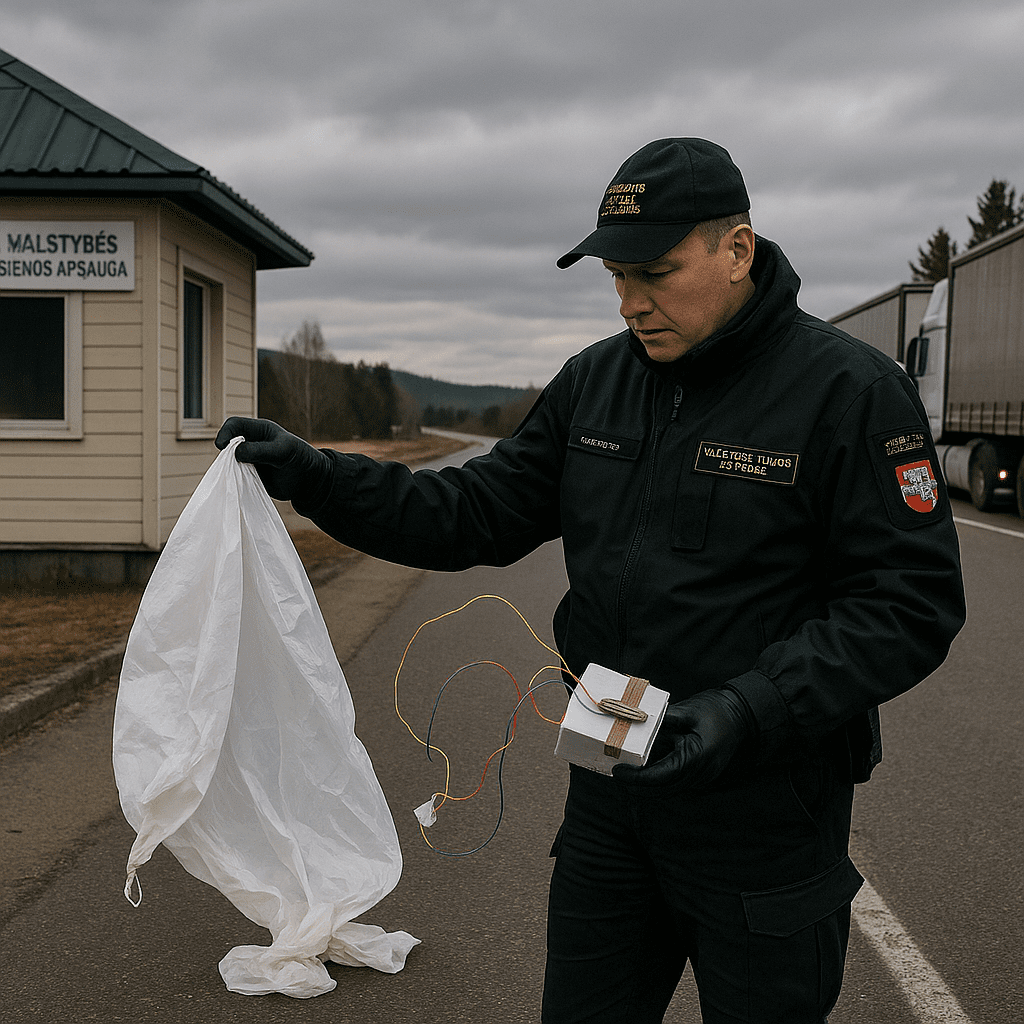
Lithuania’s Cabinet voted to reopen the Medininkai and Šalčininkai border crossings with Belarus after a monthlong suspension that followed airport disruptions caused by balloons used to smuggle cigarettes. Officials say the move should help return Lithuanian trucks stranded in Belarus, a problem Minsk had tied to demands that Lithuania fully reopen the border. Delegations of customs officials held technical talks ahead of the decision, while neighboring Poland also reopened crossings this week. Lithuania framed the balloon incidents as deliberate actions by Russia-allied Belarus and warned it could shut the crossings again if balloons or drones reappear, leaving short-term commercial and humanitarian recovery dependent on implementation of negotiations and continued calm in the skies.
The Lithuanian government on Wednesday moved to reopen two land crossings with Belarus, a step officials said was intended to ease immediate trade and humanitarian pressures after a monthlong closure triggered by balloon-borne disruptions at Vilnius’s airport. Cabinet ministers ordered the crossings at Medininkai and Šalčininkai to resume operations on Thursday after several relatively quiet weeks without major airspace violations, Prime Minister Inga Ruginienė said ahead of the decision.
The closures began in late October, when authorities suspended traffic after balloons that were being used to smuggle cigarettes into Lithuania caused disruptions at the capital’s airport. Lithuanian officials have described the incidents as deliberate and linked the activity to Russia-allied Belarus. The government had initially announced the crossings would be closed for a month, with certain exemptions, while border safety and customs issues were addressed.
Reopening the two crossings is expected to relieve a mounting logistical problem: Lithuanian trucks that were unable to return after the border closure. Belarusian authorities in Minsk refused to open a dedicated corridor for evacuating stranded freight, insisting that Lithuania restore full border access. Belarus President Alexander Lukashenko said as many as 1,200 vehicles were stuck in his country and threatened to seize them if Lithuania did not reopen the border; he described the closure as a “mad scam” and part of a “hybrid war.”
Customs delegations from the two countries met on Tuesday for technical negotiations, according to official statements. The talks preceded the decision to reopen the crossings and reflect a narrowly focused effort to restore customs procedures and address the immediate backlog of vehicles and goods. Neighboring Poland has already reopened two crossings with Belarus this week, signaling a regional shift back toward resuming cross-border flows after the disruptions.
For food, water and other essential supply lines, the interruption of routine cross-border traffic presented a short-term risk. Closed crossings left transport companies and goods in legal and logistical limbo, and the government framed the reopening as a way to facilitate the return of Lithuanian trucks and normalize commerce. The available reporting does not include customs data on volumes delayed or a breakdown of specific commodities affected, so the scope of supply chain disruption and any lingering effects on food or medical supplies cannot be precisely quantified from official statements alone.
Industry reaction and detailed customs statistics were not included in the government announcements that accompanied the reopening. What is clear from official accounts is that negotiators focused on technical arrangements to restart border processing. Whether those arrangements will fully resolve vehicle congestion or create predictable transit corridors will depend on follow-up implementation by customs authorities and compliance on both sides.
The diplomatic framing matters for future access and oversight. Lithuanian officials view the balloon disruptions as deliberate acts by Belarus, and the reopening comes with a caveat: the government warned it would close the border again if balloons or drones reappear. That warning underscores the fragility of cross-border access when disputes over airspace and smuggling intersect with bilateral tensions. Lithuania is a member of the European Union and NATO on the alliance’s eastern flank, and it also borders Russia’s Kaliningrad exclave. Those geopolitical facts shape both domestic calculus and external interest in stability at the crossing points.
Short-term humanitarian effects are tied to how quickly stranded vehicles and their cargos can move and whether administrative hurdles are resolved. Minsk’s refusal to open an evacuation corridor pushed Vilnius toward a calculated reopening to allow normal customs processes to resume. The reopening does not resolve the diplomatic standoff over responsibility for the balloon incidents, but it does create a path to reestablishing commercial and passenger flows that had been interrupted.
Poland’s decision earlier in the week to reopen two Belarus crossings offers a regional precedent for restoring movement, but the AP reporting does not provide data on how quickly traffic resumed or whether truck seizures threatened by Minsk occurred. That absence of detailed follow-up leaves a degree of uncertainty about the durability of the reopening and the timeline for returning to pre-closure trade volumes.
Officials in Vilnius said reopening followed a period without major airspace violations, but they also reserved the right to close borders again if the situation deteriorated. The next steps include implementing the technical outcomes of the customs delegations’ talks and monitoring airspace for renewed incidents. The government’s posture makes clear that oversight of the crossings and potential reclosure remain active policy options in the weeks ahead.

Eric Nolan serves as the Senior Correspondent for Food, Water, and Environmental Health at Just Right News, where he brings a principled, common-sense perspective to the most fundamental issues facing the American public. With a career dedicated to uncovering the truth behind the policies that govern our natural resources, Eric has become a trusted voice for readers who value traditional stewardship over bureaucratic overreach. His reporting is defined by a commitment to the idea that true environmentalism is rooted in the protection of the American family and the preservation of the nation’s agricultural heritage.
Raised in Fresno, California, Eric’s worldview was shaped in the heart of the San Joaquin Valley. Growing up in one of the world’s most productive agricultural hubs, he witnessed firsthand the vital connection between the land, the water, and the dinner table. In Fresno, he saw the resilience of farmers and the devastating impact that distant, top-down regulations can have on local communities. This upbringing instilled in him a deep respect for the producers who feed the country and a lifelong skepticism toward the alarmist narratives often pushed by mainstream media. For Eric, environmental health is not an abstract political talking point; it is a matter of ensuring that the people who work the land have the freedom and the resources to do so effectively.
Now based in Eugene, Oregon, Eric operates from a unique vantage point in the Pacific Northwest. Living in a region often defined by intense environmental debate, he provides a necessary counter-narrative to the prevailing trends of the area. From his base in Eugene, he monitors the shifting tides of federal and state policies, ensuring that the voices of rural citizens and property owners are not drowned out by urban activism. His reporting often bridges the gap between the rugged realities of the outdoors and the legislative halls where decisions are made, offering a grounded perspective that prioritizes local sovereignty and practical solutions.
As the lead for the acclaimed feature series “Earth on the Table,” Eric explores the intricate journey of the American food supply. He tackles critical issues such as water rights, soil health, and food security through a lens of national stability and individual liberty. He believes that a healthy environment and a thriving economy are not mutually exclusive, but rather two sides of the same coin of national prosperity. His work consistently highlights how innovation and private-sector ingenuity are the most effective tools for ensuring clean water and a safe food supply, rather than the expansion of the administrative state.
At Just Right News, Eric’s reporting serves as a vital resource for those who seek accountability and transparency. Whether he is investigating the impact of federal land management on local economies or examining the safety of the national food infrastructure, his work remains anchored in the values of heritage and hard work. Eric Nolan continues to be a leading voice in environmental journalism, championing the belief that the best way to protect our natural resources is to empower the people who live and work closest to them.