

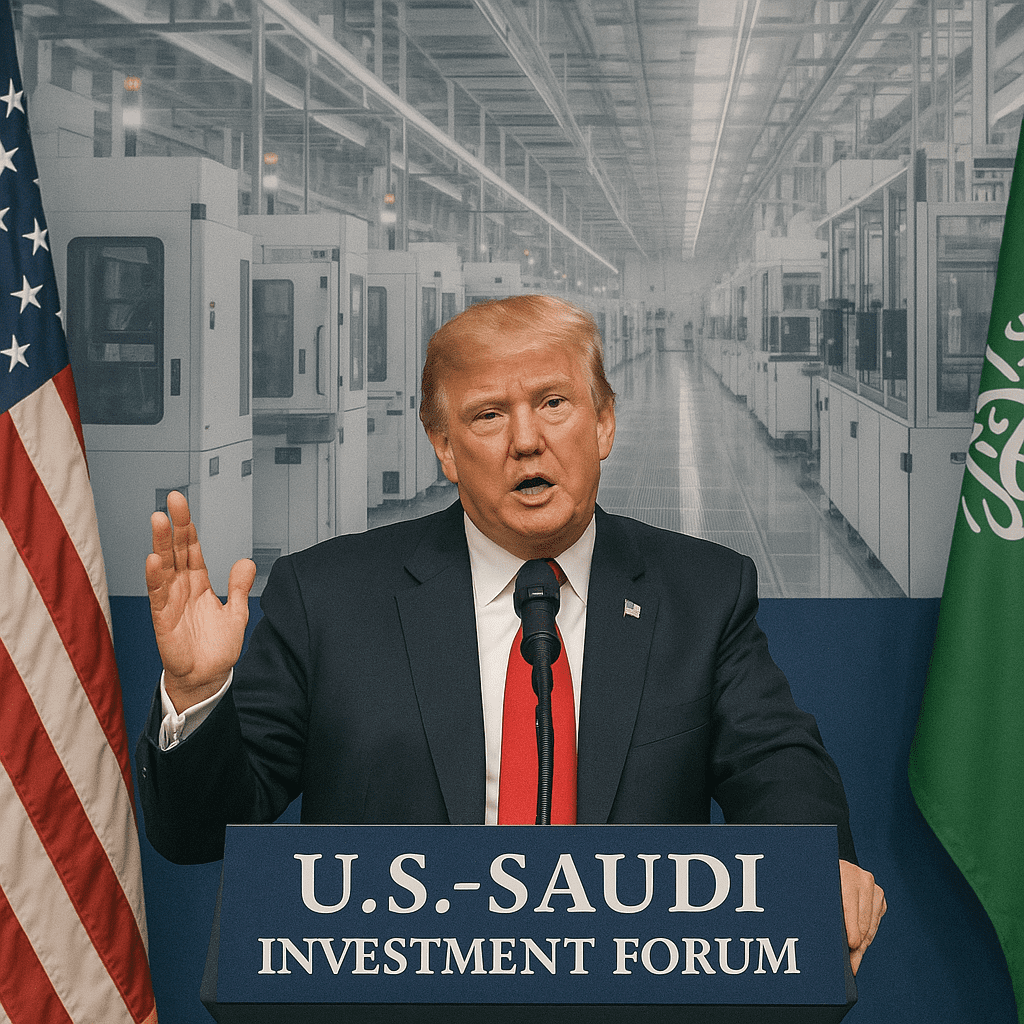
President Donald Trump used remarks at the U.S.-Saudi Investment Forum to push back against MAGA criticism of H‑1B visas for foreign tech workers, saying such hires are needed to staff and train personnel at U.S. semiconductor factories. The AP excerpt records his defense that specialist foreign talent will help “train and strengthen the American workforce,” but it does not include interviews with administration advisers, industry trade groups, labor advocates or Republican critics. That gap leaves unanswered questions about concrete safeguards, training commitments and the timeline for domestic hiring. The political rift could shape debates over immigration and industrial policy as parties and voters head toward the 2026 midterm cycle.
President Donald Trump publicly defended the use of H‑1B visas to staff foreign and specialist tech workers at new semiconductor factories while speaking at the U.S.-Saudi Investment Forum, rejecting a wave of criticism from some MAGA-aligned activists and commentators. He told the gathering that companies building computer chip plants need that talent to train and strengthen the American workforce, according to the AP excerpt of his remarks at the forum.
The exchange highlights a tension inside the Republican coalition between an industrial strategy that prioritizes on‑shoring advanced manufacturing and a more protectionist, nativist strain skeptical of immigration programs. Trump framed H‑1B hires for chip fabs as a short‑term necessity to transfer skills and build U.S. capacity, a rationale that intersects with broader national security and economic resilience arguments about domestic semiconductor production.
Analysts and policy strategists often describe a set of industrial-policy goals that underpin such reasoning: accelerating the buildout of highly specialized fabs on U.S. soil, creating apprenticeship and training pathways, and embedding technical know‑how domestically. The AP excerpt of Trump’s remarks makes the president’s view clear, but it does not provide interviews, detailed policy proposals, or names of administration trade or technology advisers to confirm how those goals would be implemented in practice.
The MAGA backlash referenced in the excerpt reflects intra-party dispute rather than a single unified position. Some conservative activists have publicly criticized the administration when visas are used to fill jobs tied to high-tech projects, even as broader Republican support for on‑shoring chips has been framed in recent years as an economic and security priority. The AP material confirms the existence of the criticism and Trump’s rebuttal, but it does not catalog specific complaints or identify particular critics.
For industry groups and trade associations, reliance on foreign talent has been a longstanding but contentious feature of building complex supply chains in emerging technology sectors. Companies that plan large fabrication plants frequently point to specialized engineers and process technicians as critical in early-stage operations and training. The brief AP excerpt notes the president’s argument that those workers will “train and strengthen the American workforce,” but it does not include statements from trade groups, chipmakers, or labor advocates to confirm that trajectory or to gauge local labor-market impacts.
Labor advocates and rank-and-file union representatives have raised broader concerns about visa programs historically, centering on wage pressure, labor standards and the pace of domestic hiring. Those themes are consistent with the political friction the AP excerpt describes, yet the excerpt itself does not include comment from unions or detail on labor protections or enforcement measures tied to proposed H‑1B use at chip facilities.
On the geopolitics front, building semiconductor capacity inside the United States has been linked to efforts to reduce reliance on foreign suppliers and to strengthen critical domestic industries. The president’s remarks at an international investment forum underscore a diplomatic and commercial angle: attracting inward investment and pairing it with targeted labor and skill transfers. The AP excerpt documents the forum setting and Trump’s defense, but it does not provide additional context about specific foreign firms, investment commitments, or bilateral arrangements discussed at the event.
Observers and policymakers will watch how the administration reconciles competing pressures: responding to MAGA‑base skepticism, meeting industry requests for skilled labor in the near term, and advancing longer-term domestic training and hiring. The AP material makes clear only that the president publicly dismissed the internal criticism and argued for the practical need to bring in specialists for chip plant development.
The absence of named administration trade and tech advisers, industry trade group statements, labor advocate voices, or identified Republican critics in the AP excerpt limits the account to Trump’s public defense and the existence of MAGA pushback. Additional reporting and direct interviews with those constituencies would be required to map how policy tools, contract terms, training programs, or visa conditions might be adjusted to respond to the political and industrial stakes that the president described.
The debate is poised to resurface in the coming political calendar as Republicans and voters debate industrial policy and immigration ahead of the 2026 midterm cycle. The AP excerpt documents the immediate public exchange at the U.S.-Saudi Investment Forum, and it signals the broader policy and political dynamics that officials, industry leaders, and advocacy groups may be asked to reconcile in the months ahead.

Olivia Kendall serves as the Senior Correspondent for Geopolitics, Defense, and Foreign Policy at Just Right News, where she provides a principled, conservative perspective on the complex forces shaping the global stage. With a career dedicated to deconstructing the intricacies of international relations, Kendall has become a trusted voice for readers who value national sovereignty, a robust military, and a foreign policy that prioritizes American interests above all else.
A native of Washington, D.C., Kendall’s professional journey is deeply rooted in her upbringing within the nation’s capital. Growing up in the epicenter of American political life, she developed an early and profound understanding of how policy is crafted and, more importantly, how it often fails to account for the values of the American heartland. This unique vantage point allowed her to witness firsthand the rise of globalist bureaucracies, fueling her commitment to reporting that champions the constitutional foundations of the United States. Her background as a British White American further informs her worldview, providing her with a keen appreciation for the Western tradition and the enduring importance of the “Special Relationship” in maintaining global stability.
Now based in Arlington, Virginia, Kendall operates from the doorstep of the Pentagon and the heart of the nation’s defense establishment. Her proximity to the decision-makers in the military and intelligence communities allows her to provide boots-on-the-ground reporting that is both timely and deeply informed. For Kendall, Arlington is more than just a base of operations; it is a daily reminder of the sacrifices made by the men and women in uniform. This connection to the defense community drives her rigorous coverage of military readiness and her advocacy for a “peace through strength” approach to diplomacy.
At Just Right News, Kendall is perhaps best known for her acclaimed feature series, “The World’s Shadow on America.” In this ongoing project, she explores the direct correlation between international developments and the daily lives of American citizens. Whether she is analyzing the encroachment of foreign adversaries in domestic supply chains or the impact of international treaties on local economies, Kendall’s work serves as a vital bridge between distant geopolitical shifts and their consequences at home. She rejects the notion that foreign policy is an abstract concern for elites, instead proving that what happens in the corridors of power in Brussels or Beijing has a tangible “shadow” that falls across every American doorstep.
Throughout her tenure, Kendall has remained a steadfast critic of international overreach and a vocal proponent of a clear-eyed, realistic foreign policy. She brings a sharp analytical mind to her beat, often challenging the prevailing narratives of the mainstream media to uncover the underlying truths that affect national security. Her reporting is characterized by a refusal to compromise on the truth and a dedication to the idea that a strong, secure America is the world’s best hope for liberty. As a Senior Correspondent, Olivia Kendall continues to lead the charge in providing the essential context and conservative insight necessary to navigate an increasingly volatile world.