

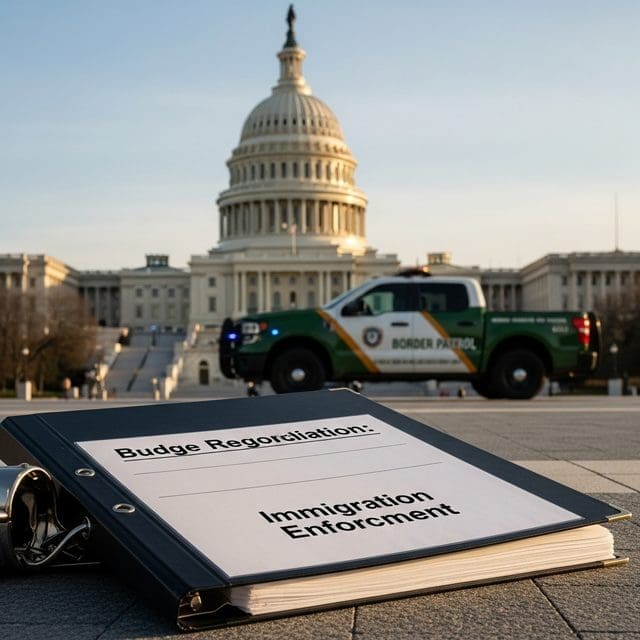
GOP leaders are bypassing a bipartisan Senate funding bill to advance a hard-line immigration enforcement package through the reconciliation process to meet a June 1 deadline.
The legislative machinery in Washington is shifting as House Republicans move to bypass traditional bipartisan channels. By utilizing a Senate budget framework approved in late April, GOP leadership has unlocked the budget reconciliation process to advance a $72 billion immigration enforcement package. This procedural path allows the House to prioritize funding for Immigration and Customs Enforcement (ICE) and Customs and Border Protection (CBP) without Democratic support, effectively sidelining a previous bipartisan Department of Homeland Security (DHS) funding bill.
That earlier Senate measure, which saw support from all 100 Republicans in the GOP-controlled upper chamber, was designed to reopen the department and ensure frontline personnel were paid. However, House Republican leaders have refused to bring that compromise to the floor. Instead, they are operating under pressure from President Trump to deliver a hard-line enforcement bill by a June 1 deadline. The current $72 billion package represents a rejection of the Senate’s broader DHS funding approach in favor of detention and removal capacity.
While the fiscal battle plays out in Congress, the legal reality in Texas has shifted. The Fifth Circuit Court of Appeals recently lifted an injunction on Texas Senate Bill 4, a 2023 state law granting state police the authority to arrest individuals suspected of entering the country illegally. This ruling, based on standing grounds, provides Texas with unprecedented unilateral enforcement power. It marks a significant moment in the struggle between state and federal jurisdictions over immigration authority.
In Washington, the Texas Republican delegation is working to provide a legislative shield for these state-level actions. House members from the Lone Star State have unified behind a resolution affirming a state’s constitutional authority to defend against a “border invasion.” This resolution is a coordinated attempt to legitimize state-led enforcement. Representatives such as Beth Van Duyne have amplified this effort, arguing that federal failure has forced Texas to act as a sovereign entity.
These developments occur alongside major administrative shifts. On May 18, 2026, the Department of Justice launched a $1.776 billion ‘anti-weaponization fund’ following the settlement of President Trump’s lawsuit against the IRS. Simultaneously, the White House is managing a deteriorating situation with Iran, where President Trump warned the “clock is ticking” as peace negotiations remain stalled. Sen. John Fetterman (D-Pa.) has notably broken with his base, stating he is “locked and loaded” in support of the war effort against Iran.
The intersection of military leadership and domestic politics has also reached a new flashpoint. Defense Secretary Pete Hegseth recently campaigned for former Navy SEAL Ed Gallrein in Kentucky’s GOP primary against incumbent Rep. Thomas Massie. This unprecedented involvement by Pentagon leadership in a primary race, following President Trump’s call for Massie’s ouster, challenges the traditional non-political posture of the Department of Defense.
As the June 1 reconciliation deadline approaches, the focus remains on the $72 billion funding bill. By choosing reconciliation over the bipartisan Senate framework, House Republicans are signaling that they view the border as a primary pillar of their national security mandate. The outcome will determine whether the federal government maintains its role as the sole arbiter of immigration law or if the Texas model becomes the new national standard.

Ben Taylor serves as the Senior Correspondent and Investigations Lead for Just Right News, where he anchors the network’s commitment to government transparency and institutional accountability. With a career defined by a relentless pursuit of the facts, Taylor spearheads the acclaimed feature series “The Paper Trail,” a deep-dive investigative column that prioritizes primary source documentation over political rhetoric. Based in the heart of the nation’s capital, he has earned a reputation as one of the most formidable investigative journalists in Washington, D.C., known specifically for his mastery of public records and the Freedom of Information Act.
Taylor’s approach to journalism is deeply rooted in his upbringing in Kansas City, Missouri. Growing up in the “Show Me State,” he developed a healthy skepticism of centralized power and a profound respect for the common-sense values of the American heartland. This Midwestern foundation informs his reporting today, as he bridges the gap between the complex machinations of federal bureaucracy and the everyday concerns of citizens across the country. For Taylor, investigative reporting is not about chasing headlines; it is about ensuring that the government remains answerable to the people it serves.
As an African American man working within the conservative media landscape, Taylor brings a principled perspective to his beat. He views the Constitution and the right to information as the ultimate equalizers in a free society. His work often highlights how bureaucratic overreach and lack of transparency disproportionately affect individual liberties. By focusing on the “paper trail,” Taylor strips away the spin of partisan talking points, instead providing Just Right News readers with the raw data and internal communications that reveal how their tax dollars are spent and how policy decisions are actually made.
In his role as Investigations Lead, Taylor oversees a team dedicated to uncovering the stories that mainstream outlets often overlook. Whether he is auditing federal spending, investigating regulatory overreach, or exposing inefficiencies within the administrative state, his methodology remains consistent: follow the evidence wherever it leads. His presence in Washington, D.C., allows him to maintain a constant watch over the halls of power, yet he remains steadfastly connected to his roots, ensuring his reporting reflects the clarity and directness of his Missouri home.
Throughout his tenure at Just Right News, Taylor has become a vital voice for those who demand integrity in public office. He believes that a well-informed electorate is the strongest defense against government overreach, and he has dedicated his career to providing the public with the tools they need to hold their leaders accountable. Through “The Paper Trail” and his broader investigative work, Ben Taylor continues to set the standard for rigorous, document-driven journalism that champions the values of transparency, individual responsibility, and the rule of law.