

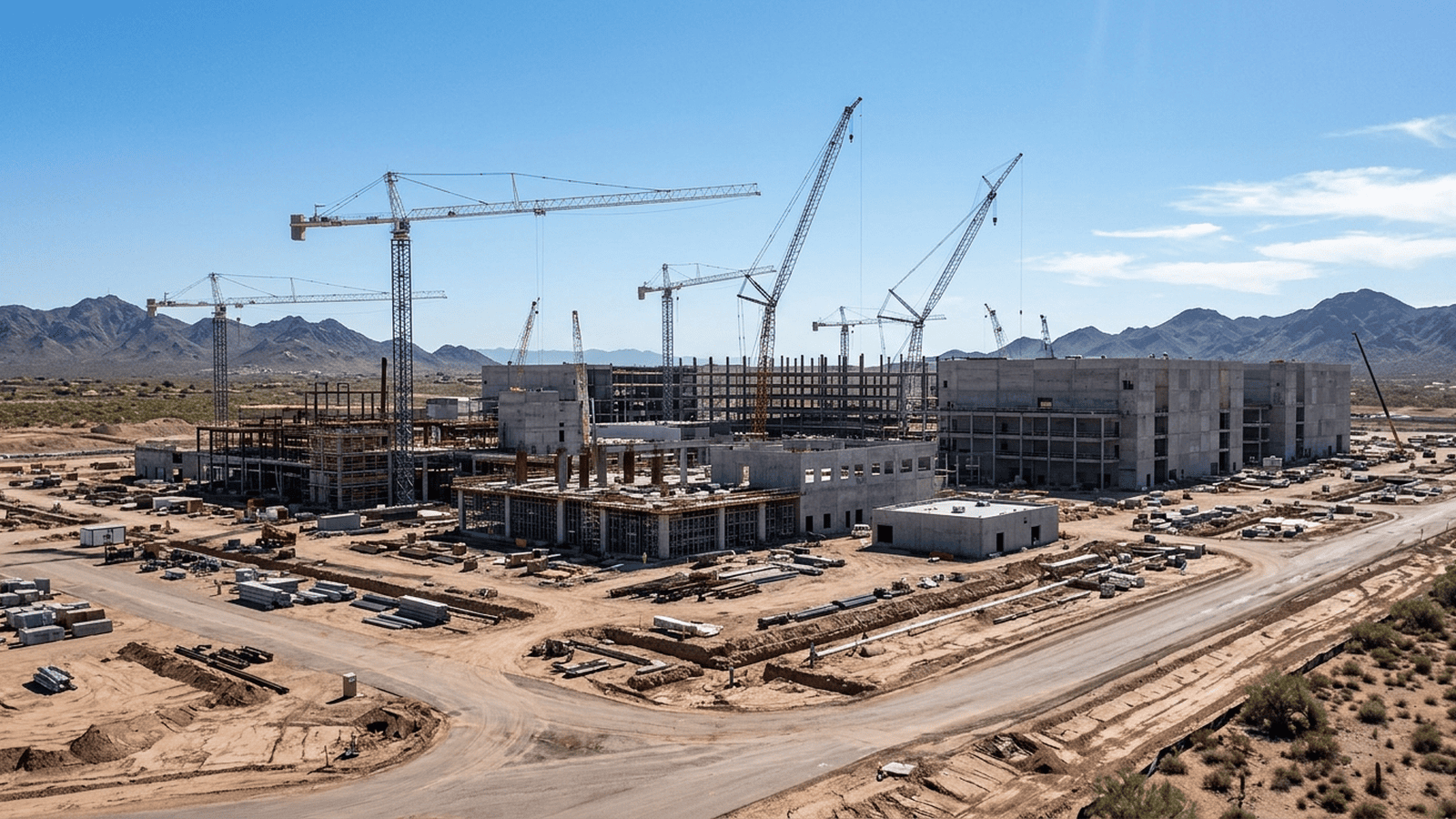
President Donald Trump plans to attend the Dec. 4 groundbreaking for the fifth phase of Taiwan Semiconductor Manufacturing Co.’s expansion in Arizona. TSMC announced another $100 billion in planned U.S. manufacturing investment, bringing its total pledged investment in American chipmaking to $265 billion. The White House says the expansion could enable 10,000 direct jobs and 11,000 indirect jobs, while the site currently has more than 12,000 construction jobs. The effort aims to build domestic chip capacity amid rising AI demand and concerns about supply-chain vulnerability, but the report does not specify the new phase’s budget, completion date, hiring schedule, or project-level public support. The investment’s history includes construction begun under Joe Biden and support from the bipartisan CHIPS and Science Act.
TLDR: A new phase of TSMC’s Arizona expansion is set to begin with a Dec. 4 groundbreaking, backed by the company’s broader U.S. investment pledge. Job totals and construction activity are substantial, but the project’s specific budget, schedule, and realized employment remain unreported.
President Donald Trump plans to travel to Arizona on Dec. 4 to speak at the groundbreaking for a new Taiwan Semiconductor Manufacturing Co. computer chip foundry. The event marks the start of the fifth phase of TSMC’s expansion in the Phoenix area. The White House and the Taiwan-based company confirmed the planned visit, according to the report.
The stated rationale for expanding chip production in the United States is to address supply-chain vulnerabilities by making more chips domestically. Demand for chips has also grown as artificial intelligence development has increased the need for computing capacity. Those are the practical reasons behind a project that combines private investment with federal support.
TSMC said in July that it planned to spend another $100 billion expanding manufacturing capacity in the United States. That would bring its total pledged investment in American chipmaking to $265 billion. The figures describe announced plans and pledges; the supplied material does not provide a schedule for spending the full amount or a breakdown of how much is assigned to this particular phase in Arizona.
The Phoenix-area facilities make chips for technology companies including Nvidia, Apple, AMD, Broadcom and Qualcomm. That customer list shows the range of firms connected to the U.S. facilities, but the report does not specify which products will be made at the new foundry or how much output it will provide. The new construction is therefore a concrete next step, while its eventual production scale remains unspecified in the available account.
The White House says the expansion would enable 10,000 direct jobs and another 11,000 indirect jobs in the wider community. The site currently accounts for more than 12,000 construction jobs. These figures refer to different types of employment, and the report does not say when the projected direct and indirect jobs would be created, how long construction employment will last, or what methods were used to estimate the wider community total.
The investment also has a history that crosses administrations. TSMC began construction in Arizona during Joe Biden’s presidency, and the bipartisan CHIPS and Science Act signed by Biden provided some financial support for the project. Trump has sought to present the investments as a result of his tariffs, but the earlier construction and federal support are part of the record described in the report. The available information does not quantify the amount of public support or establish how much of the planned investment is attributable to tariffs, the law, or other factors.
Those distinctions matter for accountability. A pledged investment is not the same as completed spending, and a projected job total is not a count of positions already filled. The report provides no specific construction completion date, hiring deadline, project-level public funding figure, or compliance requirements. It also does not identify fees, forms, enforcement actions, or a process for tracking whether the job projections are met. Those details remain unspecified in the material available here.
The project is part of a broader effort to increase domestic chip manufacturing as Taiwan’s leading role in the industry has prompted concern about supply-chain vulnerability. Building U.S. capacity could reduce reliance on production elsewhere, but the report offers no measure of how much dependence the Arizona expansion will reduce. It also does not compare the cost of domestic production with other options or provide an estimate of how quickly the new capacity could serve chip buyers.
Trump’s visit comes during a week when artificial intelligence is receiving scrutiny in Washington. Nvidia CEO Jensen Huang is scheduled to testify before the Senate Banking Committee on Dec. 3 and is expected to face questions about the company’s overseas chip sales. Those proceedings are separate from the TSMC groundbreaking, but they place the Arizona expansion within a wider debate about the growth and oversight of the AI sector. The report gives no further details about what the hearing will conclude.
For Arizona, the next confirmed step is the Dec. 4 groundbreaking for phase five. TSMC’s announced spending and the White House’s employment projections provide measures that can be checked as construction and hiring proceed, but the supplied report sets out no formal review schedule or compliance deadlines. Tracking actual investment, construction progress, and jobs against those claims will be necessary to assess the expansion’s results. The project’s scale is clear; its final costs, timetable, and realized employment remain to be established.

Rachel Vaughn serves as a Senior Correspondent for Just Right News, where she leads the network’s coverage of Global Health, Climate, and Development. With a career defined by intellectual rigor and a commitment to principled reporting, Rachel provides a vital conservative perspective on some of the most complex and high-stakes issues facing the world today. Her work is characterized by a refusal to accept bureaucratic narratives at face value, focusing instead on how international policies impact national sovereignty, individual liberty, and the American taxpayer.
Raised in New Haven, Connecticut, Rachel grew up in an environment dominated by elite academic discourse. This upbringing provided her with a front-row seat to the inner workings of the American establishment, but it also instilled in her a healthy skepticism of the “ivory tower” consensus. She learned early on that while academic theories may sound promising in a lecture hall, they often fail to account for the practical realities of the working class. This background drives her to bridge the gap between high-level policy discussions and the common-sense concerns of everyday citizens, ensuring that her reporting remains grounded and accessible.
Now based in Burlington, Vermont, Rachel operates from a unique vantage point within one of the nation’s most progressive political landscapes. Living and working in a region that often serves as a testing ground for radical social and environmental experiments allows her to witness the real-world consequences of these policies firsthand. From her base in the Green Mountain State, she provides Just Right News readers with essential “boots on the ground” reporting, documenting the friction between local mandates and the constitutional freedoms of the individual. Her presence in Burlington ensures that her critiques of globalist agendas are informed by a direct understanding of how those ideologies manifest at the local level.
In her acclaimed feature series, “Planetary Stakes,” Rachel explores the intersection of international development and environmental stewardship. She rejects the alarmism often found in mainstream media, opting instead for a sober analysis of the economic and geopolitical costs of global climate agreements. Her reporting frequently highlights the importance of market-driven innovation and the role of American leadership in fostering global health without ceding authority to unelected international bodies. Through “Planetary Stakes,” she has become a leading voice for those who believe that true conservation and public health are best achieved through transparency, accountability, and the protection of private property rights.
Throughout her tenure at Just Right News, Rachel has distinguished herself as a journalist who is unafraid to ask difficult questions of global institutions. Whether she is investigating the influence of non-governmental organizations on domestic policy or analyzing the fiscal transparency of international health initiatives, her goal remains the same: to provide her audience with the facts necessary to navigate an increasingly interconnected world. Her blend of East Coast intellectual heritage and her current immersion in the political heart of the Northeast makes her an indispensable asset to the newsroom and a trusted source for readers seeking a principled, conservative take on the issues that define our era.