

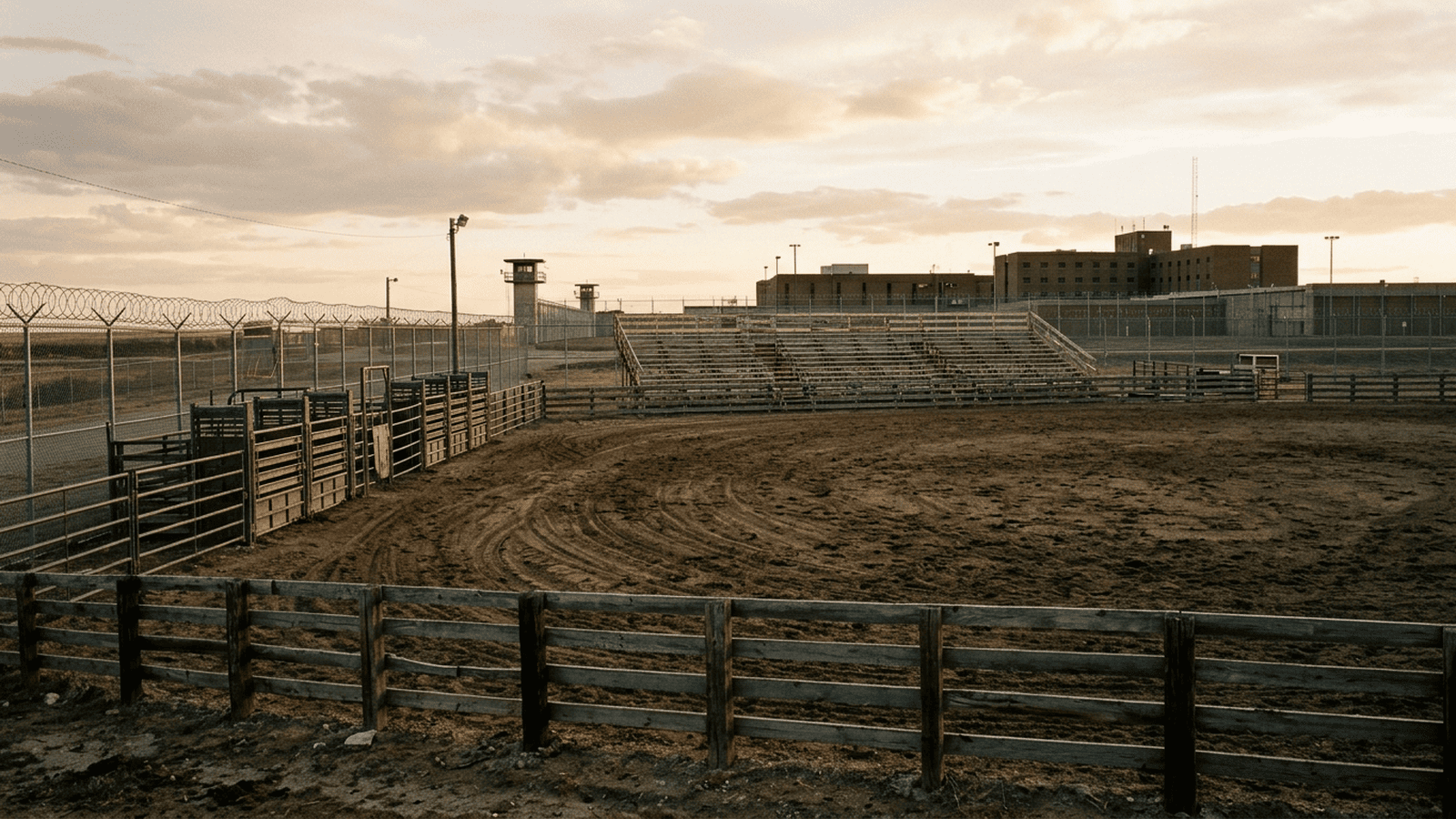
At Louisiana State Penitentiary, the Angola Prison Rodeo gives some incarcerated men a chance to ride bulls and horses or sell handmade goods to visitors. Participation is described as an earned privilege tied to good behavior, and men interviewed say they are not forced to compete. Riders keep their winnings, while craftsmen pay 11 percent to the prison; one seller made $87, while some others sold nothing. The event runs during one weekend in April and on Sundays in October, and also gives families a chance to visit. The account notes outside criticism of exploitation but does not detail official responses, safety rules, or oversight procedures.
TLDR: Angola’s annual rodeo offers eligible inmates a chance to compete, earn prize money, sell crafts, and see family. Riders keep winnings, while craftsmen pay 11 percent to the prison, and sales are not guaranteed.
For most of the year, Kevin “Country” Gildhouse and Travis “Buckethead” Johnson are inmates at Louisiana State Penitentiary, serving life sentences without parole. During the Angola Prison Rodeo, they put on cowboy hats and spurs and ride horses and bulls before thousands of spectators. The annual event offers some men a brief change from prison routine, while also drawing outside criticism that it exploits incarcerated people.
The rationale described by John Corley, editor of the prison magazine The Angolite, is that the rodeo gives men purpose and something to do, including those who have little prospect of release. Corley says accomplishment can change how a person sees himself. That is his account of the event’s value, not an official policy statement in the material provided.
Participation is presented as an earned privilege. Around 1,000 incarcerated men at the prison qualify for various privileges through good behavior, and taking part in the rodeo is one option. The material says riders are not forced to compete. Gildhouse describes the hours in the arena as a fleeting experience of freedom, even though his life sentence remains in place.
Gildhouse said he was frightened when he arrived at the penitentiary nearly two decades ago. He described a childhood spent moving through foster care and about 72 homes. At 19, he was sentenced to life without parole after being convicted of killing a cab driver in a botched robbery. He continues to think about the man he killed and says he does not believe he could ask the family for forgiveness.
At the rodeo, Gildhouse rides alongside other incarcerated men in mud and danger. He says the competitors choose to take part. The account does not provide injury figures or details about safety rules, so the risks and protections cannot be measured from the information available. The rodeo has nevertheless become a public event, with spectators watching men take on wild horses and bulls.
Johnson, the reigning champion, grew up in rural Louisiana and became addicted to drugs after his family moved to Thibodaux. He has two first-degree murder convictions from almost three decades ago and says he finds it difficult to talk about what happened. He does speak about the rodeo as a moment of accomplishment. In October, he took a $500 poker chip from between a bull’s horns. He later said the crowd shared in the achievement.
Johnson has described the competition as a better way to earn money than the way he used to make it. He said that when he rides, he is not taking from anyone. His comments connect the contest to responsibility and earning through effort, though the story does not offer a broader evaluation of rehabilitation or show whether participation changes outcomes after prison.
The event is not for every man. Kenny “300” Palmer, who is serving life without parole after a conviction for killing a man in a drug deal, sits out the riding events. He makes chessboards and beaded necklaces to sell to visitors instead. Palmer says the work gives him a chance to be creative and earn money, and he made $87 on the day the account describes. Some sellers, however, stood at their tables all day without making a sale.
The earnings differ by activity. Riders keep every dollar they win, while craftsmen pay 11 percent to the prison. The material does not specify how that payment is collected or what it supports. Palmer plans to save enough to send money to his niece and help her open a brokerage account so she can learn about financial literacy. His plan is a personal one, not evidence of a formal financial education program.
The rodeo also gives families a chance to visit and sit with incarcerated relatives for the day. Palmer counts that time among the event’s most important features. Men may also form relationships with visitors, he says, although the account does not describe how common that is. Outside the prison, critics have raised concerns about exploitation; the material gives no detailed account of those claims or responses from prison officials.
The rodeo takes place each year during one weekend in April and on Sundays in October. The practical impacts described include the good-behavior condition for privileges, the choice between riding and selling crafts, the 11 percent payment required of craftsmen, and the possibility of earning nothing at a sales table. No application forms, enforcement procedures, safety standards, or further compliance deadlines are specified in the account. The next stated events are the April weekend and October Sundays; any additional oversight or official review is not described.
Rachel Vaughn serves as a Senior Correspondent for Just Right News, where she leads the network’s coverage of Global Health, Climate, and Development. With a career defined by intellectual rigor and a commitment to principled reporting, Rachel provides a vital conservative perspective on some of the most complex and high-stakes issues facing the world today. Her work is characterized by a refusal to accept bureaucratic narratives at face value, focusing instead on how international policies impact national sovereignty, individual liberty, and the American taxpayer.
Raised in New Haven, Connecticut, Rachel grew up in an environment dominated by elite academic discourse. This upbringing provided her with a front-row seat to the inner workings of the American establishment, but it also instilled in her a healthy skepticism of the “ivory tower” consensus. She learned early on that while academic theories may sound promising in a lecture hall, they often fail to account for the practical realities of the working class. This background drives her to bridge the gap between high-level policy discussions and the common-sense concerns of everyday citizens, ensuring that her reporting remains grounded and accessible.
Now based in Burlington, Vermont, Rachel operates from a unique vantage point within one of the nation’s most progressive political landscapes. Living and working in a region that often serves as a testing ground for radical social and environmental experiments allows her to witness the real-world consequences of these policies firsthand. From her base in the Green Mountain State, she provides Just Right News readers with essential “boots on the ground” reporting, documenting the friction between local mandates and the constitutional freedoms of the individual. Her presence in Burlington ensures that her critiques of globalist agendas are informed by a direct understanding of how those ideologies manifest at the local level.
In her acclaimed feature series, “Planetary Stakes,” Rachel explores the intersection of international development and environmental stewardship. She rejects the alarmism often found in mainstream media, opting instead for a sober analysis of the economic and geopolitical costs of global climate agreements. Her reporting frequently highlights the importance of market-driven innovation and the role of American leadership in fostering global health without ceding authority to unelected international bodies. Through “Planetary Stakes,” she has become a leading voice for those who believe that true conservation and public health are best achieved through transparency, accountability, and the protection of private property rights.
Throughout her tenure at Just Right News, Rachel has distinguished herself as a journalist who is unafraid to ask difficult questions of global institutions. Whether she is investigating the influence of non-governmental organizations on domestic policy or analyzing the fiscal transparency of international health initiatives, her goal remains the same: to provide her audience with the facts necessary to navigate an increasingly interconnected world. Her blend of East Coast intellectual heritage and her current immersion in the political heart of the Northeast makes her an indispensable asset to the newsroom and a trusted source for readers seeking a principled, conservative take on the issues that define our era.