

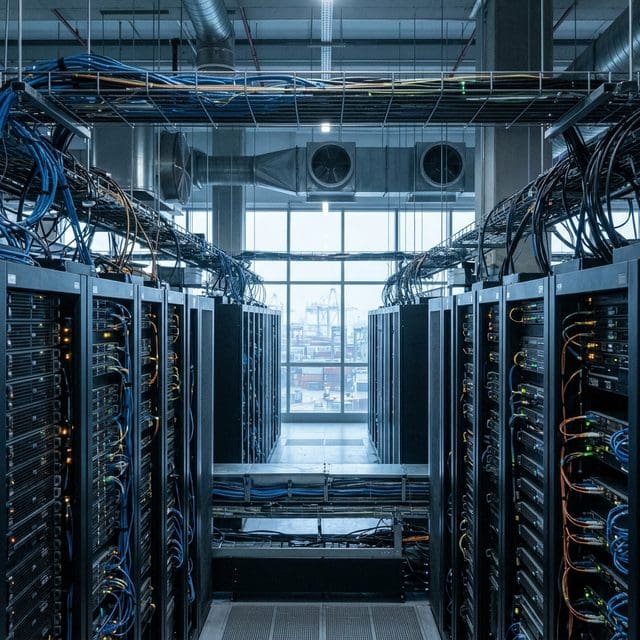
A proposed U.S. ban on overseas data centers would reshape where AI computing is built and accessed, while a pause on China-related port measures leaves another trade front unresolved.
President Donald Trump’s threat to penalize U.S. companies that build data centers overseas puts the physical location of artificial-intelligence infrastructure at the center of a new trade dispute. The question is not only where advanced chips are made or shipped, but where they are installed and put to work.
Trump said on November 20 that U.S. companies would not be allowed to build data centers abroad and warned of a “tremendous tax” for firms that do. He framed the proposal as a way to keep the United States ahead of China in AI. The available reporting does not specify how the restriction would be implemented, which facilities would be covered, or how the tax would be calculated.
The policy targets a gap between controlling a product’s export and controlling access to its computing power. Reuters reported on November 20 that Chinese companies had continued accessing restricted U.S. chips by renting computing capacity at overseas data centers. Rather than importing hardware directly, customers can obtain computing services from machines installed in another country. Trump’s proposal is intended to close that route.
That distinction matters for the supply chain. A chip can cross an export-control boundary while servers containing it remain in a facility operated by a data-center or cloud business. Restricting where U.S. firms can build those facilities would reach beyond chip sales into construction, investment and service contracts. It could also affect the customers and host countries that have counted on overseas data centers to expand their digital industries.
Reuters reported on November 17 that the controls could create short-term computing constraints for Chinese technology companies and put utilization and expansion plans at risk for data-center operators in Southeast Asia. A measure aimed at limiting Chinese access may therefore affect facilities in Asian markets whose operators need customers and predictable rules to justify expansion.
For Nvidia and other chip suppliers, the dispute underscores how export rules can shape a business even when hardware is not shipped directly to a prohibited buyer. The supplied reporting does not establish Nvidia sales figures or confirm a new company-specific restriction. The broader uncertainty reaches from chipmakers and server assemblers to data-center owners and cloud customers.
There is a separate shipping-policy clock. U.S. Section 301 actions concerning China’s maritime, logistics and shipbuilding sectors remain suspended through 11:59 p.m. Eastern time on January 9, 2027. During the suspension, covered port fees and duties on ship-to-shore cranes and other Chinese cargo-handling equipment are not payable. The pause gives importers and port operators temporary relief, but does not settle what happens after it expires.
Together, the developments show how trade policy increasingly follows infrastructure as well as finished goods. Port equipment affects cargo movement; data centers determine where computing services are delivered and who can use them. In both cases, decisions in Washington can alter investment plans far beyond U.S. shores.
The administration’s stated rationale is competition with China, while companies and overseas operators must assess whether facilities built under one set of rules will remain commercially viable under another. The supplied reports do not connect the data-center proposal to Ukraine negotiations or Russia’s objections over NATO security guarantees. Those geopolitical issues do not resolve practical questions about licensing, enforcement or implementation.
For American workers and manufacturers, the test will be whether a tougher location policy creates durable domestic capacity or shifts investment among overseas markets. Until the administration provides details, the threatened tax is a warning rather than an operating rule. But the message to the global AI supply chain is clear: where computing equipment sits may matter nearly as much as where it was made.

Sean Bradley serves as the Senior Correspondent for Trade, Supply Chains, and Global Labor at Just Right News, where he brings a principled, clear-eyed perspective to the complex systems that power the modern world. With a focus on the economic forces that impact the American household, Bradley has distinguished himself as a leading voice in explaining how global shifts in manufacturing and logistics translate to the kitchen table.
Growing up in Long Beach, California, Bradley’s interest in the movement of goods was forged against the backdrop of one of the nation’s most vital maritime gateways. Raised in a community where the towering cranes of the port were a constant fixture on the horizon, he developed an early appreciation for the blue-collar industries that form the backbone of the American economy. This upbringing instilled in him a profound respect for the dockworkers, truckers, and laborers who keep the country moving, a sentiment that remains a cornerstone of his reporting today. For Bradley, trade is not merely a series of abstract figures on a spreadsheet; it is a human endeavor that sustains families and defines the strength of a nation.
Now based in Seattle, Washington, Bradley occupies a strategic vantage point in another of the country’s most significant trade hubs. His location allows him to witness firsthand the intersection of traditional industry and the evolving technological landscape of global logistics. From the Pacific Northwest, he monitors the flow of goods across the ocean, providing Just Right News readers with timely insights into how international tensions, regulatory hurdles, and labor disputes affect the availability and cost of essential goods.
His signature feature series, “The Journey of Things,” has become a staple for readers seeking to understand the intricate path products take from raw materials to the retail shelf. Through this series, Bradley pulls back the curtain on the global marketplace, often highlighting the risks of over-reliance on foreign adversaries and the importance of domestic manufacturing resilience. His reporting consistently emphasizes the conservative values of national sovereignty, free-market competition, and the protection of the American worker from unfair global practices.
As a journalist of Irish heritage, Bradley maintains a deep-seated respect for the dignity of the individual worker and the importance of community stability. He approaches his beat with a commitment to transparency, often questioning the status quo of globalist policies that prioritize corporate efficiency over local prosperity. Whether he is reporting from a warehouse floor or analyzing a new international trade agreement, his goal remains the same: to provide the American public with the truth about where their products come from and what it costs to get them there.
Throughout his tenure at Just Right News, Bradley has remained a steadfast advocate for economic common sense. His work serves as a vital resource for those who believe that a strong nation is built on secure borders, robust trade, and a respected workforce. By combining his local roots in Long Beach with his professional experience in Seattle, Bradley continues to offer a unique and necessary perspective on the forces that shape the American way of life.