

LHCb has reported evidence for an exceptionally rare particle decay, a tantalizing result that remains short of a confirmed discovery and will require more data.
A particle that almost never appears may offer physicists one of their best ways to look for what they do not yet understand. Researchers with the LHCb collaboration at CERN have reported evidence for a rare decay in which a beauty meson transforms into two muons, heavier cousins of electrons. The finding is intriguing, but it is not yet a discovery by the standards of particle physics.
The decay, known as B_d → μ⁺μ⁻, is expected to happen only about once in every 10 billion beauty particles. That scarcity makes the process useful. If unknown particles or forces influence the decay, they could change how often it occurs. Researchers can compare the measured rate with the prediction of the Standard Model, the framework that describes known elementary particles and three of the four fundamental forces.
The combined LHCb result reaches 3.2 sigma, a statistical measure of how unlikely the signal would be if the effect were absent. That is enough to describe the result as evidence, not enough to claim a discovery. In particle physics, the customary threshold for declaring a discovery is five sigma. The distinction is not a formality: a signal can strengthen or fade as experiments collect more data and account for uncertainty.
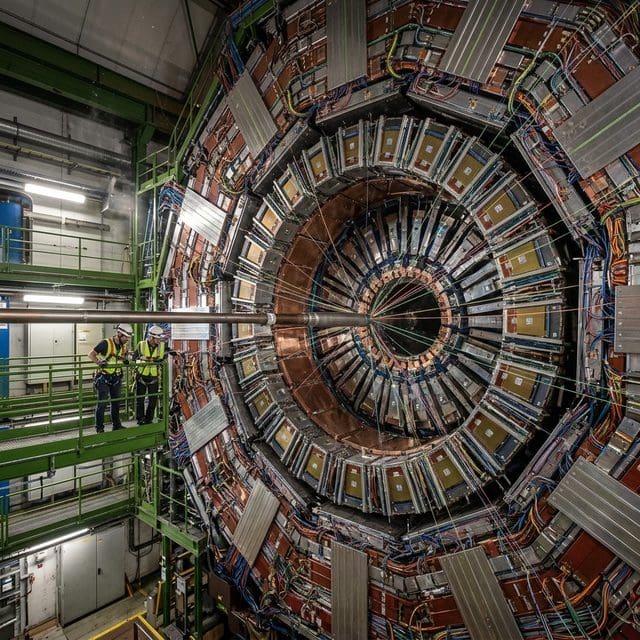
LHCb is one of the experiments at CERN’s Large Hadron Collider, which sends protons into collisions at high energies. The experiment specializes in studying particles containing beauty quarks and tracking how they decay. This analysis combines newer measurements from 2024–2025 with earlier LHCb data collected from 2011–2018. Those additional years of observations help researchers seek an extremely uncommon event among far more frequent collisions.
The detector’s job is not simply to record collisions. It must distinguish the sought-after pair of muons from other particles and reconstruct where the parent beauty meson decayed. The upgraded LHCb detector is designed to collect and analyze collision data more effectively. Its Vertex Locator, which tracks particle decay locations, operates roughly five millimeters from the LHC beams, according to the University of Manchester. Researchers there contributed to the international collaboration. Physicist Chris Parkes described the work as the product of a long design and construction effort involving an international team.
The result does not overturn the Standard Model. The reported measurements remain consistent with its expectations, and the available evidence does not establish that an unknown force or particle has affected the decay. That leaves a meaningful scientific question, not a settled claim: as measurements become more precise, will the observed rate continue to match theory?
Rare decays are valuable because they can reveal indirect traces of particles too heavy to produce directly in a collider. Even if a hypothetical particle is never observed in a detector, it could influence the behavior of known particles in subtle ways. Researchers can look for those changes by measuring a decay carefully and comparing the outcome with theoretical predictions. A persistent discrepancy would warrant further investigation; agreement can rule out or constrain some possibilities.
That makes the work relevant beyond one unusual particle transformation. It tests how well the Standard Model holds up under increasingly sensitive scrutiny, while showing how improved detectors can make faint signals measurable. The result is also a reminder that scientific confidence builds in stages: a suggestive signal calls for more evidence, not a leap to a conclusion.
The next step is to gather more data and refine the measurement. LHCb is expected to continue collecting evidence into the early 2030s, giving researchers a longer record with which to assess this decay and related processes. For now, CERN’s researchers have reported evidence for a rare event, but the case for a discovery remains open.

Mason Reed serves as a Staff Writer for Just Right News, where he spearheads the Future Frontiers & Special Projects desk. In an era defined by rapid technological shifts and evolving social landscapes, Mason provides a steady, principled voice, examining the innovations of tomorrow through the lens of traditional American values. His work is most prominently featured in his signature series, “The Next Horizon,” where he explores the intersection of emerging technology, national sovereignty, and the preservation of individual liberty.
A native of San Diego, California, Mason’s worldview was shaped by the unique culture of his hometown. Growing up in a region defined by its strong military presence and its history of maritime industry, he developed a deep-seated respect for the institutions that provide national stability and the entrepreneurial spirit that drives the American economy. This upbringing instilled in him a belief that true progress is not found in discarding the past, but in building upon a foundation of proven principles. His reporting often reflects this San Diego influence, emphasizing the importance of a robust national defense and the necessity of maintaining a competitive edge in the global marketplace.
Now based in San Francisco, Mason operates from the heart of the world’s technological engine. Living and working in the Bay Area provides him with a front-row seat to the advancements—and the ideological challenges—emanating from Silicon Valley. While many in the region embrace a “move fast and break things” mentality, Mason’s reporting serves as a vital counterweight. He offers Just Right News readers a “boots on the ground” perspective, documenting how radical local policies and the concentration of tech power impact the everyday lives of citizens. His proximity to the industry allows him to cut through the marketing jargon of big tech to uncover the real-world implications for privacy, free speech, and the nuclear family.
In his “Future Frontiers” beat, Mason tackles complex subjects ranging from the ethics of artificial intelligence to the burgeoning private space race. He approaches these topics with a healthy skepticism toward centralized bureaucracy, championing instead the decentralized innovations that empower individuals. Through “The Next Horizon,” he highlights the pioneers and thinkers who are working to ensure that the future remains a place where human dignity and constitutional rights are protected. He believes that the rapid pace of change requires more than just technical expertise; it requires a moral compass rooted in the Western tradition.
Throughout his tenure at Just Right News, Mason has remained committed to the idea that the future is something to be shaped, not merely accepted. His writing is characterized by a rigorous defense of American exceptionalism and a belief that the country’s best days lie ahead, provided it remains true to its founding ideals. Whether he is investigating the impact of automation on the American workforce or profiling the next generation of aerospace engineers, Mason Reed ensures that his readers are equipped with the insights they need to navigate a changing world with confidence and clarity.