

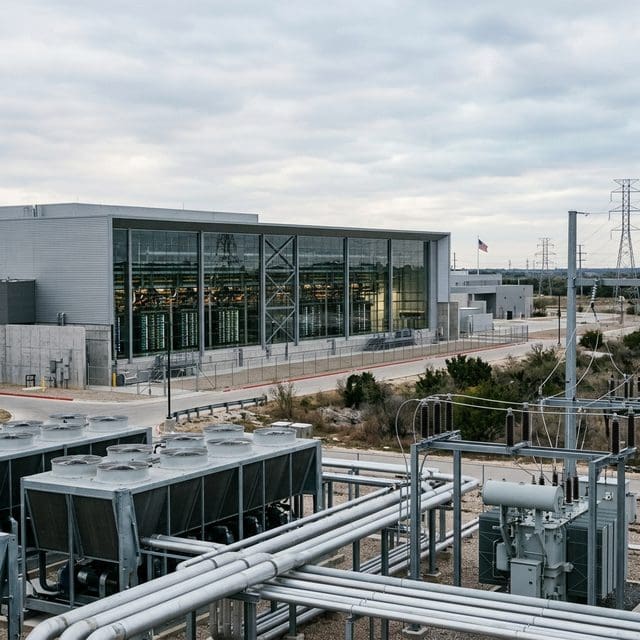
Trump threatened a tax on U.S. companies building data centers abroad, while a Senate bill would speed infrastructure reviews and shift more grid costs to data centers.
President Donald Trump’s threat to impose a “tremendous tax” on U.S. companies that build data centers overseas has put the AI industry’s global expansion in question—but has not changed the rules. Trump has provided no tax rate, start date, statutory authority or enforcement mechanism, CNBC and Reuters reported.
That uncertainty matters to Alphabet, Amazon, Microsoft, Meta and Oracle, which already operate data centers abroad. Trump said Friday the United States would not allow companies to build such facilities overseas, then added they could do so but would face a tax. The administration has not said whether a policy would cover existing facilities or only new construction. The Washington Times reported that Trump also said his administration would move to block a U.S. company from building a data center in Finland, without further details.
The announcement is not a tax law or a defined regulatory order. The Associated Press reported Trump had not yet told his own officials about the proposal, and that enforcement remained unclear. For companies making long-term investment decisions, the immediate effect is uncertainty about where capacity can be built and what rules might apply. A tax meant to bring investment home could raise costs or restrict options for locating power-hungry facilities. Reuters cited an estimate that major technology companies could spend as much as $1.8 trillion in 2027 on AI development, primarily data centers.
Congress is considering a more concrete response to AI’s infrastructure demands. The Senate passed the Bipartisan American Affordability and Jobs Act, which would tighten deadlines for federal environmental reviews, accelerate transmission construction and require large data centers to cover more grid costs associated with their electricity use. The bill now goes to the House, where it is expected to be considered after the Thanksgiving break. It must pass there before reaching Trump.
The legislation would apply to existing data centers as well as new ones, according to WyoFile and Inside Climate News. It would direct the Federal Energy Regulatory Commission to charge data centers for required grid upgrades and use of the existing grid. Sen. Martin Heinrich’s office, citing Grid Strategies, estimated the bill could require data centers to contribute about $55 billion toward transmission costs over the next decade—roughly $35 billion more than under current policy.
That shift could keep households and other electricity users from bearing some infrastructure costs driven by large new loads. But it does not guarantee lower bills; the effect will depend on implementation and how costs are allocated. Faster reviews could help energy and transmission projects get built sooner, while tighter deadlines may leave less time to assess environmental impacts. Senate Democrats’ effort to prohibit data centers on federal lands failed to advance. The bill would also limit courts’ ability to halt projects over inadequate environmental review, the outlets reported.
The power-system pressures are significant. A Harvard study cited by WyoFile and Inside Climate News found the 400 largest U.S. hyperscale data centers emit 25.7 million metric tons of carbon dioxide annually, with fossil fuels generating 54% of their electricity. McKinsey found 60% of North American data-center players plan permanent on-site power plants. These figures describe the scale of the energy challenge, not the bill’s expected effect on emissions.
A separate court ruling could affect federal workplace protections. The Fifth U.S. Circuit Court of Appeals ruled 9–8 that the House used an unconstitutional pandemic-era proxy-voting procedure when it passed a $1.7 trillion funding bill in 2022. The court upheld an injunction blocking enforcement against Texas of the Pregnant Workers Fairness Act provision in that law. The ruling does not invalidate every measure passed using proxy voting, but could prompt Supreme Court review and raises broader questions about the procedure.
The next test for the permitting bill is the House: whether lawmakers approve it and retain its cost-shifting and review provisions. Trump’s overseas-data-center threat remains a statement of intent, not a published tax policy. Until the administration provides legal authority and operating details, companies and communities cannot calculate what it would change.

Ryan Mitchell serves as a Staff Writer for Just Right News, where he anchors the desk for Cyber, Technology Policy, and Digital Sovereignty. In an era where the digital landscape has become as much a battlefield as any physical territory, Ryan provides a critical conservative lens on the forces shaping the future of American innovation and national security. His work is defined by a commitment to the idea that American leadership in the digital age is not just a matter of economic success, but a necessity for the preservation of global liberty.
Born and raised in Austin, Texas, Ryan’s perspective is deeply rooted in the Lone Star State’s tradition of independence and skepticism of centralized authority. Growing up in a city that transformed from a quiet state capital into a global technology hub, he witnessed firsthand the disruptive power of the tech industry. This upbringing instilled in him a firm belief in free-market principles and the necessity of protecting individual liberties from both government overreach and corporate overstep. His Texan background serves as a foundational compass, guiding his reporting toward stories that emphasize national resilience and the preservation of constitutional values in an increasingly virtual world.
Now based in San Francisco, California, Ryan operates from the epicenter of the very industry he scrutinizes. Living and working in the heart of Silicon Valley allows him to provide “boots on the ground” reporting that few conservative journalists can match. He navigates the cultural and political complexities of the Bay Area to bring Just Right News readers an inside look at the boardrooms and coding labs where the next generation of digital policy is forged. For Ryan, being stationed in San Francisco is a strategic choice; it allows him to challenge the prevailing ideological monoculture of the tech elite from within their own backyard, ensuring that the concerns of middle America are represented in the conversation about our digital future.
His beat—Cyber, Technology Policy, and Digital Sovereignty—covers the high-stakes world of data privacy, artificial intelligence, and the infrastructure of the modern web. Ryan is particularly focused on the concept of digital sovereignty, arguing that for a nation to remain truly free, it must maintain control over its own technological destiny and critical infrastructure. He frequently explores how international regulations and domestic policies impact the ability of American firms to compete without sacrificing the privacy or security of their citizens.
Central to his current body of work is his featured series, “The New Cold War.” Through this project, Ryan examines the escalating technological rivalry between the United States and its global adversaries. He delves into the complexities of state-sponsored hacking, the global race for semiconductor dominance, and the ideological struggle to define the rules of the internet. Ryan views this competition not merely as a commercial race, but as a fundamental defense of Western values against authoritarian digital models. Through his rigorous reporting and principled analysis, Ryan Mitchell ensures that the readers of Just Right News stay informed about the invisible forces defining the 21st century, always advocating for a future where technology serves the cause of freedom.