

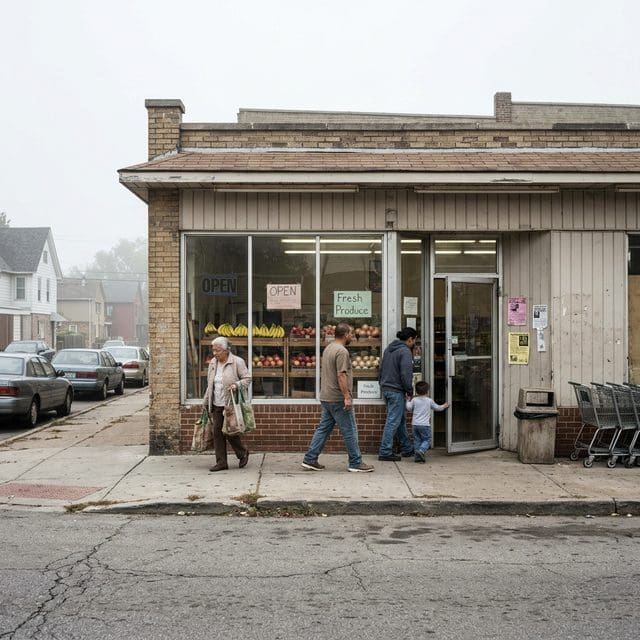
A study of 267 million grocery visits found that new stores produced only a brief increase in shopping in low-income, low-access areas, as climate talks confront food and water pressures.
Opening a grocery store in an underserved neighborhood may draw shoppers at first, but the boost can fade quickly. A nationwide study analyzing 267 million grocery-store visits in 2018 and 2019 found that visits to newly opened stores in areas designated low-income and low-access by the U.S. Department of Agriculture increased temporarily, then returned to no significant effect after about one month. UConn Today reported the findings November 18.
Published in Applied Geography, the study examines a common approach to food access: bringing a supermarket closer to residents with limited access to healthy, affordable food. Its findings do not mean a new store is useless. They suggest that opening one alone may not produce lasting changes in where people shop.
Researchers identified affordability, cultural preferences, existing shopping habits and reliance on convenience stores as possible barriers. The available account does not explain which factors drove the results in particular neighborhoods or provide a breakdown of who visited the new stores. Local officials and the USDA assessing food-access efforts may need to look beyond store locations to whether food is affordable, suits community preferences and is convenient to buy.
A report from Peoria, Illinois, concerns another part of the agricultural system. The Guardian reported that a 41-year-old man pleaded not guilty in federal court to charges connected to a bomb threat at an ethanol plant, where an explosive device was found. The report describes a criminal case, not a contamination event; it provides no evidence that the plant’s products, air or water were affected.
At COP31, agriculture negotiations ended without consensus on text addressing trade measures and adaptation finance, Carbon Brief reported November 18. The issue was deferred to intersessional discussions in Bonn. The report does not detail the competing proposals, leaving the precise points of disagreement unclear.
The U.N. Food and Agriculture Organization launched its Turquoise Nexus Initiative, intended to help countries coordinate food-security, water and climate policies. The announcement sets out a goal, not evidence of results in specific communities. Its value will depend on whether coordination leads to practical decisions for farmers and households facing food or water constraints.
Those constraints are visible in Panama’s canal watershed. A NOAA regional hazards briefing updated November 18 reported hydrological drought and reduced freshwater inflow to Gatun Lake. The shortfall has forced restrictions on vessel-transit capacity. The supplied briefing does not report unsafe drinking water or food contamination.
Panama’s Instituto de Mercadeo Agropecuario scheduled subsidized-price agro-fairs on November 18 across provinces and Indigenous territories, including Panama, Colón, Chiriquí, Darién, Veraguas and Ngäbe-Buglé. Shoppers had to present identification, Telemetro reported. The source gives no prices, attendance figures or evidence of the fairs’ effect on household food security.
Nepal’s needs were also raised at COP31. The New York Times reported that a deadly glacier collapse left the country with $5 billion in recovery costs and that few had stepped forward with aid. The supplied account does not specify effects on crops or water supplies, but the recovery bill underscores the stakes in debates over adaptation finance.
These reports show why projects and policy announcements need to be measured by results. Food-access efforts should be judged by sustained shopping patterns and affordability, not just a store’s opening. Water reporting likewise requires distinguishing documented shortages from unverified claims of contamination—and tracking whether new programs deliver.

Eric Nolan serves as the Senior Correspondent for Food, Water, and Environmental Health at Just Right News, where he brings a principled, common-sense perspective to the most fundamental issues facing the American public. With a career dedicated to uncovering the truth behind the policies that govern our natural resources, Eric has become a trusted voice for readers who value traditional stewardship over bureaucratic overreach. His reporting is defined by a commitment to the idea that true environmentalism is rooted in the protection of the American family and the preservation of the nation’s agricultural heritage.
Raised in Fresno, California, Eric’s worldview was shaped in the heart of the San Joaquin Valley. Growing up in one of the world’s most productive agricultural hubs, he witnessed firsthand the vital connection between the land, the water, and the dinner table. In Fresno, he saw the resilience of farmers and the devastating impact that distant, top-down regulations can have on local communities. This upbringing instilled in him a deep respect for the producers who feed the country and a lifelong skepticism toward the alarmist narratives often pushed by mainstream media. For Eric, environmental health is not an abstract political talking point; it is a matter of ensuring that the people who work the land have the freedom and the resources to do so effectively.
Now based in Eugene, Oregon, Eric operates from a unique vantage point in the Pacific Northwest. Living in a region often defined by intense environmental debate, he provides a necessary counter-narrative to the prevailing trends of the area. From his base in Eugene, he monitors the shifting tides of federal and state policies, ensuring that the voices of rural citizens and property owners are not drowned out by urban activism. His reporting often bridges the gap between the rugged realities of the outdoors and the legislative halls where decisions are made, offering a grounded perspective that prioritizes local sovereignty and practical solutions.
As the lead for the acclaimed feature series “Earth on the Table,” Eric explores the intricate journey of the American food supply. He tackles critical issues such as water rights, soil health, and food security through a lens of national stability and individual liberty. He believes that a healthy environment and a thriving economy are not mutually exclusive, but rather two sides of the same coin of national prosperity. His work consistently highlights how innovation and private-sector ingenuity are the most effective tools for ensuring clean water and a safe food supply, rather than the expansion of the administrative state.
At Just Right News, Eric’s reporting serves as a vital resource for those who seek accountability and transparency. Whether he is investigating the impact of federal land management on local economies or examining the safety of the national food infrastructure, his work remains anchored in the values of heritage and hard work. Eric Nolan continues to be a leading voice in environmental journalism, championing the belief that the best way to protect our natural resources is to empower the people who live and work closest to them.