

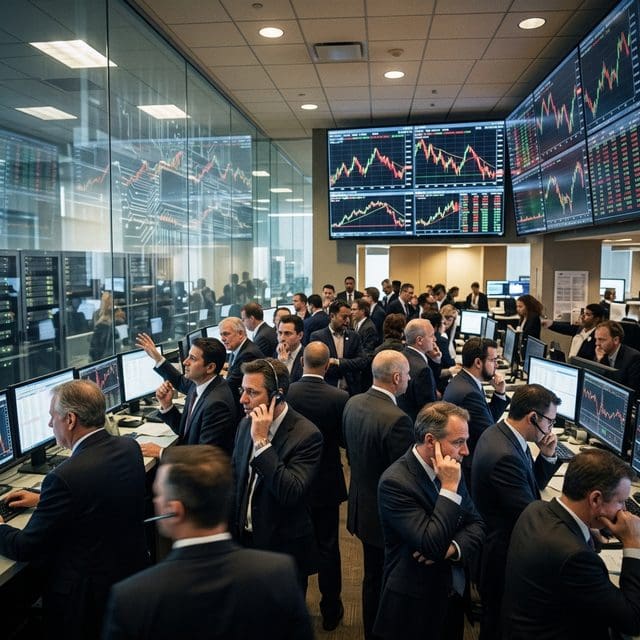
Nvidia’s upbeat forecast offered a counterweight to Tuesday’s broad selloff, but leadership uncertainty and questions about AI spending kept investors cautious.
Nvidia’s stronger-than-expected results and optimistic revenue forecast gave investors a reason to reconsider the recent selloff in technology shares. They did not erase doubts about the durability of the artificial-intelligence trade or uncertainty surrounding the chipmaker’s leadership.
The S&P 500 closed down 1.0% Tuesday, while the Nasdaq-100 fell 0.7%. Losses extended beyond technology: all 11 S&P 500 sectors declined, according to Reuters. Energy and industrials were the relative leaders, each down 0.6%; utilities fell 1.6% and financials dropped 1.9%. The breadth of the decline suggests the session was more than a retreat from high-priced tech shares.
Nvidia reported third-quarter results above expectations and forecast $130 billion in quarterly revenue. Its shares initially rose after the report, but the response was not sustained in the latest accounts. The company is a key gauge of demand for AI computing. Its outlook can reassure investors that customers are spending heavily, but it cannot settle whether that spending will ultimately generate returns sufficient to justify the valuations built around it.
Leadership adds uncertainty. Jensen Huang resigned as CEO on November 12, and Colette Kress remains interim chief executive. On November 17, Nvidia Chairman Harvey Jones said the board would not rehire Huang. Nvidia has engaged Heidrick & Struggles to conduct a search but has given no timetable. Kress has also said the company will scrutinize financing for neocloud and other AI customers, putting attention on the funding behind some demand for its products.
The pullback began well before Nvidia’s report. Reuters said the S&P 500 technology sector had fallen about 20% since October 6 and the Philadelphia Semiconductor Index roughly 30%. Salesforce and Nike were among the Tuesday decliners, while Broadcom rose. Against that backdrop, a favorable forecast can prompt a short-term rebound without ending wider concerns about expectations, concentrated customer spending or the scale of investment required to build AI infrastructure.
Bond and currency moves gave a mixed signal. In its latest market report, Reuters put the 10-year U.S. Treasury yield down 2.1 basis points at 5.08%. The dollar index was near 103.60 after reaching its highest level since April 2, 2025. Reuters also reported that Treasury yields fell across the curve Tuesday, even as markets continued to price greater Federal Reserve tightening risk. The available material did not identify a new economic release or Fed announcement as the session’s main catalyst, so the yield move alone does not establish a changed policy outlook.
Oil reflected competing pressures. Brent crude was reported down 0.6% at $92.60 a barrel in Asian trading after U.S. data showed higher crude and fuel inventories. Conflict in the Middle East and disruption risks near the Strait of Hormuz limited the decline. Those supply concerns complicate the reading of prices: inventories weighed on crude, while shipping risks offered support.
The timing of the reports matters. The freshest coverage did not include a full November 18 close for U.S. cash markets; it described Tuesday’s session and subsequent premarket or Asian trading. Nasdaq-100 contracts rose 0.4% earlier on November 18 after the index’s fourth consecutive decline, a tentative sign of stabilization rather than proof that investors had changed their minds about AI valuations.
Investors’ next tests include whether Nvidia converts its forecast into sustained results, whether demand holds through its leadership transition, and how the market receives Anthropic’s planned IPO. Reuters called the listing a potential referendum on AI enthusiasm. The valuation figures circulating around the offering were not confirmed in the available material. The broader question is whether earnings can catch up with the expectations attached to the AI boom.

Jordan Lee serves as the Senior Correspondent for Wall Street, Finance, and Monetary Systems at Just Right News. Based in the heart of the world’s financial capital, New York City, Lee brings a sharp, principled eye to the complex mechanisms that drive the global economy. His reporting is defined by a commitment to fiscal responsibility, the defense of the free market, and a deep-seated belief that a transparent monetary system is the bedrock of a free society.
Raised in Portland, Oregon, Lee’s perspective was forged in a city that has undergone significant cultural and economic shifts. His upbringing in the Pacific Northwest instilled in him a profound appreciation for the industriousness of small business owners and the importance of local economic stability. Watching the evolution of his hometown’s landscape sparked an early interest in how federal fiscal policy and large-scale financial trends eventually trickle down to the average citizen. This background provides him with a unique vantage point; he understands the growing disconnect between the policy-making elite and the reality of Main Street, a theme that frequently resonates throughout his work.
Now operating from his base in New York City, Lee bridges the gap between the high-stakes trading floors of Manhattan and the households of everyday Americans. He views the financial sector not merely as a collection of numbers and tickers, but as a vital engine of American prosperity that requires constant vigilance and accountability. His reporting often highlights the dangers of centralized financial control and the necessity of maintaining a system that rewards merit, risk-taking, and innovation.
As the creator and lead of the featured series, “The Invisible Economy,” Lee pulls back the curtain on the often-opaque world of monetary systems. He specializes in translating the dense jargon of central banking and international finance into actionable insights for the Just Right News audience. His work explores the “invisible” forces—such as inflationary pressures, regulatory creep, and the expansion of the administrative state—that erode the purchasing power of American families. By focusing on these systemic issues, Lee empowers readers to understand the hidden forces shaping their financial independence.
Lee’s journalistic philosophy is rooted in a steadfast commitment to traditional American values. As an Asian American professional who has navigated the competitive corridors of the financial world, he is a vocal advocate for meritocracy and the preservation of the American Dream. He believes that a stable currency and a predictable regulatory environment are essential for national sovereignty and individual liberty. His reporting frequently warns against the risks of government overreach in the private sector, arguing that the most effective solutions to economic challenges arise from competition and individual enterprise rather than bureaucratic mandates.
At Just Right News, Jordan Lee remains dedicated to providing a clear-eyed defense of the taxpayer. Whether he is analyzing market volatility or investigating the long-term implications of national debt, his mission is to provide the truth about where the money is going and what it means for the future of the country. Through his rigorous analysis and principled stance, Lee has become a trusted voice for those who value a strong, sovereign, and fiscally sound America.