

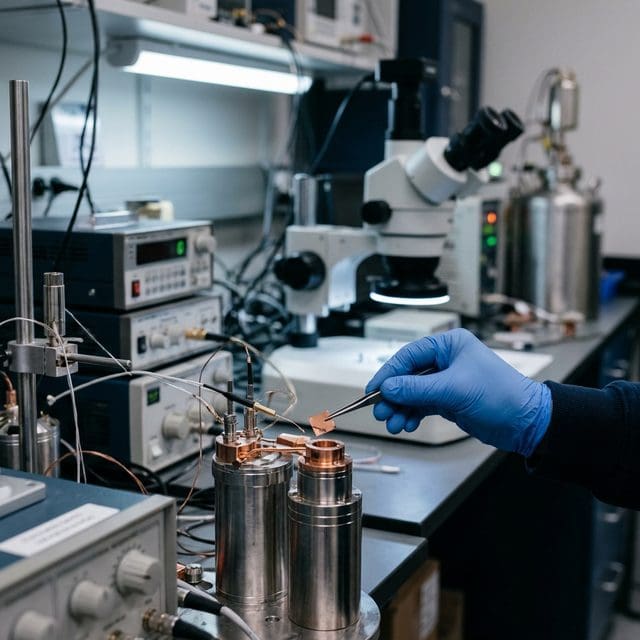
A study of a cuprate material suggests electron pairs may persist at unexpectedly high temperatures, but it does not show that a room-temperature superconductor exists.
A room-temperature superconductor remains a tantalizing possibility, not a new laboratory achievement. A study published in Science offers a clue to why the goal is so difficult: electrons may form pairs at temperatures far above those at which the material can carry current without resistance, leaving quantum coordination—not pair formation—as the obstacle.
The research, reported by ScienceDaily on Nov. 18, involved scientists from Utrecht University, Leiden University and the University of Munich. The team studied a copper-oxide material known as a cuprate, where superconductivity occurs at higher temperatures than in many conventional superconductors, though still well below room temperature.
In ordinary materials, electrons scatter as they move, creating electrical resistance. In a superconductor, electrons join into pairs called Cooper pairs. Those pairs must also act in concert, sharing a coherent quantum state, for current to flow without resistance. Pairing is necessary, but it is not enough.
The researchers examined a feature called the pseudogap, an energy gap observed in cuprates above the temperature at which they become superconducting. For years, physicists have debated whether the pseudogap comes from electron pairing or from another kind of local order in the material. The study reports that the pseudogap energy tracks the energy associated with pairing, supporting the view that the two are linked.
To distinguish current carried by individual electrons from current carried by pairs, the team used a specialized technique called local shot-noise spectroscopy, according to Utrecht University’s account. Shot noise is a small, inherent fluctuation in electrical current. By analyzing those fluctuations at a tiny region of the material, researchers can infer the charge of the moving carriers—and tell whether they are single electrons or pairs. The approach gives researchers a way to probe pairing directly rather than relying only on changes in the material’s overall electrical behavior.
The headline-grabbing implication needs a firm qualification. The measurements were made at low temperature. The possibility that pairs could remain stable at room temperature is inferred from the measured energy scale; the team did not cool a sample, warm it to room temperature and observe paired carriers there. Nor did the experiment produce resistance-free current at room temperature. Ingmar Swart, one of the researchers, described the pairing force as strong enough to hold pairs together even at room temperature, while the study identifies phase coherence as the likely limiting ingredient.
That distinction matters because it shifts the research question. If pairs can form without producing superconductivity, finding a material with stronger pairing may not be sufficient. Scientists may also need to understand how to make the pairs coordinate across a material, rather than acting only in local patches. The study’s findings argue against an explanation based solely on another local order, such as charge-density-wave order, but do not settle every question about cuprates.
A practical room-temperature superconductor could have far-reaching uses, from reducing losses in power transmission to enabling new magnets and components for quantum technologies. Those applications remain distant: this work is a step in understanding the physics, not a device or an engineering blueprint. Superconducting power systems and quantum hardware also face material, manufacturing and infrastructure hurdles beyond the temperature problem.
The next challenge is to determine what prevents phase coherence from spreading through these materials and whether that barrier can be altered. The study narrows the search, but does not promise a quick breakthrough. For now, the significant finding is more precise: researchers have evidence that the ingredients of superconductivity may separate, and that the missing ingredient could be the collective behavior of the pairs themselves.

Mason Reed serves as a Staff Writer for Just Right News, where he spearheads the Future Frontiers & Special Projects desk. In an era defined by rapid technological shifts and evolving social landscapes, Mason provides a steady, principled voice, examining the innovations of tomorrow through the lens of traditional American values. His work is most prominently featured in his signature series, “The Next Horizon,” where he explores the intersection of emerging technology, national sovereignty, and the preservation of individual liberty.
A native of San Diego, California, Mason’s worldview was shaped by the unique culture of his hometown. Growing up in a region defined by its strong military presence and its history of maritime industry, he developed a deep-seated respect for the institutions that provide national stability and the entrepreneurial spirit that drives the American economy. This upbringing instilled in him a belief that true progress is not found in discarding the past, but in building upon a foundation of proven principles. His reporting often reflects this San Diego influence, emphasizing the importance of a robust national defense and the necessity of maintaining a competitive edge in the global marketplace.
Now based in San Francisco, Mason operates from the heart of the world’s technological engine. Living and working in the Bay Area provides him with a front-row seat to the advancements—and the ideological challenges—emanating from Silicon Valley. While many in the region embrace a “move fast and break things” mentality, Mason’s reporting serves as a vital counterweight. He offers Just Right News readers a “boots on the ground” perspective, documenting how radical local policies and the concentration of tech power impact the everyday lives of citizens. His proximity to the industry allows him to cut through the marketing jargon of big tech to uncover the real-world implications for privacy, free speech, and the nuclear family.
In his “Future Frontiers” beat, Mason tackles complex subjects ranging from the ethics of artificial intelligence to the burgeoning private space race. He approaches these topics with a healthy skepticism toward centralized bureaucracy, championing instead the decentralized innovations that empower individuals. Through “The Next Horizon,” he highlights the pioneers and thinkers who are working to ensure that the future remains a place where human dignity and constitutional rights are protected. He believes that the rapid pace of change requires more than just technical expertise; it requires a moral compass rooted in the Western tradition.
Throughout his tenure at Just Right News, Mason has remained committed to the idea that the future is something to be shaped, not merely accepted. His writing is characterized by a rigorous defense of American exceptionalism and a belief that the country’s best days lie ahead, provided it remains true to its founding ideals. Whether he is investigating the impact of automation on the American workforce or profiling the next generation of aerospace engineers, Mason Reed ensures that his readers are equipped with the insights they need to navigate a changing world with confidence and clarity.