

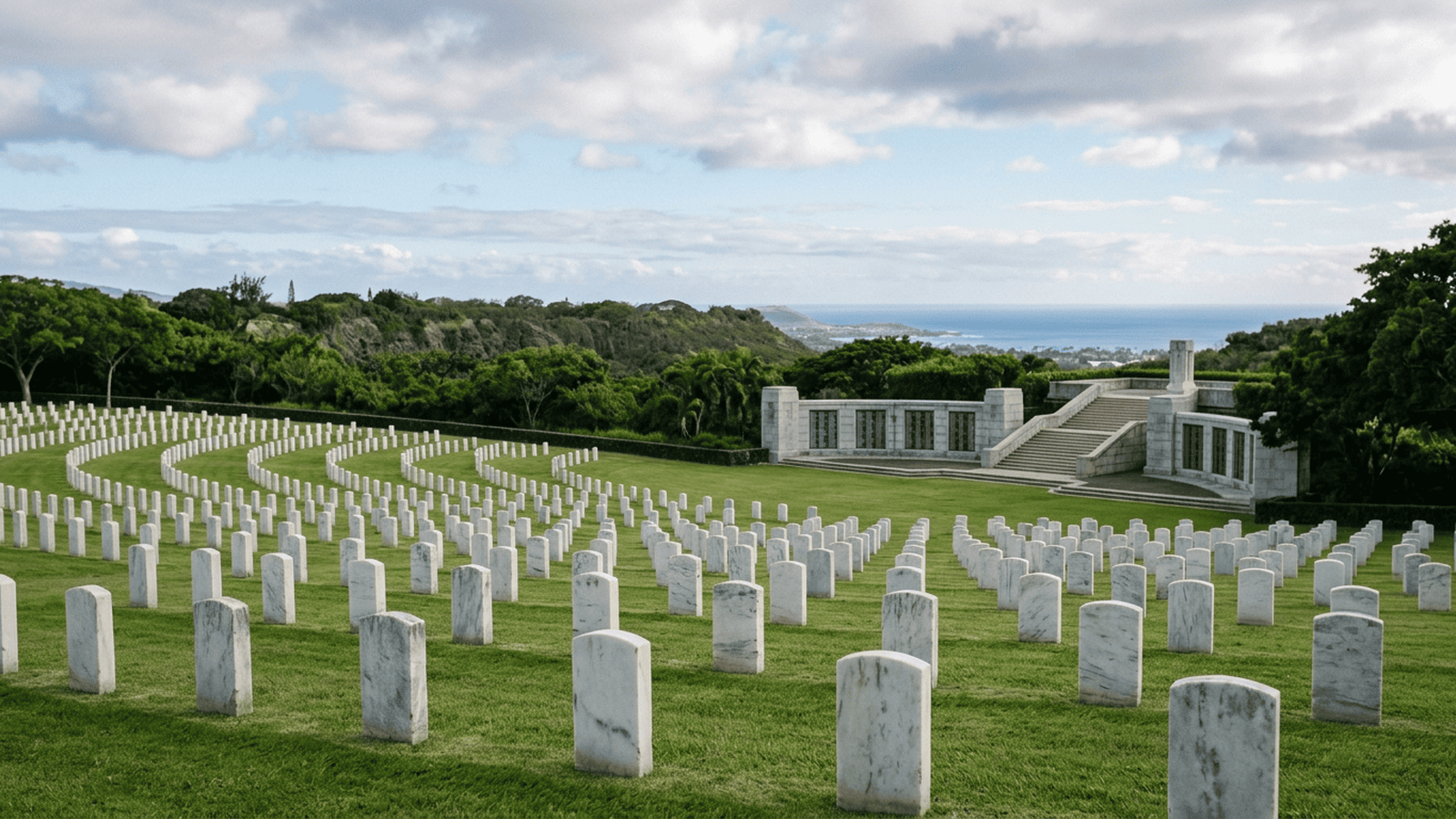
The Defense POW/MIA Accounting Agency says six U.S. soldiers from the Korean War have now been accounted for, including two who were 18. Several sets of remains had been buried as unknown before later disinterment and laboratory analysis identified them; public details are limited for one case. The agency’s work includes recovery missions and review of dental evidence, records, X-rays, DNA and isotope analysis. The six names will receive rosettes at the National Memorial Cemetery of the Pacific, and identified service members receive burial with full military honors. The agency may provide further information after families are briefed, while about 7,500 Americans from the war remain unaccounted for.
TLDR: Six Korean War service members, including two teenagers, have been identified after decades as missing or buried as unknown. The agency says family briefings, cemetery rosettes and military honors follow, while the broader accounting effort continues.
Six U.S. soldiers who died in the Korean War have been accounted for decades after they went missing, the Defense POW/MIA Accounting Agency announced Monday. Two were 18-year-old corporals. The identifications bring six service members closer to a burial with full military honors and add their names to a continuing effort to locate and identify those killed in the conflict.
The agency’s stated purpose is to locate and identify the remains of Korean War dead. That is a direct public duty: resolve long-standing missing-person cases with evidence and give identified service members the recognition attached to being accounted for. The work has taken years in several cases, and the public record does not include every detail of every identification.
Cpl. Jackie Lee Thurman, 18, served as a forward observer near Waegwan, South Korea. During a heavy attack, he was last seen trying to evacuate a shell-shocked officer under enemy fire. He was reported missing, and a presumptive finding of death was issued in 1953. His remains were declared unrecoverable in January 1956.
A set of remains recovered near Kumhwa-dong in October 1952 was buried as unknown at the National Memorial Cemetery of the Pacific in Honolulu. The agency disinterred it in November 2022, and analysis identified Thurman. The agency marked him accounted for on May 18, 2026. The long gap between recovery and identification shows why a recorded unknown status was not the end of the process.
First Lt. Raymond Banker Gilbert, 23, went missing during the battle of the Ch’ongch’on River in North Korea. Witness statements indicated that he had been captured by Chinese forces and died from battlefield wounds in a prisoner-of-war camp on Jan. 31, 1951. Remains returned to U.S. custody in the 1954 exchange known as Operation Glory could not then be identified and were buried as unknown.
The agency disinterred Gilbert’s remains on July 1, 2024, and sent them to its laboratory. Analysis, circumstantial evidence and historical evidence supported the identification. He was marked accounted for on June 4, 2026. The case combines records about his fate with remains that had rested for decades in a cemetery without his name.
Cpl. William R. Laughlin Jr., 21, was among the U.S. soldiers ambushed at the Chosin Reservoir in North Korea. The battle lasted 17 days in frigid weather, and Laughlin could not be located afterward. Remains tied to an isolated burial east of the reservoir had been returned during Operation Glory and interred as unknown. After disinterment in July 2022, modern forensic techniques at the agency’s laboratory identified them as Laughlin’s. He was marked accounted for on Sept. 28, 2026.
Sgt. Joseph A. Platzkoester, 28, went missing after his convoy encountered an enemy roadblock near Inje, South Korea. The area was searched, but his remains were not found at the time. A set recovered in 1951 was buried as unknown at the National Memorial Cemetery of the Pacific. The agency disinterred it in November 2023, and laboratory analysis identified Platzkoester. He was marked accounted for on May 29, 2026.
Cpl. Andrew R. Tischler, 21, was reported missing during a road march near Taewol Village in South Korea. The agency said it accounted for him on May 5, 2026, but information about how his remains were found and identified was not available in the account. The other teenage soldier was Cpl. Richard N. Lennox, 18, who went missing after his unit was attacked near Sachang-ni, North Korea, in November 1950. He was captured and died in a prisoner-of-war camp in October 1951. His remains, returned during Operation Glory and buried as unknown, were disinterred in 2016; the agency marked him accounted for on Aug. 7, 2025.
The practical process involves locating a potential recovery site, sending a recovery mission, and examining remains in a laboratory. The account says scientists may use dental evidence, records, X-rays, DNA and isotope analysis, and compare a family member’s DNA reference sample. It gives no fees, family paperwork requirements, compliance deadlines or enforcement measures; those are not described as part of this accounting effort. The process does require time, laboratory work and the handling of remains previously buried as unknown, while families wait for answers.
Each soldier’s name had been engraved on the Walls of the Missing at the National Memorial Cemetery of the Pacific. Rosettes will be placed beside their names now that they have been accounted for, and identified soldiers receive burial with full military honors. The agency may share further details after families are briefed. Those briefings and the cemetery updates are the next necessary steps, while the search continues for about 7,500 Americans still unaccounted for from the Korean War.
Max Grant serves as the Senior Correspondent for Data and Financial Forensics at Just Right News, where he brings a meticulous, investigative eye to the complex world of numbers. In an era where media narratives often overshadow objective reality, Max operates on a simple but firm principle: while rhetoric can be manipulated, the ledger never lies. As the architect behind the acclaimed feature series “Numbers That Talk,” he has carved out a vital niche in conservative journalism, translating dense financial data into clear, actionable insights for the American public.
Max’s journey to the forefront of financial reporting began in Buffalo, New York. Growing up in the Queen City, he was raised with the grit and grounded perspective typical of the Rust Belt. Buffalo is a place that understands the value of a dollar and the consequences of economic shifts on the working class. This upbringing instilled in Max a deep-seated respect for fiscal responsibility and a healthy skepticism toward bureaucratic overreach. He carries the spirit of his hometown into every investigation, viewing his work not just as reporting, but as a form of public service dedicated to protecting the interests of taxpayers and everyday citizens.
Now based in Brooklyn, New York, Max operates from the heart of one of the world’s most influential financial and cultural hubs. This vantage point allows him to keep a close watch on the institutions that drive the global economy. Living and working in a city often defined by progressive policy experiments, Max provides a necessary counter-perspective, using his forensic skills to analyze the real-world costs of local and national governance. His proximity to the financial district ensures he is never far from the source of the data he deconstructs, yet he remains firmly rooted in the conservative values that prioritize transparency and individual liberty.
His beat, Data and Financial Forensics, is more than just a job title; it is a commitment to uncovering the truth hidden within spreadsheets and annual reports. In “Numbers That Talk,” Max dives deep into federal spending, corporate accountability, and the intricate web of international finance. He has a unique ability to spot the anomalies that others miss, identifying where public funds are being mismanaged or where economic policies are failing to deliver on their promises. His reporting is characterized by a relentless pursuit of clarity, stripping away the jargon to show readers exactly how their money is being used and how the economy is truly performing.
At Just Right News, Max Grant is recognized as a steady hand and a sharp mind. He understands that for a free society to function, its citizens must have access to the facts regarding their financial future. By combining his British heritage’s tradition of rigorous inquiry with an American drive for accountability, Max ensures that the numbers don’t just sit on a page—they tell the story of where the country has been and where it is headed. His work stands as a testament to the power of forensic journalism in holding the powerful to account and championing the principles of a transparent, fiscally sound nation.