

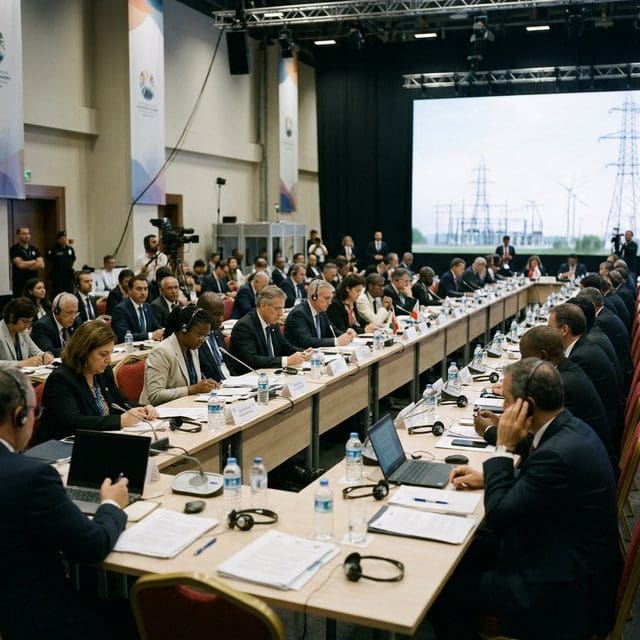
As COP31 enters its final week, negotiators are weighing electrification, climate finance and worker protections while disagreeing over whether global targets should prescribe specific energy choices.
COP31 entered its final week Monday with ministers taking over negotiations on climate finance and the energy transition, as governments remain split over how far a global agreement should prescribe changes to energy systems.
The United Nations climate summit in Antalya, Turkey, is scheduled to close Nov. 20. Australian climate minister Chris Bowen, who is leading the negotiations, said the first draft of the overarching decision would circulate early this week. Negotiators are handling 160 agenda items and 60 substantive mandates, with further drafts expected after ministerial consultations, Hürriyet Daily News reported.
One proposal from Turkey would raise electricity’s share of global final energy consumption to 35 percent by 2035, supported by investment in renewable generation, power grids, storage and energy efficiency. Electrification can reduce reliance on direct fossil-fuel use in some sectors, but the proposal’s practical effects would depend on whether electricity supply and networks can expand reliably and affordably.
That distinction matters for governments and consumers: a target for electricity use does not itself build transmission lines, add storage or ensure dependable power when renewable output varies. The proposal points to infrastructure investment as a necessary part of the transition, but the available reporting does not specify its cost, financing plan or how countries would meet the target.
The negotiating divide is also about who sets the terms. The Arab Group rejected global targets imposed from above, including goals focused on particular sectors or energy sources. The European Union, Pacific island states and least-developed countries supported the presidency’s proposed negotiating structure. Bowen declined to say whether the negotiating text would explicitly call for moving away from fossil fuels, according to Hürriyet.
A Guardian live-update headline characterized a draft climate deal as calling for a faster shift away from fossil fuels. That characterization sits alongside Hürriyet’s report that the overarching draft was expected to circulate early this week and that Bowen had not confirmed whether the text would include such language. With negotiations still under way, the final wording remains unsettled.
A proposed just-transition mechanism would pair a policy arm with an implementation arm to coordinate assistance, training, social protection and worker participation during industrial restructuring. Its details are still being negotiated. Such protections may help communities and workers manage disruption, but they do not settle the underlying questions of which industries change, how quickly, or who pays.
Finance is another pressure point. Discussions include easier access to funding, more predictable grants and concessional finance, and better tracking of adaptation spending. The talks build on the COP29 goal of providing developing countries at least $300 billion annually by 2035 and efforts to scale total public and private finance to $1.3 trillion a year by then. Those figures set an ambition; the summit’s negotiations concern how funding is delivered and monitored.
For energy markets, the outcome will matter less as a slogan than as a signal about investment and policy direction. Clear rules and credible financing can help governments and businesses plan for power generation and infrastructure. But targets that outrun financing, grid capacity or local political support risk widening the gap between pledges and implementation.
The available reporting identifies no new Duke Energy emissions or fossil-fuel transition policy in the past two days. The company’s latest indexed item was a Nov. 13 consumer energy-saving notice. With COP31’s final decision still being negotiated, the clearest immediate story is not a settled global commitment but the unresolved balance among emissions goals, reliable energy and the cost of getting there.

Mark Davis serves as the Senior Correspondent for Energy, Climate, and Resource Economics at Just Right News. In an era where the conversation around the environment is often dominated by alarmism and top-down mandates, Mark provides a vital, market-oriented perspective on the complex forces shaping our world. As the lead voice behind the acclaimed feature series “Power and the Planet,” he explores the intersection of environmental policy, global energy markets, and the fundamental economic principles that sustain modern civilization.
Mark’s pragmatic approach to resource management was forged in the high desert of his hometown, Albuquerque, New Mexico. Growing up in a region defined by both its breathtaking natural beauty and its rugged, resource-dependent landscape, he developed an early appreciation for the delicate balance between conservation and utilization. New Mexico’s unique position as a hub for both traditional energy production and cutting-edge scientific research provided Mark with a front-row seat to the evolution of the American energy sector. This upbringing instilled in him a deep-seated belief that true environmental stewardship is inseparable from economic prosperity and technological innovation.
Now based in Boulder, Colorado, Mark operates from the heart of the nation’s climate research community. While Boulder is often seen as a bastion of environmental idealism, Mark utilizes his post to provide a necessary counterweight, grounded in the realities of resource economics. He understands that energy policy does not exist in a vacuum; it has tangible consequences for the American taxpayer, the stability of the national power grid, and the strength of the domestic manufacturing sector. By reporting from the front lines of the climate debate, he is able to challenge prevailing narratives with hard data and a commitment to the principles of the free market.
Throughout his tenure at Just Right News, Mark has distinguished himself by focusing on the “Resource Economics” aspect of his beat. He frequently highlights the hidden costs of rapid energy transitions and advocates for an “all-of-the-above” energy strategy that prioritizes American energy independence. His work often shines a light on the geopolitical implications of resource scarcity, arguing that a secure nation must first be an energy-secure nation. Whether he is analyzing the impact of federal land-use regulations or investigating the supply chains required for new technologies, Mark remains focused on how policy decisions affect the lives and livelihoods of everyday citizens.
In “Power and the Planet,” Mark continues to bridge the gap between complex scientific concepts and the economic realities facing the country. He rejects the false choice between a healthy environment and a thriving economy, instead seeking out solutions that leverage American ingenuity and private-sector competition. For Mark, reporting on the climate is not about following the latest trends, but about ensuring that the conversation remains tethered to the foundational values of liberty, property rights, and fiscal responsibility. His contributions ensure that Just Right News readers receive a comprehensive, clear-eyed view of the challenges and opportunities defining the future of our planet.