

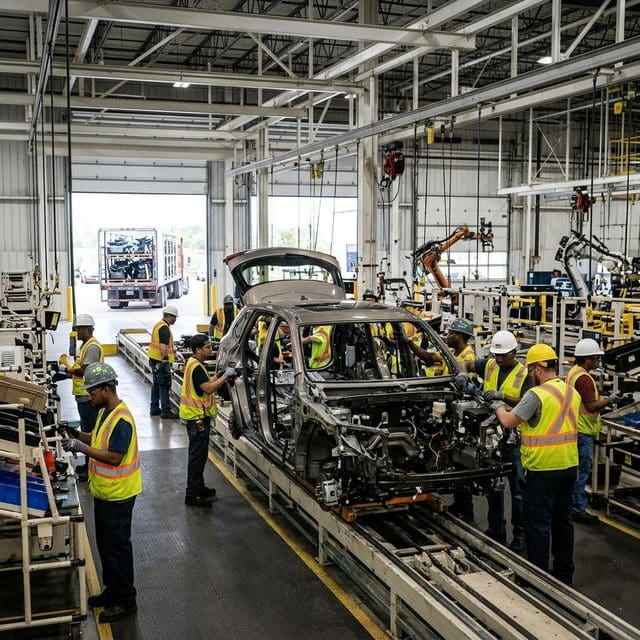
Canada’s prime minister says no U.S. trade agreement is acceptable without a viable Canadian auto industry, as a threatened 50% tariff increase looms on vehicles, parts and steel.
A vehicle crossing the Canada-U.S. border carries more than a finished product: it carries the outcome of a manufacturing system built across two countries. That system is now a central fault line in trade negotiations, with Canadian Prime Minister Mark Carney warning that Ottawa will not accept a deal that leaves Canada’s auto sector unable to compete.
After what he described as a “quite long, substantive conversation” with U.S. President Donald Trump this week, Carney said the talks were advancing but no agreement had been reached. Autos, he said, are both fundamental to the negotiations and among their most challenging issues, CBC reported Nov. 14.
The stakes are not confined to the location where a vehicle is finally assembled. Carney argued that U.S. automotive manufacturing also depends on Canadian production, and that the continental industry needs a stable framework as it faces challenges in production speed and electrification. A border policy that treats the two countries’ manufacturing bases as wholly separate could therefore disrupt the system on both sides, even as each government seeks to protect its own workers and supply chains.
The latest discussions included U.S. Trade Representative Jamieson Greer and White House chief of staff Stephen Miller, Carney said. Greer confirmed recent talks but offered no timetable, saying the substance of a deal mattered more than when it was completed, according to The Hub on Nov. 13. Washington has emphasized protecting American supply chains; Ottawa wants a return to earlier unfettered cross-border trade.
Those aims leave a difficult question: how can a trade agreement secure domestic production without making the cross-border links that sustain the industry prohibitively costly? The answer matters to workers whose livelihoods depend on factories operating across a supply chain, not merely on a final assembly plant bearing a national label.
A major deadline is approaching. The United States has threatened to raise tariffs on Canadian vehicles, auto parts and steel to 50% on Jan. 1, 2027, The Hub reported. That is a threatened increase, not a tariff already in force. If enacted, it could change the economics of sourcing and production, while leaving manufacturers to weigh the costs of adapting against the risks of waiting for a durable agreement.
Carney has also connected the trade dispute to a concrete workplace obligation. Stellantis has announced the sale of its Brampton, Ontario, assembly plant to defence contractor Roshel. Ottawa is “not satisfied in any way” with what Carney called the company’s partial approach, and says Stellantis must honor its commitments to workers and Canada, CBC reported. The dispute underscores that manufacturing policy is not only about attracting investment; it is also about whether companies follow through on promises made to the communities and employees who host production.
The talks are taking place against the pressure of a broader industrial shift toward electrification and faster production. Carney’s call for a stable continental framework recognizes that the transition cannot be managed by tariff announcements alone. Businesses need rules they can plan around, but workers and communities also need assurance that efficiency gains and new investment will not come at the expense of a viable domestic industry.
For now, both governments are negotiating over the terms, not announcing a settlement. The looming tariff date gives those talks urgency, while the unresolved Brampton dispute puts the consequences of corporate decisions in plain view. The eventual deal will help determine where vehicles and components are made, how reliably they move across the border, and whether the jobs supporting that trade remain part of the communities that built the industry.

Sean Bradley serves as the Senior Correspondent for Trade, Supply Chains, and Global Labor at Just Right News, where he brings a principled, clear-eyed perspective to the complex systems that power the modern world. With a focus on the economic forces that impact the American household, Bradley has distinguished himself as a leading voice in explaining how global shifts in manufacturing and logistics translate to the kitchen table.
Growing up in Long Beach, California, Bradley’s interest in the movement of goods was forged against the backdrop of one of the nation’s most vital maritime gateways. Raised in a community where the towering cranes of the port were a constant fixture on the horizon, he developed an early appreciation for the blue-collar industries that form the backbone of the American economy. This upbringing instilled in him a profound respect for the dockworkers, truckers, and laborers who keep the country moving, a sentiment that remains a cornerstone of his reporting today. For Bradley, trade is not merely a series of abstract figures on a spreadsheet; it is a human endeavor that sustains families and defines the strength of a nation.
Now based in Seattle, Washington, Bradley occupies a strategic vantage point in another of the country’s most significant trade hubs. His location allows him to witness firsthand the intersection of traditional industry and the evolving technological landscape of global logistics. From the Pacific Northwest, he monitors the flow of goods across the ocean, providing Just Right News readers with timely insights into how international tensions, regulatory hurdles, and labor disputes affect the availability and cost of essential goods.
His signature feature series, “The Journey of Things,” has become a staple for readers seeking to understand the intricate path products take from raw materials to the retail shelf. Through this series, Bradley pulls back the curtain on the global marketplace, often highlighting the risks of over-reliance on foreign adversaries and the importance of domestic manufacturing resilience. His reporting consistently emphasizes the conservative values of national sovereignty, free-market competition, and the protection of the American worker from unfair global practices.
As a journalist of Irish heritage, Bradley maintains a deep-seated respect for the dignity of the individual worker and the importance of community stability. He approaches his beat with a commitment to transparency, often questioning the status quo of globalist policies that prioritize corporate efficiency over local prosperity. Whether he is reporting from a warehouse floor or analyzing a new international trade agreement, his goal remains the same: to provide the American public with the truth about where their products come from and what it costs to get them there.
Throughout his tenure at Just Right News, Bradley has remained a steadfast advocate for economic common sense. His work serves as a vital resource for those who believe that a strong nation is built on secure borders, robust trade, and a respected workforce. By combining his local roots in Long Beach with his professional experience in Seattle, Bradley continues to offer a unique and necessary perspective on the forces that shape the American way of life.