

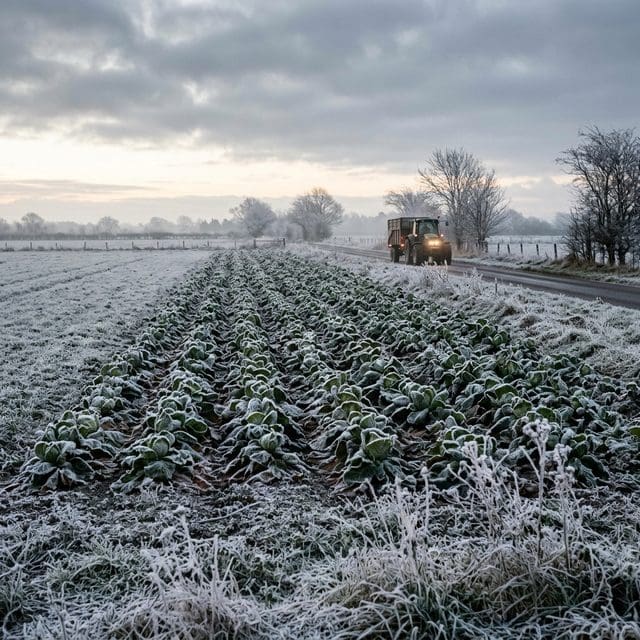
A forecast cold snap is expected across much of the central and eastern United States, while an Ontario farm-truck stop highlights a separate rural-road safety concern.
An early-season cold snap is expected across much of the central and eastern United States this weekend, raising the possibility of damage to late-season crops. The available reports do not estimate agricultural losses or predict effects on food supplies.
About 230 million people were forecast to experience below-average temperatures by the weekend, according to the National Weather Service’s Weather Prediction Center, as reported by USA Today. The coldest conditions are expected Nov. 14–15. Overnight lows in the central Plains could reach the mid-to-upper 20s, while parts of the Great Lakes could fall below 20 degrees.
NBC News reported that a departing storm brought more than a foot of snow to parts of New York State on Friday, ahead of the expected freeze. The reports do not identify which crops remain in the field, how many acres may be exposed, or whether growers have reported damage. A freeze can end a growing season, but local effects depend on crop, location and timing; no specific losses should be inferred from the forecast.
A weather alert is an early warning, not an accounting of damaged produce or a prediction that store supplies will change. The source material does not quantify farm losses, describe transportation disruptions or document an effect on prices. Assessing those consequences will require follow-up from growers, agricultural officials and markets after the cold arrives.
The material also contains no FDA recall, water-contamination alert or EPA enforcement action tied to the weather. It offers no evidence of a food-safety problem or a change in drinking-water quality. The public-health issue described is exposure to unusually cold weather; the agricultural question is what the conditions do to crops in specific locations.
A separate Ontario report points to a more immediate safety issue on farm roads. Global News reported that Ontario Provincial Police charged a 49-year-old driver with careless driving after a farm truck was recorded traveling 92 kilometers per hour in a 40-kilometer-per-hour zone in Mapleton Township. The report does not say whether the truck was carrying a particular load, whether anyone was injured, or what happened in court. A charge is an allegation, not a court finding.
The weather forecast and police stop are separate developments, but both concern practical conditions around agriculture. Cold and snow can complicate field work and transport; farm vehicles also share public roads with other traffic. The reported speed provides a basis for the charge, but the account does not describe road conditions, the vehicle’s equipment or the officer’s full assessment. One stop cannot support broader conclusions about farm-truck safety.
Neither report demonstrates a failure of food inspection or environmental regulation. Forecasts can prompt preparation, while observed crop damage and enforcement records provide different kinds of evidence. The material does not establish federal involvement in either development or provide a basis for evaluating EPA or FDA performance.
For now, growers and local officials can follow weather alerts, and drivers can heed posted restrictions around agricultural equipment. The forecast warrants attention, but a reliable account of crop losses or broader food impacts will have to wait for reports from affected areas after the freeze.

Eric Nolan serves as the Senior Correspondent for Food, Water, and Environmental Health at Just Right News, where he brings a principled, common-sense perspective to the most fundamental issues facing the American public. With a career dedicated to uncovering the truth behind the policies that govern our natural resources, Eric has become a trusted voice for readers who value traditional stewardship over bureaucratic overreach. His reporting is defined by a commitment to the idea that true environmentalism is rooted in the protection of the American family and the preservation of the nation’s agricultural heritage.
Raised in Fresno, California, Eric’s worldview was shaped in the heart of the San Joaquin Valley. Growing up in one of the world’s most productive agricultural hubs, he witnessed firsthand the vital connection between the land, the water, and the dinner table. In Fresno, he saw the resilience of farmers and the devastating impact that distant, top-down regulations can have on local communities. This upbringing instilled in him a deep respect for the producers who feed the country and a lifelong skepticism toward the alarmist narratives often pushed by mainstream media. For Eric, environmental health is not an abstract political talking point; it is a matter of ensuring that the people who work the land have the freedom and the resources to do so effectively.
Now based in Eugene, Oregon, Eric operates from a unique vantage point in the Pacific Northwest. Living in a region often defined by intense environmental debate, he provides a necessary counter-narrative to the prevailing trends of the area. From his base in Eugene, he monitors the shifting tides of federal and state policies, ensuring that the voices of rural citizens and property owners are not drowned out by urban activism. His reporting often bridges the gap between the rugged realities of the outdoors and the legislative halls where decisions are made, offering a grounded perspective that prioritizes local sovereignty and practical solutions.
As the lead for the acclaimed feature series “Earth on the Table,” Eric explores the intricate journey of the American food supply. He tackles critical issues such as water rights, soil health, and food security through a lens of national stability and individual liberty. He believes that a healthy environment and a thriving economy are not mutually exclusive, but rather two sides of the same coin of national prosperity. His work consistently highlights how innovation and private-sector ingenuity are the most effective tools for ensuring clean water and a safe food supply, rather than the expansion of the administrative state.
At Just Right News, Eric’s reporting serves as a vital resource for those who seek accountability and transparency. Whether he is investigating the impact of federal land management on local economies or examining the safety of the national food infrastructure, his work remains anchored in the values of heritage and hard work. Eric Nolan continues to be a leading voice in environmental journalism, championing the belief that the best way to protect our natural resources is to empower the people who live and work closest to them.