

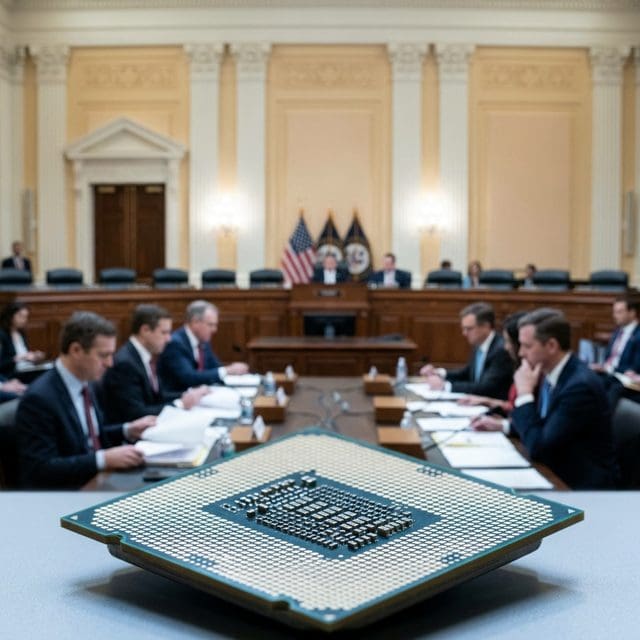
Congress and the White House face mounting questions over Nvidia chip exports to China, while tariff disputes test economic policy and presidential authority.
The central Washington policy fight on Friday is over Nvidia’s advanced AI chips and the administration’s decisions on exports to China. The dispute now spans the Commerce Department, the White House and Congress, with potential consequences for chipmakers, exporters and the rules governing advanced computing technology.
Commerce Secretary Howard Lutnick is under scrutiny as the “ultimate overseer” of U.S. export-control programs, Bloomberg reported. The questions include whether the department prevented Nvidia processors from reaching unauthorized Chinese buyers and whether it halted a probe into Singapore-based Megaspeed’s dealings with Nvidia. President Donald Trump publicly backed Lutnick on November 12. That support does not resolve whether export controls were effectively enforced.
Lawmakers allege that the administration used Section 232 of the Trade Expansion Act of 1962 to require Taiwan-made H200 chips to enter the United States for security review and pay a 25% tariff before Commerce authorized their export to China. The dispute raises a basic question: whether a national-security tool was used in a way that facilitated, rather than restricted, sensitive technology transfers. The available reporting does not establish that the arrangement was unlawful.
Sen. Ron Wyden and Rep. Richard Neal, senior Democrats on the Senate Finance and House Ways and Means committees, are examining the administration’s approvals and have asked Lutnick to preserve records, according to reports. Their inquiry puts tax-writing lawmakers at the intersection of export policy, national security and executive authority. Its scope and next steps remain unclear from the available material.
Pressure for tighter controls is growing. House Speaker Mike Johnson said November 12 that congressional consensus was building around limiting advanced-chip exports to China. A proposed AI Overwatch Act would give Congress a larger role in reviewing export-control changes, but it has not changed the rules. Commerce staff have also pushed for restrictions on Chinese remote access to advanced AI chips, AFP reported. Lutnick is not expected to act without Trump’s direction.
For Nvidia and other exporters, tighter controls could restrict access to the Chinese market and alter the commercial terms for advanced chips. For policymakers, the immediate question is whether existing licensing and enforcement systems can prevent sales to unauthorized buyers without leaving critical decisions solely to the executive branch. Congress has not enacted the proposed oversight measure.
Investigations are active, but allegations remain unproven. Trump said the FBI is examining spying allegations, while the Justice Department is investigating whether Megaspeed smuggled Nvidia chips into China. Megaspeed said November 12 that it would cooperate with U.S. authorities and denied wrongdoing. No conclusion has shown that Nvidia CEO Jensen Huang knowingly assisted Chinese intelligence or that Nvidia secrets were compromised.
Huang is expected to testify before Congress before November 26, Reuters reported. House Foreign Affairs Chairman Brian Mast, along with John Moolenaar and Rick Crawford, requested a closed-door November 18 briefing on Huang’s dealings with Alice Huang and Nvidia’s anti-espionage safeguards. The briefing and expected testimony are near-term opportunities for lawmakers to seek details, not findings of wrongdoing.
The chip dispute coincides with a broader fight over Trump’s tariffs. CNN reported that Democrats intend to make tariff repeal a priority when the new Congress convenes in January 2027. A repeal bill could pass both chambers by simple majorities, but a presidential veto would require two-thirds majorities in each chamber to override. A September Federal Reserve Bank of New York study cited by CNN estimated that about 26% of tariff increases are passed through to consumers. That is an estimate across tariff increases, not a forecast for any particular product or household.
The practical effects depend on decisions still pending: whether the administration changes export rules, whether Congress creates a formal review role, and whether tariff opponents can assemble enough votes to overcome a veto. The reporting establishes no change to export permissions or tariff authority. The next markers are the requested November 18 briefing, Huang’s expected testimony before November 26, and the new Congress’s arrival in January. The available reporting identifies no comparably well-sourced court development that clearly overtakes these policy disputes.

Ryan Mitchell serves as a Staff Writer for Just Right News, where he anchors the desk for Cyber, Technology Policy, and Digital Sovereignty. In an era where the digital landscape has become as much a battlefield as any physical territory, Ryan provides a critical conservative lens on the forces shaping the future of American innovation and national security. His work is defined by a commitment to the idea that American leadership in the digital age is not just a matter of economic success, but a necessity for the preservation of global liberty.
Born and raised in Austin, Texas, Ryan’s perspective is deeply rooted in the Lone Star State’s tradition of independence and skepticism of centralized authority. Growing up in a city that transformed from a quiet state capital into a global technology hub, he witnessed firsthand the disruptive power of the tech industry. This upbringing instilled in him a firm belief in free-market principles and the necessity of protecting individual liberties from both government overreach and corporate overstep. His Texan background serves as a foundational compass, guiding his reporting toward stories that emphasize national resilience and the preservation of constitutional values in an increasingly virtual world.
Now based in San Francisco, California, Ryan operates from the epicenter of the very industry he scrutinizes. Living and working in the heart of Silicon Valley allows him to provide “boots on the ground” reporting that few conservative journalists can match. He navigates the cultural and political complexities of the Bay Area to bring Just Right News readers an inside look at the boardrooms and coding labs where the next generation of digital policy is forged. For Ryan, being stationed in San Francisco is a strategic choice; it allows him to challenge the prevailing ideological monoculture of the tech elite from within their own backyard, ensuring that the concerns of middle America are represented in the conversation about our digital future.
His beat—Cyber, Technology Policy, and Digital Sovereignty—covers the high-stakes world of data privacy, artificial intelligence, and the infrastructure of the modern web. Ryan is particularly focused on the concept of digital sovereignty, arguing that for a nation to remain truly free, it must maintain control over its own technological destiny and critical infrastructure. He frequently explores how international regulations and domestic policies impact the ability of American firms to compete without sacrificing the privacy or security of their citizens.
Central to his current body of work is his featured series, “The New Cold War.” Through this project, Ryan examines the escalating technological rivalry between the United States and its global adversaries. He delves into the complexities of state-sponsored hacking, the global race for semiconductor dominance, and the ideological struggle to define the rules of the internet. Ryan views this competition not merely as a commercial race, but as a fundamental defense of Western values against authoritarian digital models. Through his rigorous reporting and principled analysis, Ryan Mitchell ensures that the readers of Just Right News stay informed about the invisible forces defining the 21st century, always advocating for a future where technology serves the cause of freedom.