

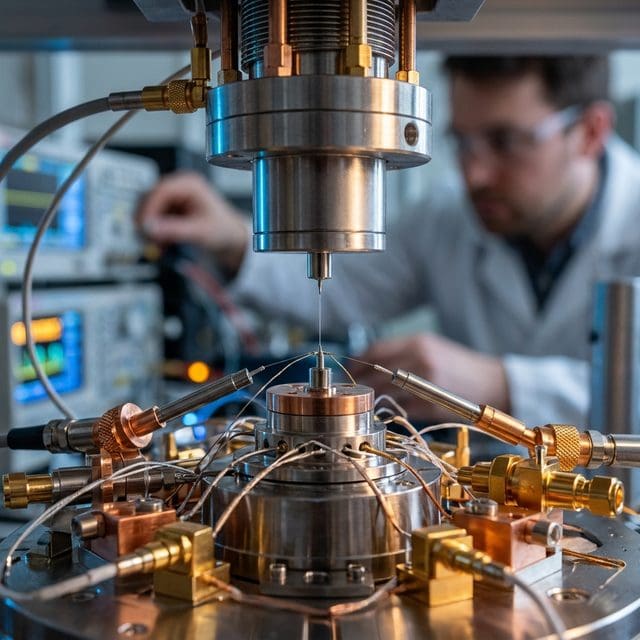
A theoretical proposal would read an Andreev qubit through its own oscillating supercurrent, but the device has not yet been built or tested.
A quantum computer may one day read a qubit by detecting the faint current it produces, rather than handing its information to another qubit. A proposal in *Physical Review B* describes how a sensor might register that signal. The approach could offer a new route to measuring fragile quantum states, but it remains theoretical, not a demonstrated device.
The proposal centers on an Andreev qubit: a quantum bit encoded in energy levels inside a gate-defined quantum dot in an indium-arsenide nanowire. Superconducting leads connect to both sides of the dot. In the researchers’ model, the qubit’s state is reflected in an oscillating supercurrent. A SQUID—a superconducting device that detects tiny changes in magnetic flux—could register the signal.
The corresponding authors are José Carlos Egues of the University of São Paulo and Yugui Yao of Beijing Institute of Technology. Xian-Peng Zhang and Chuanchang Zeng, also of Beijing Institute of Technology, and Zhen-Biao Yang of Fuzhou University are co-authors.
Measurement is a persistent challenge in quantum computing because extracting information can disturb a qubit’s delicate state. Some readout strategies also use an auxiliary, or “ancilla,” qubit to carry information away from the one being measured. This proposal instead seeks to obtain information from a signal produced by the qubit itself, potentially reducing the hardware and operations needed for this particular readout.
Simulations reported state-reconstruction accuracies of 99.52%, 99.81% and 99.85%, depending on the number of measurements. These are results from calculations, not tests of a working quantum device. They do not establish that a SQUID can achieve comparable accuracy in a real system while leaving the qubit sufficiently undisturbed.
That distinction is central. The proposed geometry has not been built. Egues told Agência FAPESP that the parameters are realistic, but “that geometry” does not yet exist. As of November 5, the work remained a theoretical readout proposal.
A separate analysis by PostQuantum questions whether the paper’s assumptions about measurement precision and weak disturbance are consistently connected. This is an external technical critique, not an experimental refutation. It underscores the test the proposal must pass: a device must show both that the signal can be detected and how much detection changes the quantum state.
The proposal also does not eliminate auxiliary qubits from quantum error correction. It addresses readout of a single Andreev qubit. Error-correction schemes still require joint parity or syndrome measurements across multiple qubits, and the paper offers neither a fault-tolerant architecture nor an estimate of the resources one would require. Any practical benefit will depend on how the technique fits into those larger systems.
The next milestone is an experiment: build the arrangement, search for the predicted voltage-free oscillating supercurrent, and measure detector back-action against readout accuracy. That would test whether the signal is both informative and gentle enough to be useful—and whether the assumptions behind the simulations hold in a physical device.
The paper was published in *Physical Review B* on August 5, 2026, rather than first appearing on November 4, as some coverage suggested. Its significance is not a new experimental discovery this week, but a possible measurement strategy drawing attention. If testing confirms the predicted signal, it could give researchers another way to simplify quantum-computer readout. For now, the decisive evidence remains to come from the laboratory.

Mason Reed serves as a Staff Writer for Just Right News, where he spearheads the Future Frontiers & Special Projects desk. In an era defined by rapid technological shifts and evolving social landscapes, Mason provides a steady, principled voice, examining the innovations of tomorrow through the lens of traditional American values. His work is most prominently featured in his signature series, “The Next Horizon,” where he explores the intersection of emerging technology, national sovereignty, and the preservation of individual liberty.
A native of San Diego, California, Mason’s worldview was shaped by the unique culture of his hometown. Growing up in a region defined by its strong military presence and its history of maritime industry, he developed a deep-seated respect for the institutions that provide national stability and the entrepreneurial spirit that drives the American economy. This upbringing instilled in him a belief that true progress is not found in discarding the past, but in building upon a foundation of proven principles. His reporting often reflects this San Diego influence, emphasizing the importance of a robust national defense and the necessity of maintaining a competitive edge in the global marketplace.
Now based in San Francisco, Mason operates from the heart of the world’s technological engine. Living and working in the Bay Area provides him with a front-row seat to the advancements—and the ideological challenges—emanating from Silicon Valley. While many in the region embrace a “move fast and break things” mentality, Mason’s reporting serves as a vital counterweight. He offers Just Right News readers a “boots on the ground” perspective, documenting how radical local policies and the concentration of tech power impact the everyday lives of citizens. His proximity to the industry allows him to cut through the marketing jargon of big tech to uncover the real-world implications for privacy, free speech, and the nuclear family.
In his “Future Frontiers” beat, Mason tackles complex subjects ranging from the ethics of artificial intelligence to the burgeoning private space race. He approaches these topics with a healthy skepticism toward centralized bureaucracy, championing instead the decentralized innovations that empower individuals. Through “The Next Horizon,” he highlights the pioneers and thinkers who are working to ensure that the future remains a place where human dignity and constitutional rights are protected. He believes that the rapid pace of change requires more than just technical expertise; it requires a moral compass rooted in the Western tradition.
Throughout his tenure at Just Right News, Mason has remained committed to the idea that the future is something to be shaped, not merely accepted. His writing is characterized by a rigorous defense of American exceptionalism and a belief that the country’s best days lie ahead, provided it remains true to its founding ideals. Whether he is investigating the impact of automation on the American workforce or profiling the next generation of aerospace engineers, Mason Reed ensures that his readers are equipped with the insights they need to navigate a changing world with confidence and clarity.