

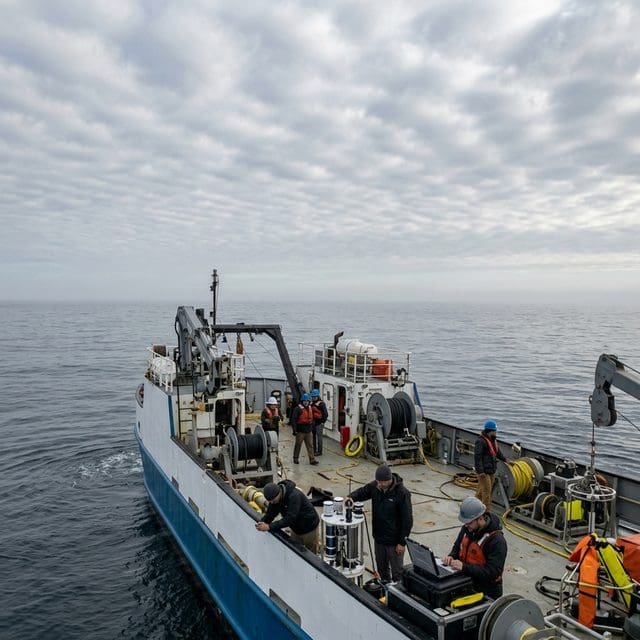
New research links human activity to rising planetary heat storage, while NOAA-backed guidance says marine cloud brightening must clear six scientific checkpoints before it can be considered technically feasible.
The planet is storing more heat, and a proposed way to reflect some sunlight back into space remains far from a proven remedy. Research reported by Princeton and NOAA scientists on October 29 found that human activity drove a positive trend in Earth’s energy imbalance. Meanwhile, new scrutiny of marine cloud brightening—a technique intended to make certain clouds more reflective—highlights how uncertain climate interventions remain.
The findings matter well beyond research institutions. Climate impacts can cross borders, and choices about interventions could carry consequences that are difficult to confine to the countries or communities conducting them. For Americans, the immediate question is not whether a speculative technology will solve climate change, but how much confidence and public authority should be required before governments or private actors consider changing conditions in the atmosphere.
The Princeton and NOAA researchers reported a trend in the planet’s energy imbalance: human activity has increased the amount of heat Earth retains. The supplied research summary does not provide a numerical estimate of the trend or details on its precise effects, so it does not support claims about how quickly particular risks will unfold. It does, however, point to the underlying challenge: climate policy must contend with an accumulating physical change, not simply future emissions.
Marine cloud brightening is one possible intervention under discussion. The idea is to increase the reflectivity of some marine clouds, reducing the amount of solar energy absorbed at the surface. But recent research coverage describes a “Goldilocks” problem: conditions may need to be calibrated precisely for the technique to work, and it may not work at all. That uncertainty makes it a poor substitute for measures that address the source of warming.
NOAA-led guidance published October 28 set out six scientific checkpoints that would need to be met before marine cloud brightening could be considered technically feasible. The guidance places decarbonization first. That order is consequential: a research program that asks whether an intervention might work is not evidence that it is ready for deployment, still less that it can replace emissions reductions.
The distinction also raises a governance question. Climate interventions could create disputes about who decides whether, where and how to test them, and who bears the risk if effects differ from expectations. Those are not resolved by technical feasibility alone. Any public program would need clear disclosure of costs, evidence and decision-making authority, rather than treating a scientific proposal as an automatic mandate for government action.
Princeton’s October 29 public programming offers a local window into those broader debates. Pulitzer Prize-winning journalist Eliza Griswold, who directs the university’s journalism program, was scheduled to lead “A Field Guide to Watersheds: Division and Unity.” The university’s description presents watersheds as both dividing and unifying systems. That framing is relevant to adaptation: water, like climate, does not follow political boundaries, while the costs and benefits of policy are experienced by particular communities.
Princeton also listed a lecture on democratically governing geoengineering research. The listing signals that questions of public oversight are part of the conversation, though an event announcement does not establish consensus on how such research should be governed. Those questions become more pressing as proposals move from theory toward tests in the natural environment.
The source material offers no new global-health or foreign-aid initiative tied to these developments. The clearest international stake here is the climate system itself, alongside the need for transparent, evidence-led choices. The reported research strengthens the case for understanding human influence on planetary heat storage; the cloud-brightening guidance, by emphasizing uncertainty and decarbonization, cautions against selling technological possibility as a ready-made solution.

Rachel Vaughn serves as a Senior Correspondent for Just Right News, where she leads the network’s coverage of Global Health, Climate, and Development. With a career defined by intellectual rigor and a commitment to principled reporting, Rachel provides a vital conservative perspective on some of the most complex and high-stakes issues facing the world today. Her work is characterized by a refusal to accept bureaucratic narratives at face value, focusing instead on how international policies impact national sovereignty, individual liberty, and the American taxpayer.
Raised in New Haven, Connecticut, Rachel grew up in an environment dominated by elite academic discourse. This upbringing provided her with a front-row seat to the inner workings of the American establishment, but it also instilled in her a healthy skepticism of the “ivory tower” consensus. She learned early on that while academic theories may sound promising in a lecture hall, they often fail to account for the practical realities of the working class. This background drives her to bridge the gap between high-level policy discussions and the common-sense concerns of everyday citizens, ensuring that her reporting remains grounded and accessible.
Now based in Burlington, Vermont, Rachel operates from a unique vantage point within one of the nation’s most progressive political landscapes. Living and working in a region that often serves as a testing ground for radical social and environmental experiments allows her to witness the real-world consequences of these policies firsthand. From her base in the Green Mountain State, she provides Just Right News readers with essential “boots on the ground” reporting, documenting the friction between local mandates and the constitutional freedoms of the individual. Her presence in Burlington ensures that her critiques of globalist agendas are informed by a direct understanding of how those ideologies manifest at the local level.
In her acclaimed feature series, “Planetary Stakes,” Rachel explores the intersection of international development and environmental stewardship. She rejects the alarmism often found in mainstream media, opting instead for a sober analysis of the economic and geopolitical costs of global climate agreements. Her reporting frequently highlights the importance of market-driven innovation and the role of American leadership in fostering global health without ceding authority to unelected international bodies. Through “Planetary Stakes,” she has become a leading voice for those who believe that true conservation and public health are best achieved through transparency, accountability, and the protection of private property rights.
Throughout her tenure at Just Right News, Rachel has distinguished herself as a journalist who is unafraid to ask difficult questions of global institutions. Whether she is investigating the influence of non-governmental organizations on domestic policy or analyzing the fiscal transparency of international health initiatives, her goal remains the same: to provide her audience with the facts necessary to navigate an increasingly interconnected world. Her blend of East Coast intellectual heritage and her current immersion in the political heart of the Northeast makes her an indispensable asset to the newsroom and a trusted source for readers seeking a principled, conservative take on the issues that define our era.